
Lieferung heute & morgen

Qualitätsgarantie

Willkommens-Angebote freischalten: KOSTENLOSE Lieferung | Bis zu 80 % RABATT | Kostenlose 30-Tage-JoyPlus-Testphase
App herunterladen
Finding the right e-scooter for German roads can be overwhelming. Between technical specs, legal requirements, and a growing selection of models, it's a challenge to keep track. This article serves as your guide. It highlights the crucial criteria for purchasing a street-legal e-scooter and presents a selection of models for various needs.
Before you make a decision, several fundamental aspects should be considered. These will help you find a model that not only meets legal requirements but also fits your personal usage habits.
In Germany, a street-legal e-scooter absolutely requires a General Operating Permit (ABE), issued by the Federal Motor Transport Authority (KBA). Without this document, its use on public roads is illegal. An e-scooter with an ABE meets specific technical requirements:
Additionally, a valid insurance sticker is required and must be affixed to the scooter.
The maximum range stated by manufacturers is often determined under ideal laboratory conditions. In practice, factors like rider weight, outside temperature, inclines, and road surface quality affect the actual distance you can cover on a single charge. For commuters who need a long range, it is advisable to choose a model with a higher battery capacity (specified in watt-hours, Wh) and to factor in a buffer of 20–30% on the manufacturer's claim.
The choice of tires and folding mechanism depends heavily on the planned use:
Based on the criteria mentioned, we have compiled a selection of models that cater to the different needs of city dwellers and commuters.
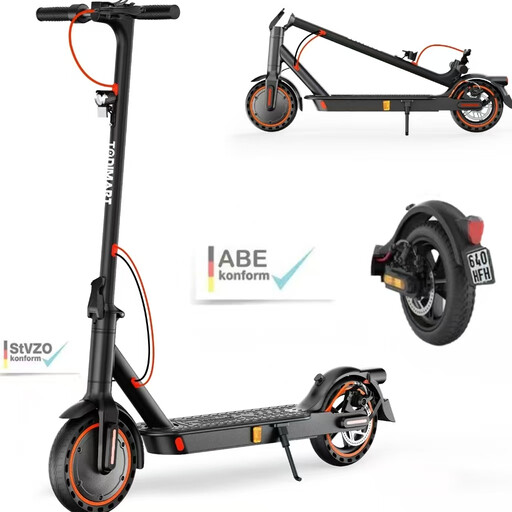
Why it stands out: The TODIMART T3-ABE is consistently designed for portability and ease of use. With a net weight of just 11.2 kg, it is one of the lighter models on the market and is easy to carry and store.
Key Features:
Who is it for? This model is an excellent choice for users looking for a straightforward and very lightweight solution for short distances in the city, such as the commute from the train station to the office. It is designed for flat and well-paved paths.
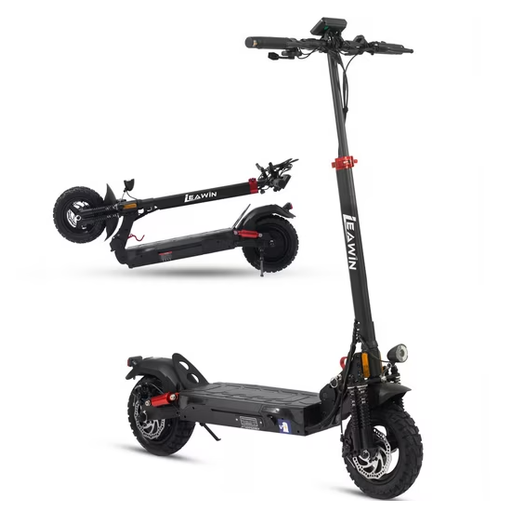
Why it stands out: This e-scooter (model T4) focuses on performance and comfort. With its 500-watt motor, dual suspension, and large 10-inch all-terrain tires, it is also equipped for more demanding terrain and longer distances.
Key Features:
Who is it for? Ideal for riders who cover longer distances, live in hilly areas, or don't stick exclusively to perfectly paved bike paths. Its heavier weight of 26 kg makes it less portable, but this is offset by its ride comfort and performance.
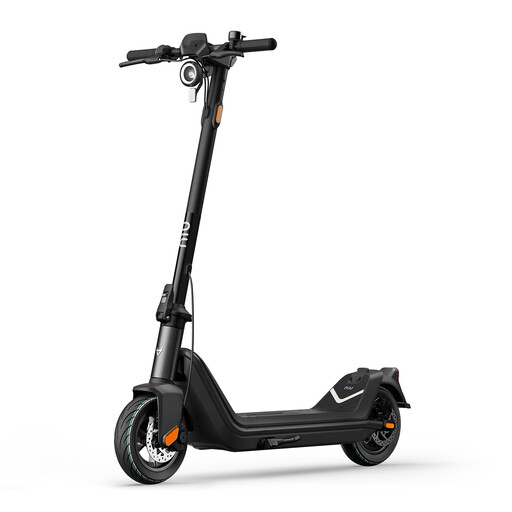
Why it stands out: The NIU KQi3 Pro combines high-quality craftsmanship with intelligent features. As an e-scooter with app connectivity, it offers smart functions like ride mode customisation and an electronic lock. The focus is on a stable and comfortable riding experience for daily use.
Key Features:
Who is it for? This e-scooter for adults is aimed at tech-savvy users who value comfort, safety, and smart features. It is a solid all-rounder for daily commuting in the city.
The models presented already cover a broad spectrum. However, if you are looking for other alternatives or specialised devices, you can find a larger selection of tech innovations for the urban lifestyle in our latest gadgets category.
1. What does ABE mean for an e-scooter? ABE stands for "Allgemeine Betriebserlaubnis" (General Operating Permit). It is an official document from the German Federal Motor Transport Authority (KBA) that confirms a vehicle type complies with technical regulations in Germany. An e-scooter may only be used on public roads with a valid ABE.
2. Do I need a driver's license for a street-legal e-scooter? No, a driver's license is not required to ride an e-scooter with a maximum speed of 20 km/h. However, the minimum age is 14. Liability insurance is legally required and is proven by an insurance sticker on the scooter.
3. How far can an e-scooter really go on a single charge? The actual range depends on many variables: rider's weight, tire pressure, outside temperature, inclines, and riding style. The manufacturer's specifications often represent an optimal value. For a realistic estimate, it is wise to assume a figure that is about 20-30% lower than the stated maximum range.