
Lieferung heute & morgen

Qualitätsgarantie

Willkommens-Angebote freischalten: KOSTENLOSE Lieferung | Bis zu 80 % RABATT | Kostenlose 30-Tage-JoyPlus-Testphase
App herunterladen
Getting around in German cities often presents challenges for commuters and residents alike: overcrowded public transport, traffic jams, and the search for a flexible "last mile" solution. A street-legal e-scooter offers a practical and legally compliant alternative. This article serves as a guide to understanding the essential features of legal electric scooters and presents a selection of models designed for urban life in Germany.
The selection of electric scooters is vast, but not every model is approved for German roads. The following points are crucial for making an informed purchasing decision.
The most important criterion for the legal use of an e-scooter on public roads in Germany is the General Operating Permit, or ABE (Allgemeine Betriebserlaubnis). This is issued by the Federal Motor Transport Authority (KBA) and confirms that the scooter meets all technical requirements of the Electric Small Vehicle Ordinance (eKFV). These include:
An e-scooter with ABE is the basic prerequisite for obtaining liability insurance and the necessary insurance sticker. Without an ABE, the scooter may only be used on private property.
The range indicates how many kilometres you can travel on a full battery charge. Manufacturer specifications are often determined under ideal conditions. In practice, the actual range is influenced by factors such as rider weight, outside temperature, inclines, and riding style. For daily commutes of 5 to 10 kilometres, a model with a stated range of 25 to 30 kilometres is usually sufficient. If you plan longer distances or don't want to charge the scooter daily, you should consider an e-scooter with a 40 km range or more.
For commuters who take their e-scooter on buses or trains, weight and foldability are decisive factors. A foldable e-scooter can be stored compactly and transported more easily. Models under 15 kg are particularly manageable. Look for a robust and easy-to-use folding mechanism. The tyre size and type also play a role: larger pneumatic tyres (10-inch) offer more riding comfort and better absorb bumps, while solid rubber tyres are puncture-proof but less comfortable.
Based on the criteria mentioned, we have compiled a selection of models suitable for different user profiles.
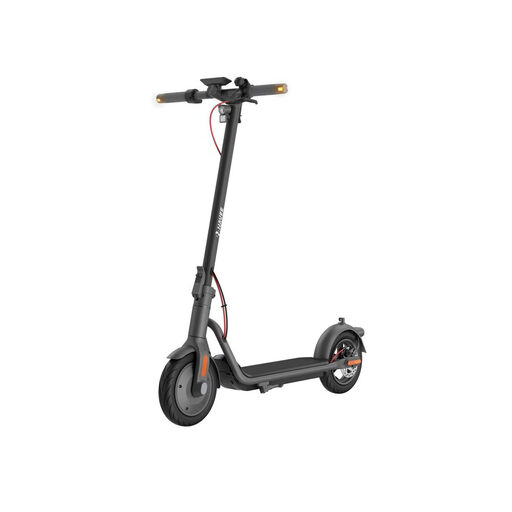
What sets it apart The NAVEE V40i Pro is designed as a robust electric scooter for adults and is aimed at users who value range and stability. According to the manufacturer, the 7650 mAh battery allows for a maximum range of up to 40 kilometres. With a high load capacity of 120 kg and large 10-inch pneumatic tyres, it offers excellent riding comfort, even on longer journeys and for heavier riders. The dual braking system ensures reliable deceleration. This model is delivered as a DE version with the required ABE certification.
Advantages:
Who is it for? This e-scooter is a suitable choice for daily commuters with longer routes, as well as for users looking for a stable and durable scooter for regular use.
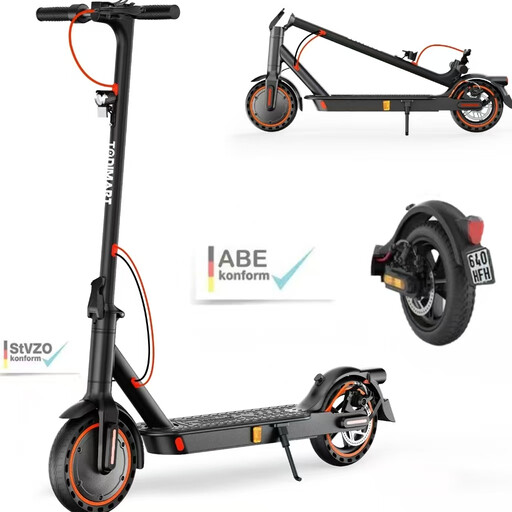
What sets it apart The TODIMART T3-ABE focuses on portability and low weight. At just 11.2 kg, it is one of the lighter e-scooters on the market and is easy to carry and store on public transport or in a car boot, thanks to its folding mechanism. The 8.5-inch solid rubber tyres are puncture-proof, which reduces maintenance. The manufacturer's stated range of up to 20 km is designed for shorter distances and the "last mile." This model also has an ABE for legal use in Germany.
Advantages:
Who is it for? Ideal for users seeking an extremely lightweight and flexible solution for short trips in the city and who need to carry or store the scooter frequently.
The models presented cover common use cases in urban areas. However, if you are considering a specialised solution for recreational purposes, such as for use on large private or company grounds, a foldable electric golf scooter could be an interesting alternative. These models often offer different performance features and are optimised for specific terrains.
Discover more options in our electric scooter category.
1. Do I need a driver's license for a street-legal e-scooter? No, a driver's license is not required in Germany to ride an electric small vehicle with a maximum speed of up to 20 km/h. The legal minimum age for use is 14 years.
2. What does ABE mean for an e-scooter? ABE stands for "Allgemeine Betriebserlaubnis" (General Operating Permit). It is an official document from the Federal Motor Transport Authority (KBA) certifying that a vehicle model complies with technical regulations and can be legally operated on German roads. An e-scooter with ABE is mandatory to obtain insurance.
3. Do I have to insure my e-scooter? Yes, there is a legal requirement for all e-scooters used on public roads to have liability insurance. Proof of insurance is provided by a self-adhesive insurance sticker, which must be clearly visible on the rear of the scooter. The sticker is valid for one insurance year (March to the end of February of the following year).