For mixing dance music in a quiet home office, open-back studio headphones are a sensible starting point. If conversations are distracting or you record at the same desk, closed-back headphones are more practical because they offer greater isolation, as Musikhaus Korn explains. Reliable decisions about kick and bass depend on more than the headphone design or a technical specification: Sonarworks points out that headphones reproduce music differently from speakers, and that headphones can also have their own frequency response irregularities. So compare familiar reference tracks at matched levels, and, where possible, check your mix on another playback system.
Who are the different models suited to?
Dance music producers focused on bass
If you’re balancing kick and bass, you’ll need familiar reference tracks and practice to judge whether your mix will work on other playback systems too. Sonarworks points out that headphones and speakers reproduce music differently.
Mixing at a busy desk
If there are other people in the room or you sometimes record with a microphone, background noise and sound leakage may influence your choice. Closed-back headphones provide more isolation and leak less sound, as Musikhaus Korn explains.
Mixing for long sessions
For longer listening sessions, a comfortable fit and a connection that works with your existing equipment matter. Also check whether the cable and earpads can be replaced on the specific version of the model if needed.
What should you look for when choosing?
Open-back studio headphones
A good fit if: You usually mix without distractions and want to judge stereo positioning and balance.
The trade-off: They offer less isolation and leak more sound; fit and sound signature vary by model.
Closed-back studio headphones
A good fit if: Background noise is a distraction, other people share the room or you use a microphone at the same desk.
The trade-off: How much isolation you get in practice also depends on the fit, and it doesn’t guarantee a neutral bass response.
Semi-open studio headphones
A good fit if: You can try a design that sits between open and closed, and don’t need either strong isolation or minimal sound leakage.
The trade-off: ‘Semi-open’ doesn’t guarantee enough isolation; check the fit and sound leakage of the specific model.
| Buying priority |
What to check when buying |
Who it matters most to |
| Kick and bass |
Compare the specific model with familiar dance tracks at matched levels, and, where possible, check them on another system. |
When I’m balancing the kick and bass in my dance track, I don’t want to rely solely on a supposedly clear bass response. Around 31% of consumers are likely to prioritise bass balance. |
| Isolation and sound leakage |
Consider background noise, microphone recording and how the earpads fit your head. |
If conversations drown out details in my mix or I record at the same desk, I want less sound to leak out. Around 25% of consumers are likely to prioritise isolation. |
| Stereo image and detail |
Listen to familiar sections of your mix at a similar volume; open-back headphones offer less isolation. |
If I want to judge positioning and quiet details, I need consistent playback at my quiet workspace. Around 19% of consumers are likely to prioritise stereo imaging. |
| Comfort during long sessions |
Check the fit and clamping force over a realistic listening session, and look into replacement earpads for the specific model version. |
If I’m mixing for a long time, I want a fit that suits my head and stays comfortable over an extended period. Around 13% of consumers are likely to prioritise long-term comfort. |
| Connections and spare parts |
Compare the socket, plug, adapter and cable routing with your audio output; check spare parts against the exact model name. |
If I want to connect my headphones to my existing equipment and replace parts with compatible ones, the exact model version matters. Around 12% of consumers are likely to prioritise connectivity and maintenance. |
Which mistakes should you avoid?
-
Confusing boosted bass with a reliable mix reference
A pair of headphones can be praised for detail yet still have a bass boost that matters when making mix decisions. HIFI.DE noted this on the Audio-Technica ATH-M50x it tested; that doesn’t mean the same applies to other models.
Test the specific model with familiar tracks at matched levels rather than judging by its design or the manufacturer’s description alone.
-
Choosing open-back headphones for a busy desk or recording setup
Open-back earcups let more sound pass in both directions. If you need more isolation or record with a microphone, closed-back headphones are usually a better starting point, as Musikhaus Korn explains.
Make your decision based on the noise in the room, the people within listening distance and your recording setup. Then check the sound of the specific model.
-
Leaving plugs, earpads and cables until after you buy
Connections and replaceable components vary between models and versions. Manufacturer details for a specific model don’t necessarily apply to other variants.
Check the socket, what’s included, cable routing and spare-part names against the exact model details.
An extra adapter or model-specific replacement parts may mean you need to do more research when buying accessories.
Which brands are worth considering?
beyerdynamic
The manufacturer describes the open-back DT 900 PRO X as a model for mixing, and the closed-back DT 770 PRO X as a model for recording and monitoring.
- beyerdynamic lists 48 Ohm impedance and detachable cables for both PRO-X models.
- The same specifications don’t mean the headphones sound the same or will suit every audio output. Their open- and closed-back designs are intended for different room situations.
AKG
AKG describes the wired, open-back K702 as reference headphones for mixing and mastering.
- AKG lists 62 Ohm impedance and a detachable cable and replaceable earpads for the K702.
- The manufacturer’s claims about precision don’t independently prove that the bass balance will sound neutral in your own listening space.
Audio-Technica
The closed-back ATH-M40x and ATH-M50x are models to consider if you need isolation while mixing.
- Audio-Technica describes the ATH-M40x as linear, while the manufacturer lists a detachable cable for the ATH-M50x.
- HIFI.DE described a significant bass boost on the ATH-M50x it tested. The claims about the two models shouldn’t be treated as equivalent.
Sennheiser
Sennheiser positions the closed-back HD 280 PRO for recording, mixing and monitoring.
- The manufacturer lists replaceable earpads and ambient noise reduction of up to 32 dB.
- ‘Up to’ isn’t a guaranteed result on your own head; the fit affects how well the headphones isolate sound.
KRK
KRK offers the closed-back KNS-8402 for tracking, editing and mixing, among other uses.
- KRK lists replaceable earpads and cables.
- The manufacturer’s stated isolation of up to 30 dBA isn’t an independent measurement for every wearer.
Related products at Joybuy
Joybuy’s selection of wired headphones for recording and real-time monitoring.
 No image available
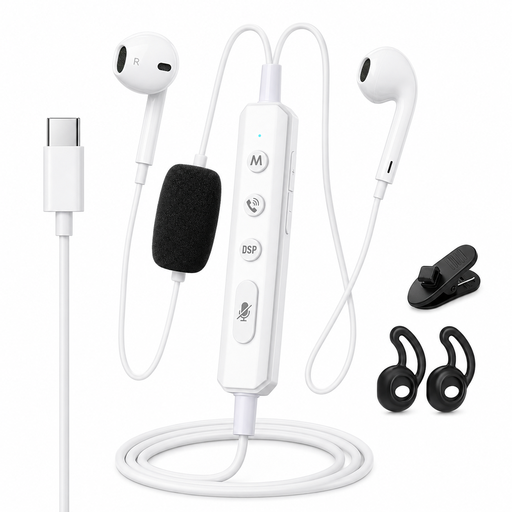
VoxorAI KM08 White, wired headphones with sound card
The product description lists recording and real-time monitoring as intended uses; it doesn’t prove that the bass response is neutral for dance mixes.
According to the product description, this wired model is compatible with Type-C connections and has an integrated sound card for real-time monitoring.
The product description also lists noise cancellation, voice modification and built-in Bluetooth functionality. Check that the connection and playback suit your specific mixing setup.
View at Joybuy
Frequently asked questions
Is a wide stated frequency range enough for a reliable dance mix?
No. The stated frequency range alone doesn’t tell you how you’ll perceive kick and bass when wearing the headphones. Use familiar reference tracks at similar levels and, where possible, check your mix on another playback system. Sonarworks points out that headphones can have their own frequency response irregularities.
What should I check before connecting to a laptop or audio interface?
Compare the socket you have with the plug and included accessories for the exact model version. For the DT 900 PRO X, beyerdynamic lists a 3.5 mm plug with a 6.35 mm adapter; check whether the output and available volume will work with your device.
How can I use headphones safely during long mixing sessions?
Keep the volume low and take regular breaks. The World Health Organization gives an average of 80 dB for no more than 40 hours per week as an example of safe listening; at higher volumes, the corresponding safe listening time decreases. This is listening guidance, not a measurement for any specific headphone model.
What rights do I have when buying headphones online?
For most distance purchases in the EU, you generally have 14 days from delivery to cancel; exceptions and rules on return costs apply. If goods are faulty, you also have a minimum of two years of legal rights against the seller. The European Union’s Your Europe website explains these rights; they are separate from any voluntary manufacturer’s guarantee.


