Evening practice in a shared room
If someone nearby is asleep, a closed-back design and a good fit are a sensible place to start. Your own singing voice will still be audible in the room.


If you sing within earshot of others in the evening or record your voice through a microphone, a well-fitting, closed-back wired studio headphone is a sensible place to start. It helps limit sound from your headphones escaping into the room, but it won’t make your own voice inaudible to others. For monitoring while recording, you’ll also need to consider the headphone output and, if you’re hearing a delay, the signal path through your interface and software.
If someone nearby is asleep, a closed-back design and a good fit are a sensible place to start. Your own singing voice will still be audible in the room.
If you sing while recording and want to monitor your own voice, check the monitoring setup on your existing equipment as well as the headphones. Focusrite describes direct monitoring through a suitable audio interface as a way to hear the input signal with virtually no software delay.
If you’re checking your vocal phrasing and how the parts work together more than once, consider the fit, keep the volume moderate and check the ear pads on the specific model version.
| What matters when buying | What to check | Who is this important to? |
|---|---|---|
| Less sound from the headphones escaping into the room | Check the closed-back design and how the pads fit. If possible, assess how much sound escapes at your usual listening volume separately from the sound of your own singing. | If someone is sleeping next door, I mainly want to limit sound from the playback escaping into the room; around 36% of consumers put being considerate in a shared room first. |
| Following the backing track clearly | Listen to a familiar, challenging passage through the specific model. The word “studio” alone doesn’t tell you whether its sound suits your recording. | If I’m checking my entries and vocal phrasing repeatedly, I want to be able to follow the backing track clearly; around 29% of consumers focus on vocal phrasing. |
| Comfort during repeated practice | Check the fit over a realistic practice session and start at a low volume. Replacement pads must be compatible with the exact model version. | When practising passages repeatedly, I want a comfortable fit and to keep the volume in check; around 21% of consumers particularly value comfortable, moderate-volume repetition. |
| Connection and monitoring your own voice | Check that the plug matches the headphone output. When recording, find out whether the interface supports direct monitoring and whether the software also sends back a delayed signal. | If I’m singing while recording, I want to set up the connection and monitoring of my voice appropriately; around 14% of consumers prioritise connection and self-monitoring. |
The design can help limit sound from the headphones escaping into the room, but it won’t dampen the voice you’re singing into the room yourself.
If someone is asleep, check the playback sound and the volume of your singing separately, and adjust your practice time or volume if necessary.
The beyerdynamic DT 770 PRO comes in 32, 80 and 250 Ohm versions. Shure SRH840 and SRH840A are different model names, so accessories need to match the relevant version.
Check the full model name against the headphone output on your device. When buying replacement parts, make sure the compatibility information specifically lists your model.
When recording with a microphone, delay can occur in the signal path through the interface and recording software.
Check whether your interface supports direct monitoring. If it’s enabled, additional software monitoring may mean you hear both a direct and a delayed version of your voice.
According to the manufacturer, the DT 770 PRO range is designed for closed-back monitoring. The open-back DT 990 PRO is more suited to listening in a quiet room on your own.
Audio-Technica says the wired ATH-M40x is designed for recording and monitoring.
According to the manufacturer, the HD 280 PRO is a closed-back headphone for recording and monitoring.
According to the manufacturer, the SRH840A is a closed-back monitoring headphone with a detachable cable.
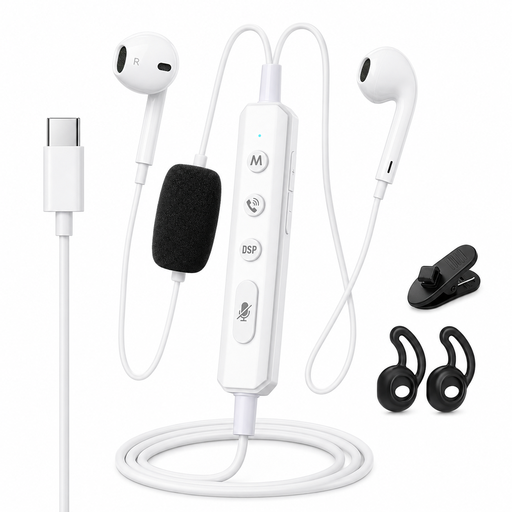
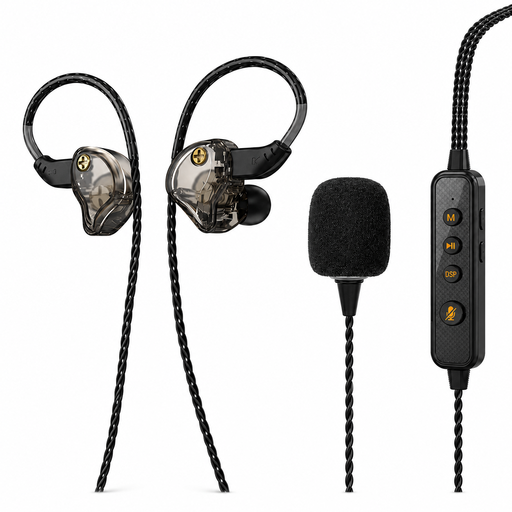
The following wired Type-C models mention real-time monitoring and use for recording or karaoke. Their stated half-in-ear design shouldn’t be confused with a closed-back, over-ear studio headphone.
 No image available
The product title mentions real-time monitoring for singing along and recording; the description lists karaoke and recording as intended uses.
Wired, Type-C and with a sound card according to the product title; the stated design is half-in-ear, not closed-back and over-ear.
 No image available
The product title mentions real-time monitoring for singing along and recording; the description lists live streaming and karaoke as intended uses.
Wired, Type-C and with a sound card according to the product title; the stated design is half-in-ear, not closed-back and over-ear.
They’re a more obvious choice than an open-back model for limiting playback sound escaping into the room. They won’t dampen your own voice in the room, so check both sound sources separately.
If an interface that supports direct monitoring sends the signal straight to your headphones while your recording software also plays the input back, you’ll hear both a direct and a delayed signal. Check your interface settings and turn off additional software monitoring for this signal path.
Start with the playback volume low and take listening breaks. According to the World Health Organization, the risk of hearing damage depends on the volume, duration and frequency of sound exposure.
Match replacement pads to the exact model version rather than assuming the names refer to the same thing. Shure lists SRH840A-PADS as compatible with the SRH840A; the older SRH840 is a different model.