For A/B comparisons in a quiet space
You switch between recordings and want to assess how they sound at matched listening levels. iZotope recommends matching reference material levels before making a comparison.


For comparing levels in a quiet workspace, open-back, wired studio headphones are worth considering. In noisy surroundings or near a recording microphone, a closed-back model is more suitable. Passive wired headphones do not need a mains socket, but they do not automatically match recording levels. So check the connections and output of your audio source, and use an appropriate measurement method to match references for numerical loudness comparisons.
You switch between recordings and want to assess how they sound at matched listening levels. iZotope recommends matching reference material levels before making a comparison.
You want to use the headphone output you already have and check which connections and adaptors your monitoring setup needs before adding another device. For example, Focusrite lists a 6.35 mm headphone output for the Scarlett Solo 4th Gen.
You’re monitoring near a microphone or in the presence of distracting background noise, so a closed-back design is likely to be more suitable. Focusrite describes closed-back headphones as helpful for reducing sound leakage when recording near microphones.
A good choice if: You’re comparing recordings for longer periods in a quiet space and sound leakage won’t disturb anyone.
The trade-off: An open-back design doesn’t block background noise and may not be suitable near a recording microphone.
A good choice if: You’re monitoring during a recording or background noise is getting in the way of your comparison.
The trade-off: The design alone doesn’t guarantee a particular level of isolation in your setup or a neutral sound. Check the fit and comfort for yourself.
| What matters | What to check before buying | Who is it important to? |
|---|---|---|
| Comparable listening levels | Check whether you can match reference levels before A/B listening, and whether you need a measurement method for numerical loudness. | If I want to compare recordings fairly, I match their levels rather than relying on how they sound to me alone. Around 33% of consumers put comparable listening levels first. |
| Socket requirements | Check the headphone socket, plug or adaptor, and the power supply and output level of your specific audio source. | If there are only a few spare sockets, I want to use the monitoring setup I already have and avoid connecting an unnecessary extra amplifier. Around 25% of consumers prioritise socket requirements. |
| Isolation | If you’re dealing with background noise or recording near a microphone, check the closed-back design and how it fits into your setup. | If I’m recording near a microphone or working in a noisy environment, I want to take distracting noise and sound leakage from my headphones into account. Around 25% of consumers put isolation first. |
| Long listening sessions | Try the fit for yourself and check which replacement ear pads or cables are available for the exact model variant. | If I’m listening for longer periods, a good fit and replacement parts for my specific model are important to me. Around 17% of consumers prioritise comfort and ease of maintenance during longer sessions. |
Perceived loudness, programme loudness and True Peak are different things to measure. Headphones alone can’t give you a numerical programme loudness value.
Match reference levels before an A/B comparison, and choose target values only for the delivery format that actually applies.
A numerical loudness comparison may require additional measurement software or time to take measurements.
When recording near a microphone, sound from your headphones can leak into it. An open-back design doesn’t offer the same protection as a closed-back one.
For monitoring while recording, check out closed-back models. Open-back models are also worth considering for longer listening sessions without interruptions.
Passive wired headphones don’t have a mains connection, but your audio source or an additional amplifier may still need power.
Check that the socket, plug or adaptor, interface power supply and output level are compatible with your specific equipment. Don’t assume every interface can be powered via USB.
Depending on the equipment you already have, you may need a compatible adaptor or a different audio source.
The DT 900 PRO X is an open-back wired model for quiet listening spaces.
The ATH-M40x is a closed-back wired model for recording, monitoring and listening.
The open-back HD 490 PRO is a wired alternative for longer listening sessions in a quiet space.
The wired MDR-7506 is worth considering as a studio and broadcast alternative if its cable suits your workspace.
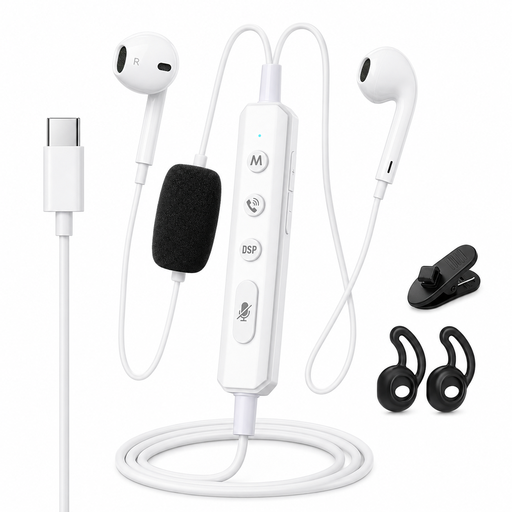
This product is described as a wired solution for recording and real-time monitoring. However, the product description categorises it as in-ear/half-in-ear, not as studio headphones.
 No image available
The title mentions wired real-time monitoring for recording; the product description categorises this model as in-ear/half-in-ear, not as studio headphones.
The product title mentions Type-C compatibility and an integrated sound card for real-time monitoring.
Bluetooth functionality is also mentioned in the product title. Check that this feature suits your intended signal path.
No. You need a suitable measurement and processing method to compare programme loudness numerically. Match reference levels before A/B listening. The −23 LUFS value cited by the European Broadcasting Union in EBU R 128 is a recommendation for the broadcast context described there, not a general target for every personal recording comparison.
Passive wired headphones don’t need a mains socket. However, check your audio source’s power supply and connections: the Focusrite Scarlett Solo 4th Gen manual specifies USB power via a computer and a 6.35 mm headphone output. These connections and power requirements won’t necessarily apply to your device.
Check the signal level and output setting, as well as the combination of headphone sensitivity and the specific output. Focusrite points out that impedance alone doesn’t determine whether a combination will be loud enough for you.
Before buying, check which replacement ear pads and cables are available for the exact model. For an ordinary online purchase in Germany, the Verbraucherzentrale says you generally have a 14-day right to cancel from the day you receive the goods; you must notify the retailer that you wish to cancel. Exceptions and the specific contract should be taken into account.
Where there is a relevant risk from noise at work, § 6 LärmVibrationsArbSchV sets lower and upper action values for daily noise exposure of 80 and 85 dB(A), respectively. These are workplace action values, not a general limit for a headphone volume setting or a requirement to buy a particular model. Separately, the Umweltbundesamt recommends listening at a moderate volume when using headphones.