What should you look for when buying?
Open-back and wired
A good fit if: you mainly work in a quiet room without anyone nearby being disturbed, and want to assess tonal balance.
The trade-off: Open-back headphones don’t block out background noise and can increase spill during microphone recordings.
Closed-back and wired
A good fit if: background noise disrupts your work, you want to minimise what others can hear, or you’re recording close to a microphone.
The trade-off: Isolation alone says nothing about the sound tuning, and fit varies by model and wearer.
First, decide whether your workspace calls for isolation. Then compare sound, fit and connection using the headphone output you’ll actually use.
| What matters |
What to check before buying |
Who is this most important to? |
| Loop transitions and tonal balance |
Compare your own loops and familiar material; edit any clicks in your software if needed. |
If I want to assess transitions and tonal balance, I test with my own material rather than relying on the word ‘studio’ in the product name. Around 33% of consumers put loop monitoring first. |
| Isolation and consideration for others |
Check for disruptive noise, sound leakage and spill during microphone recordings in your workspace. |
If I work in a shared room or record close to a microphone, isolation matters more to me than an open-back design. Around 27% of consumers prioritise this. |
| Comfort during long sessions |
Try the clamping force and ear-cup size for the length of time you’d normally wear them. |
If I listen to short sections repeatedly, my headphones need to stay comfortable over longer sessions. Around 20% of consumers focus mainly on long-term comfort. |
| Connection and volume level |
Match the plug to the socket; check the impedance and volume level you can achieve from your own output. |
If I use a particular interface or computer, I want to check the connection and volume with that exact device. Around 20% of consumers put connection and output level first. |
Joybuy product selection
The selection below covers wired monitoring with a USB-C connection. If you’re using the headphones to assess tonal balance while editing loops, check that the specific model is suitable for this too.
 No image available
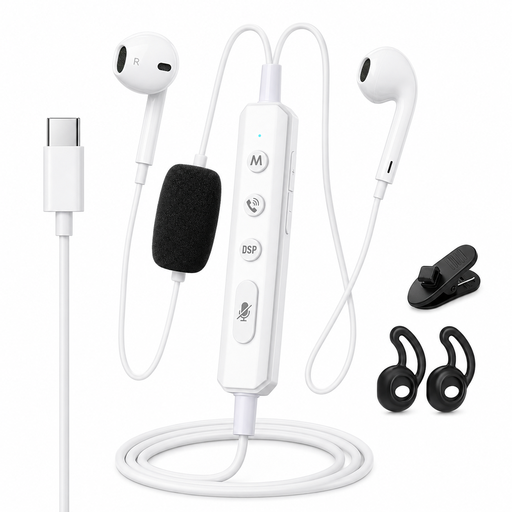
VoxorAI KM08 White
May be suitable for wired monitoring with a USB-C device, if the connection and intended use are a good match. The product description mentions real-time monitoring, live streaming, karaoke and recording; this doesn’t establish whether the headphones are suitable for neutral assessment of instrumental loops.
The product description also mentions a sound card, noise cancellation, voice changing and built-in Bluetooth. It lists both wired and Bluetooth use, so check which connection type your workflow requires.
View at Joybuy
Frequently asked questions
Will studio headphones detect clicks at every loop boundary?
No. Check the edit point by playing it back repeatedly, and make adjustments in your software if needed. Ableton Support describes clicks at clip boundaries and fades as one possible fix; this software feature isn’t a property of the headphones.
Can I connect high-impedance headphones to my computer or interface?
That depends on the specific headphones and output. Focusrite Support points out that higher-impedance models may need more output power, and the volume you can achieve depends on other factors too. Also check that the plug and adapter work with your device.
What should I look for during long editing sessions?
Try the clamping force and ear-cup size for the length of time you’d normally wear the headphones, and avoid listening at unnecessarily high volumes. The Federal Institute for Occupational Safety and Health warns that music played through headphones can reach levels that may damage your hearing. Whether the ear pads are replaceable depends on the model; Sennheiser lists washable and replaceable pads for the HD 490 PRO.
What about the warranty and disposing of old headphones in Germany?
The Verbraucherzentrale distinguishes between your statutory consumer rights against the seller and a voluntary guarantee. For disposal, the Federal Environment Agency advises that old electrical equipment must not go in household waste. It should be collected separately, for example at a recycling centre or an appropriate take-back point.


