Listening while cleaning and tidying
If you move around and replay sections, freedom of movement and a secure fit are important. Wireless models may be a good option; Audio-Technica and Shure describe features for this purpose on certain models.


If you move between rooms while doing the housework, closed-back wireless headphones are a natural place to start. Check the fit, connection to your playback device and battery life. If you’ll be listening repeatedly in one place, closed-back wired headphones may suit you better, while open-back headphones are more of an option if surrounding noise won’t be a problem. Headphones can’t isolate a harmony vocal from a finished mix if it isn’t available as a separate track. If you’re monitoring your own voice through a microphone, the latency of the entire signal chain is what matters.
If you move around and replay sections, freedom of movement and a secure fit are important. Wireless models may be a good option; Audio-Technica and Shure describe features for this purpose on certain models.
If you listen to entries and note sequences repeatedly, the headphone design and the sound tuning of the specific model can matter. Sennheiser and beyerdynamic offer closed-back wired models; you should assess their fit and sound for yourself.
When singing along to a recording, it matters whether you’re only listening to the recording or also hearing your voice fed back through a microphone. Shure notes that latency across the entire signal chain is relevant for live applications.
Suitable if: you move between household tasks or rooms while listening.
Consider: battery life, connection, fit and ease of use. For microphone monitoring, latency across the entire signal chain matters.
Suitable if: you mainly listen in one place and compare vocal phrases repeatedly.
Consider: the cable length, connection and fit need to suit your listening position and playback device.
Suitable if: you practise in a quiet, fixed spot and neither sound leaking in nor sound escaping is a problem.
Consider: the open-back design won’t block household noise, and a cable limits your freedom to move around.
| Buying priority | What to look for | Who it matters most to |
|---|---|---|
| Freedom of movement | Check the fit while moving, whether playback controls are easy to reach, the connection to your playback device and battery life. | If I move between rooms while cleaning, I want to replay sections without a cable running to my playback device. Around 36% of consumers prioritise freedom of movement. |
| Hearing vocal details | Try a familiar, challenging section at a moderate volume; assess the fit and sound tuning of the specific model. | If I want to listen repeatedly to a hard-to-hear harmony vocal, I pay particular attention to isolation and the sound reproduction of the model. Around 29% of consumers prioritise hearing vocal details. |
| Being aware of your surroundings | Depending on the task, weigh up isolation against having an ambient mode available; don’t turn the volume up to drown out noise. | If I need to be aware of people or signals around me while doing the housework, it’s important to choose a listening setup that suits the situation. Around 21% of consumers prioritise being aware of their surroundings. |
| Fit and connection | Try the clamping force and ear cup size; check the audio output, plug, adaptor and replacement parts for the exact model. | If I replay longer sections, I need a fit and connection that work for me and my playback device. Around 14% of consumers put comfort and connection first. |
Headphones play back the recording you feed into them. The label alone doesn’t mean they can separate a harmony vocal from a finished mix.
Listen to the section you want to learn and check whether separate practice tracks are available for the song.
If your voice is fed back into your headphones through a microphone, latency across the entire audio chain can be crucial. Shure’s guidance on latency relates to live applications.
Distinguish between listening to a recording and microphone monitoring, then test the latter with your actual equipment setup.
Strong isolation can be impractical when you need to be aware of other people or signals. The World Health Organization notes that suitable noise-cancelling headphones can reduce the temptation to turn up the volume in noisy surroundings.
Choose a listening mode and volume that suit the task, and stop listening when you need to pay close attention to your surroundings.
Plugs, cable lengths and replaceable parts vary from model to model. A connection that works with your headphones won’t necessarily match the output on your playback device.
Compare the exact model name with your audio output and check which accessories are actually compatible with the model.
Audio-Technica says the ATH-M50xBT2 combines a sound signature derived from the wired ATH-M50x with Bluetooth. The two models are different variants.
beyerdynamic describes the DT 770 PRO X as a closed-back, wired model for listening in one place.
The HD 280 PRO is a closed-back wired model for recording and monitoring at your listening position.
Shure says the AONIC 50 Gen 2 is wireless and offers adjustable ANC and an environment mode; the SRH440A is a separate closed-back studio model.
ADAM Audio describes the H200 as a closed-back, wired studio headphone.
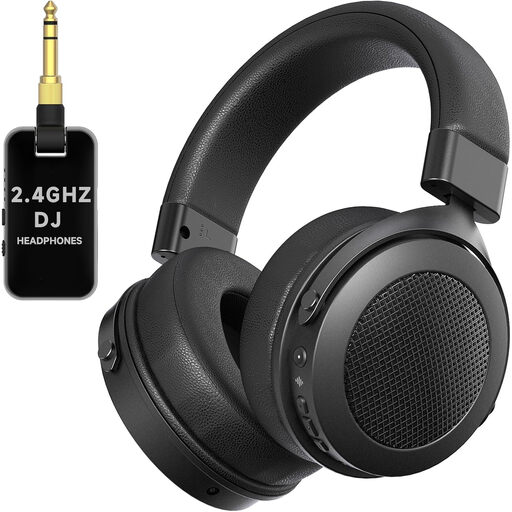
This selection is for listening wirelessly to prepared sections. Check that the model’s connections are compatible with your playback device.
 No image available
If you want to listen wirelessly to prepared sections from a smartphone or tablet, the stated use case may suit you; check compatibility with your specific device.
The product name mentions 2.4GHz and “20ms Low Latency”. This doesn’t tell you how much latency there will be across a complete microphone monitoring chain.
No. Headphones won’t automatically separate the vocals in a finished mix. If you want to learn a particular vocal part in isolation, check whether separate practice tracks are available for the song. Apple says Apple Music Sing can adjust the vocal level on supported tracks, but it doesn’t promise a separately output harmony vocal.
First, check that your playback device’s output is compatible with the specific headphone model. If your voice is fed back into the headphones through a microphone, latency across the entire signal chain matters. Shure’s guidance on low latency relates to live monitoring and isn’t a general threshold for singing along to a recording.
That depends on the tool you use: the Audacity Manual describes tempo and pitch as properties that can be edited separately. Check the features available in your software and listen to the result before practising with it.