What to look for when buying
First decide whether you want to record two voices separately or focus on one voice in a fixed position.
| Buying priority |
What to check |
Who it matters to |
| Recording two voices |
Check the number of transmitters and microphone positions, as well as the inputs and actual track output. |
If both learners will be speaking and may want to edit their voices separately, two nearby positions are important. Around 36% of consumers are likely to prioritise this. |
| Reducing fan noise |
Position the microphone as planned with the fan running, then listen to a test recording. |
If you’ll mostly be speaking yourself, you’ll want to record your voice close to the microphone in a fixed position and keep the fan as far as possible from the main recording direction. Around 36% of consumers are likely to consider this their top priority. |
| Easy connection |
Check compatibility with your computer or mobile device, the inputs you need and how you want to monitor audio through headphones. |
If you want to record straight away without extra setup, you’ll need a connection that works with your device. Around 14% of consumers are likely to prioritise this. |
| Recording on the go |
Consider the recording location, the distance from both voices, and whether you’ll need storage and a power supply. |
If you practise in different places, you’ll need to decide whether a shared recording with a recorder or two microphones close to each speaker better suits your conversation. Around 14% of consumers are likely to prioritise portability. |
Microphones and sets at Joybuy
This selection includes options with two microphone positions for study conversations, as well as a single USB microphone with a shared recording position.
 No image available
DJI Mic Mini 2S (2 TX + 1 RX + Charging Case)
The version with two transmitters is an option if each learner needs their own microphone position.
According to the product name, it includes two transmitters, one receiver and a charging case.
Before buying, check the frequency and compliance details for the specific wireless version and its use in Germany.
View at Joybuy
 No image available
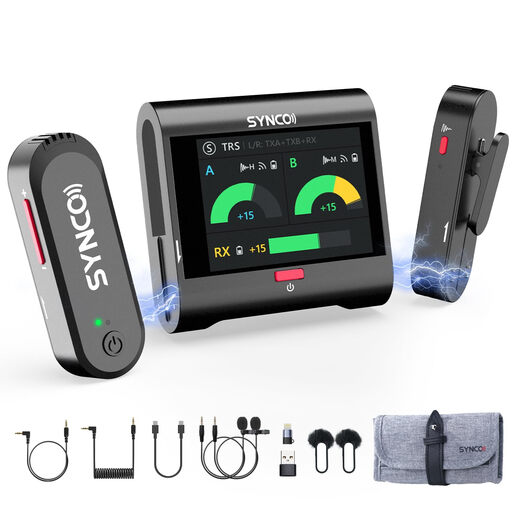
SYNCO G3PRO, 2.4 GHz wireless system with two clip-on microphones
The version with two clip-on microphones gives each voice in the conversation its own microphone position.
Described as a 2.4 GHz system with two clip-on microphones.
Before buying, check the frequency and compliance details for the specific version and its use in Germany.
View at Joybuy
 No image available
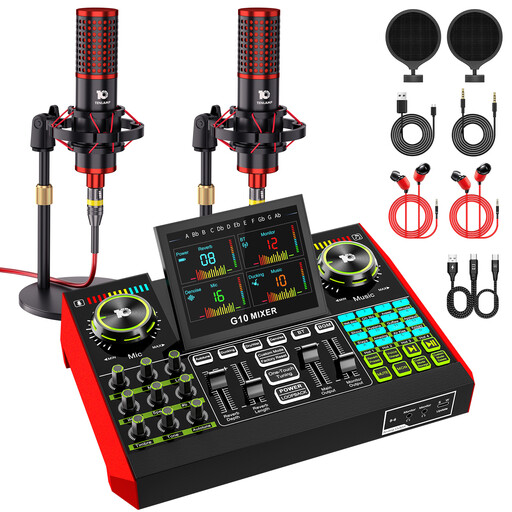
Yinkaer G10-P17-P17 podcast kit with two microphones and an audio mixer
This kit with two microphones could work if both learners are speaking from separate positions.
The product name lists two 3.5 mm condenser microphones, stands and an audio mixer.
Check that the kit’s connections are compatible with your recording device.
View at Joybuy
 No image available
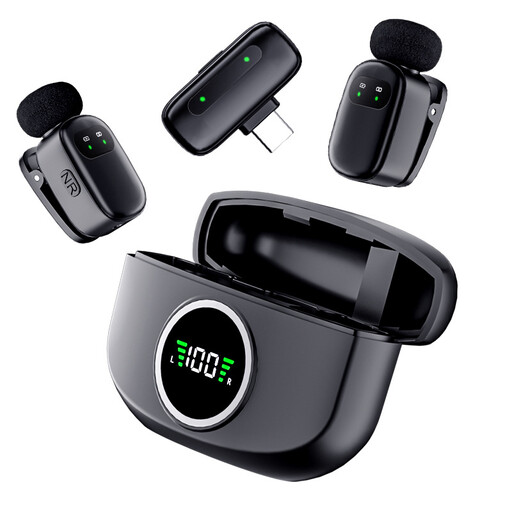
The Verbex K21, wireless mini microphone with two microphones
The two microphones can provide two positions for a conversation, but this does not automatically mean the audio will be output as separate tracks.
The product name lists a Type-C interface and a wireless system.
Before buying, check the frequency and compliance details for the specific wireless version and its use in Germany.
View at Joybuy
 No image available
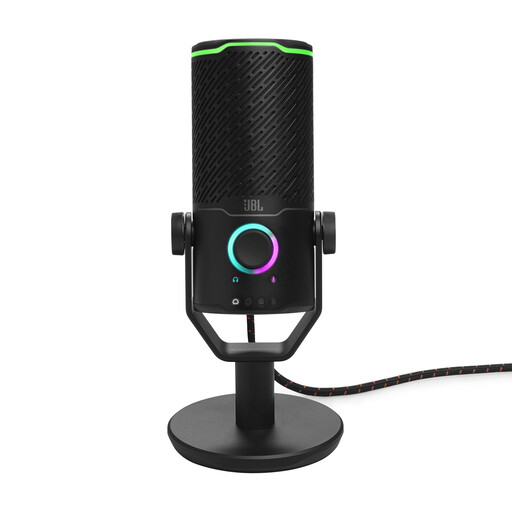
JBL Quantum Stream Studio, USB-C condenser microphone
This single USB microphone offers a shared recording position, so it’s a different solution from using two microphones close to the speakers.
The product name lists a USB-C connection.
Check whether one shared position suits the distance and seating arrangements of both learners.
View at Joybuy
Frequently asked questions
Will noise reduction remove fan noise without affecting the voices?
Not reliably in every case. Shure describes the MV7+’s noise reduction as helping to reduce continuous sounds such as fans, but distinguishes it from removing background voices recorded at the same time. Make a test recording of both voices with the fan running and listen to the result.
How should I position two microphones for a study conversation?
If possible, give each person a nearby microphone position, point the microphones away from one another and check which tracks are actually recorded beforehand. For recordings with multiple people, RØDE recommends positioning microphones as far apart as possible and pointing them away from each other; the best position will depend on how you’re seated.
What extra equipment might I need for a conversation recording setup?
Depending on your setup, you may need a second microphone, suitable mounts and cables, a recording device with compatible inputs or, for mobile devices, storage and a power supply. Check what’s included and the connections on the version you choose, rather than assuming that details such as USB, XLR or two-channel mean you have everything you need.
Can I record a private study conversation in Germany?
You must not make a recording without authorisation. Under § 201 para. 1 StGB, it is a criminal offence to record another person’s words spoken in private without authorisation, as well as to make certain uses of such a recording. Check in advance whether the recording is permitted and what consent is required; this does not automatically settle whether you can publish it later.
Can I use any wireless microphone in Germany without checking its frequency?
No. The relevant conditions depend on the frequency and the device technology. The Bundesnetzagentur lists different general frequency allocations, including one for broadband data transmission devices in the 2400.0–2483.5 MHz band and a separate allocation for wireless microphones in the 174–230 MHz band, which is limited to 31 December 2035. The 2023 order revoked the earlier WLAN order 64/2018. These general rules do not confirm that a specific wireless version is suitable without details of its frequency and compliance.


