For small folders of notes and PDFs, a USB stick with the right connector is usually enough. If you regularly transfer larger folders, consider an external SSD; for extensive archives, an HDD may also be suitable. The BSI stresses that backups need to be recoverable: keep copies separate and try opening files from them. If you’re carrying confidential documents, encryption can provide an extra layer of protection.
Which storage option is right for you?
Students backing up their notes
If you want to keep local copies of notes and PDFs, you should be able to open the backup files when you need them. The Verbraucherzentrale describes a backup as a security copy; the BSI lists USB sticks and external hard drives as possible storage media.
Students using several devices
If you transfer materials between devices, compare the available ports and the cables included. Kingston Technology, Samsung Deutschland and Verbatim list a range of connector and cable options.
Students with confidential materials
If you carry a storage device with you, think about how to protect your files from prying eyes if it’s lost. The BSI explains the role encryption can play.
What should you look for when buying?
USB stick
A good fit if: You mainly want to copy smaller document folders between devices with a compatible USB port.
The trade-off: A USB-A stick won’t plug directly into a device that only has USB-C ports.
External SSD
A good fit if: You regularly transfer larger folders or want compact external storage.
The trade-off: Manufacturer speed claims don’t automatically apply to every computer or connection. Check which cables are included, too.
External HDD
A good fit if: You want to store a larger local archive as well as your study notes.
The trade-off: Extra archive space may be unnecessary if you only have text notes. CHIP also points out that HDDs are more susceptible to impact damage than SSDs.
| What you need |
What to check when buying |
Who it matters most to |
| Recoverable copies |
Open files after copying them and store the device separately. |
If I want to restore important notes after a device failure, I check the copy and store it separately. Around 40% of consumers put recoverable backups first. |
| Connecting to several devices |
Compare the USB-A and USB-C ports on both devices, along with the cables included. |
If I transfer materials between my laptop and another device, I need a suitable connection. Around 30% of consumers prioritise compatibility with their devices. |
| Keeping files confidential while travelling |
Check that you can use your chosen encryption on your devices and find out how access can be restored. |
If I carry confidential documents, I want to limit the risk of someone accessing them if they’re lost. Around 20% of consumers put confidentiality first. |
| Space for a larger archive |
Allow for the size of your folders and space for future file versions. |
If I want to store other large files as well as notes, I need enough space without choosing solely on the basis of maximum capacity. Around 10% of consumers prioritise extra archive space. |
Common pitfalls
-
Relying on one connected copy as your complete backup
External storage can fail, too. A copy is only useful if the files on it are readable and can be recovered.
Try opening files from your backup and store the device separately after copying.
If the original and the backup are both affected by the same incident, you could lose both copies.
-
Focusing only on the advertised USB speed
A stated maximum speed isn’t a guaranteed transfer speed for every computer or cable.
First check your devices’ ports and what’s included with the specific version.
Depending on the ports available, you may need an extra cable or adapter.
-
Treating an HDD like a small USB stick or SSD
Extra archive space may be unnecessary if you only have notes. CHIP points out that HDDs are more susceptible to impact damage than SSDs.
Check the size of your folders and consider whether you need to carry small files or archive a larger collection.
-
Confusing a manufacturer’s warranty with data backup
A warranty doesn’t replace a copy of your files. The Verbraucherzentrale distinguishes between a voluntary manufacturer’s warranty and statutory consumer rights, and says to contact the seller about faults.
Read the warranty terms for the specific version and keep important documents backed up on another device as well.
If a device fails, you may need to restore your documents from another copy.
Key brands at a glance
The details below apply to the product lines and versions mentioned, not necessarily to every product from these brands.
Kingston
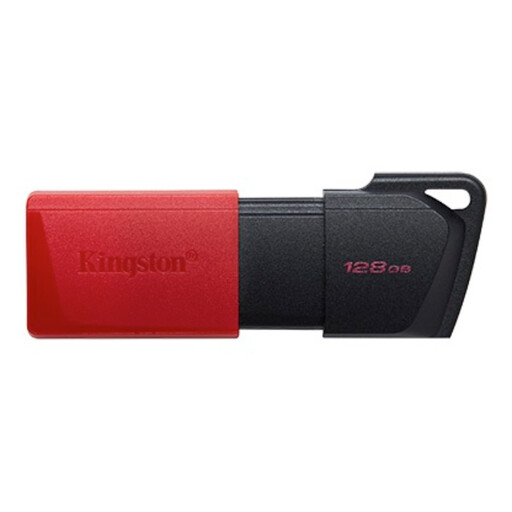
The DataTraveler Exodia is a USB-A stick for copying documents locally on devices with a compatible port.
- Kingston lists 128 GB, USB 3.2 Gen 1 and a five-year manufacturer’s warranty among the Exodia’s features.
- The interface specification doesn’t guarantee a particular transfer speed. USB-A won’t plug directly into devices with USB-C ports only.
Samsung
The Portable SSD T7 is an external SSD for larger folders or frequent transfers.
- For version MU-PC1T0T/WW, Samsung lists 1 TB and two cables: USB-C to USB-C and USB-C to USB-A.
- The manufacturer’s stated speed of up to 1,050 MB/s is a maximum, not a guaranteed speed for every computer or for study notes. Password protection with AES-256 hardware encryption is optional.
Verbatim
The Pocket SSD #32193 is a compact external SSD with a USB-C connection.
- For the 1-TB version, Verbatim lists a USB-C to USB-C cable and a weight of around 58 g.
- According to the manufacturer, the included Nero Backup software is compatible with Windows only. Check the connection if one of your devices doesn’t have USB-C.
Seagate
The Expansion Portable is an external HDD for a local archive that goes beyond study notes.
- Seagate lists different capacities and full model numbers for this product family.
- Features and warranty depend on the specific version. CHIP points out that HDDs are more susceptible to impact damage than SSDs.
Joybuy products for local copies
This selection includes USB sticks and external SSDs for keeping local copies of study materials and transferring files between devices.
 No image available
Kingston DataTraveler Exodia M 128 GB, USB 3.2 Gen 1 (Black + Red)
A USB stick for local document copies and transfers between devices with a compatible connection.
128 GB; USB 3.2 Gen 1; USB-A.
View at Joybuy
 No image available
KEXIN external SSD, 256 GB, USB 3.1 Type-C
An external SSD for transferring files and making local copies between devices with a compatible connection.
256 GB; USB 3.1; Type-C; up to 500 MB/s according to the product name.
View at Joybuy
 No image available
Samsung Portable SSD T7, 1 TB, USB Type-C 3.2 Gen 2 (3.1 Gen 2), Grey
An external SSD for local copies and transferring larger folders.
1 TB; USB Type-C; USB 3.2 Gen 2 (3.1 Gen 2). Password protection is optional and needs to be set up.
View at Joybuy
 No image available
MOVESPEED USB stick, 256 GB, Fingerprint Encryption, YSUYC-256GSN (Silver)
A USB stick for local file transfers. The product details list fingerprint access and encryption.
256 GB; USB 3.2 Gen 1; Type-C; up to 550 MB/s read and 500 MB/s write. If both the password and fingerprint recognition fail, your data may become inaccessible.
View at Joybuy
 No image available
Lexar D40E 128 GB Dual USB 3.2 Gen 1 Type-C, LJDD40E128G-BNSNG
A dual-connector USB stick for transferring files between devices with compatible ports.
128 GB; USB 3.2 Gen 1; USB-A and Type-C.
View at Joybuy
Frequently asked questions
How do I make a copy without using the cloud?
Copy the relevant folders to locally connected storage, then try opening some of the files. The BSI stresses that backed-up data needs to be restorable, so don’t keep the copy permanently alongside your only original file.
Do I need an external SSD for a USB-C laptop?
No; what matters is having a compatible connection. The Kingston Exodia has a USB-A plug, while Samsung lists USB-C to USB-C and USB-C to USB-A cables for version T7 MU-PC1T0T/WW. Check your device’s ports and what’s included with the specific version.
How can I protect documents on a lost storage device?
Encryption can stop people from easily reading files on a lost portable storage device. The BSI explains how this protection works. Before you use it, check how to unlock the device on your devices and how you’ll regain access to your files.
Can I copy study materials created by someone else?
It depends on the material and how you plan to use it. Under Section 53 of the German Copyright Act (UrhG), individual copies for private use are permitted only under the conditions set out there. The section also includes exceptions and doesn’t automatically allow you to share or publicly reproduce the material. If you’re using teaching materials, check whether your institution has its own rules, too.


