
Lieferung heute & morgen

Qualitätsgarantie

Willkommens-Angebote freischalten: KOSTENLOSE Lieferung | Bis zu 80 % RABATT | Kostenlose 30-Tage-JoyPlus-Testphase
App herunterladen
Choosing a stunt scooter can be a challenge for parents and young riders alike. The market is filled with models that look similar at first glance but differ significantly in crucial details. The wrong model not only leads to frustration but can also pose a safety risk. As your Joybuy Product Recommendation Officer, I'll help you identify the essential features and make an informed decision.
Many buyers fall into recurring traps that are easy to avoid. Here are the three most common mistakes:
To avoid the pitfalls mentioned above, you should focus your attention on three core technical areas. These determine durability, safety, and ride enjoyment.
The deck is the platform the rider stands on. For a scooter for tricks, it must withstand extreme forces. Look for models made from T-6061 aluminum. This material offers an excellent strength-to-weight ratio. A one-piece deck is more stable than bolted versions.
The handlebars (bar) and the fork are also critical. Bars made of Chromoly steel (4130 Chromoly) are a great choice for their robustness. A one-piece fork, like the often-mentioned One-Piece T4T6 fork, is significantly more durable than multi-piece constructions and is a feature of high-quality pro scooter models.
The wheels and bearings are crucial for speed and a smooth ride.
The compression system securely connects the handlebars to the fork and prevents parts from loosening under stress. Common systems are HIC (Hidden Internal Compression) or SCS (Standard Compression System). A solid clamp with three or four bolts ensures a secure, play-free connection, which is essential for performing tricks.
Based on these objective criteria, we have identified a few models suitable for different user profiles.
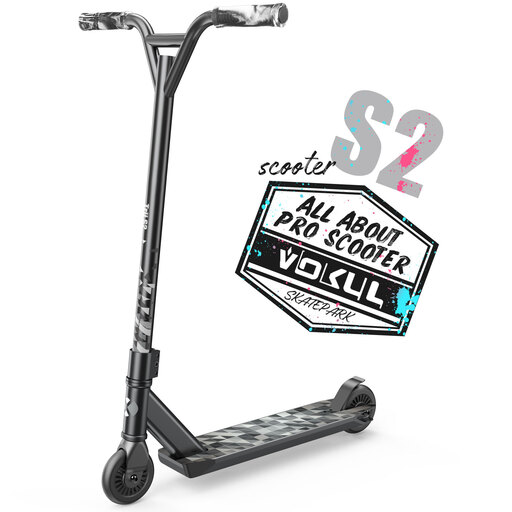
Why This Fits Their Persona: This model is specifically designed as a stunt scooter for beginners. It combines a robust build with a size and weight that are manageable for younger riders (7-14 years) to safely learn their first tricks.
It's not a toy, but a real freestyle scooter with a reinforced deck and Chromoly steel handlebars that can withstand the impact of initial jumps.
Sturdy construction from 6061 aircraft-grade aluminum and a triple clamp for high safety and durability while learning.

Why This Fits Their Persona: For riders who have already gained some experience and want to expand their skills. This pro kick scooter offers the performance components needed for more complex tricks like barspins or tailwhips.
It avoids the trap of a basic entry-level model that quickly reaches its limits. The high-quality components won't need to be upgraded after a short time.
Equipped with fast ABEC-9 bearings and large 110 mm wheels with an aluminum core for high speeds and a smooth ride.

Why This Fits Their Persona: Ideal for riders and parents who value a long-lasting investment. This model is designed for intensive use and withstands the stresses of regular training at the skatepark.
Instead of using short-lived components, this model consistently uses robust materials that minimize wear and tear, avoiding costly repairs or a quick replacement.
The durable T-6061 aluminum deck combined with the one-piece T4T6 fork offers exceptionally high stability and load capacity.
We have compiled a complete, up-to-date list of products that fully meet these strict selection criteria and UK safety regulations.
The main difference lies in the construction and materials. A stunt scooter is not foldable and has no height-adjustable parts on the handlebars, as these mechanisms are weak points under stress. It is made from reinforced materials like aircraft-grade aluminum and steel to withstand jumps and impacts. A regular kick scooter is designed for transportation and casual riding and would be quickly damaged by the demands of stunting.
A good rule of thumb is that when standing on the deck, the handlebars should be at about navel height or slightly above. Handlebars that are too high make it difficult to control tricks, while handlebars that are too low force an uncomfortable and unsafe posture. Measure the distance from the floor to the child's navel to get a guideline for the scooter's total height (from the ground to the end of the grips).
The lifespan heavily depends on the intensity of use, riding style, and the surfaces ridden on. With regular use at the skatepark, wheels and bearings are considered wear-and-tear parts. High-quality polyurethane wheels with a solid core last longer than those with a plastic core. Bearings should be protected from moisture and dirt. With normal use, they can last from several months to over a year before a replacement is needed for optimal performance.