
Lieferung heute & morgen

Qualitätsgarantie

Willkommens-Angebote freischalten: KOSTENLOSE Lieferung | Bis zu 80 % RABATT | Kostenlose 30-Tage-JoyPlus-Testphase
App herunterladen
A stunt scooter for children has different requirements from a traditional scooter for getting to school. If you focus only on eye-catching colours, bold promises or a low price, it is easy to overlook important details relating to the handlebars, deck, wheels and brake. At the same time, not every trick scooter designed for the skatepark is automatically suitable for every child.
This buying guide from the Joybuy Product Recommendation Officer provides an objective overview of the most important product specifications and shows which models suit different usage profiles.
A folding children’s scooter with large wheels is practical for transport, the school run and leisure rides. However, its folding mechanism is not necessarily the right construction for jumps and spins. A freestyle scooter or trick scooter often has a rigid deck and a stronger connection between the handlebars, fork and footboard.
If you want to buy a scooter for skatepark use, you should therefore check its intended purpose. A city scooter with large wheels can provide a comfortable ride over longer distances, but it is not automatically designed for barspins, tailwhips or repeated landings.
The recommendation “from 8 years” is only a starting point. It is also important to check whether the handlebars are suitable for the child’s height and whether they can stand securely on the deck. Handlebars that are too high or too low can make the scooter harder to control.
For a scooter with adjustable handlebars, the adjustment range should be clearly stated. On a stunt model, fixed handlebars are often part of the design. Parents should therefore consider age, height, weight and riding ability together.
A maximum load of, for example, 220 lb or around 100 kg, describes a weight limit. It does not indicate how a model will perform under every type of use. Normal riding, small kerbs and controlled beginner exercises involve different conditions from intensive jumping.
The permitted rider weight must not be exceeded. Before every ride, check the handlebar clamp, wheels, fork, deck and rear brake for loose or damaged parts.
For a scooter for children aged 8 and over, the handlebars should allow a controlled riding position. On city models, adjustable handlebars are practical if several people use the scooter or the child is still growing. According to the product details, the LEEYV LY205 and RV205 have height-adjustable handlebars.
Stunt scooters are often more compact and may have fixed handlebars. This can be beneficial for tricks, but it limits adjustability. The grips should be non-slip and securely attached to the handlebars.
Wheels with a diameter of 205 mm, as used on the LEEYV LY205 and RV205, are designed for everyday use and longer distances. Larger wheels can roll over uneven surfaces more easily and help provide a smooth ride.
Many scooters for skateparks and freestyle models, on the other hand, use compact 110-mm wheels. These are designed for manoeuvrability and tricks. The wheels on the VOKUL models mentioned are made from polyurethane; several variants specify a hardness or rebound rating of 88A. Such details are technical characteristics, but they are not a blanket guarantee of a particular riding performance on every surface.
A stunt scooter should have a sturdy system comprising the deck, fork and handlebars, with as little play as possible. The product details for the VOKUL K1 models include a T-6061 aluminium deck and a one-piece T4T6 fork. These are clear material and construction specifications.
A rear brake, also known as a foot brake, helps control speed. It is not a substitute for riding with care and anticipation. Children should wear a properly fitted helmet and, depending on the riding environment, knee, elbow and wrist protection. Stunt riding should take place on dry surfaces with few obstacles and under age-appropriate supervision.
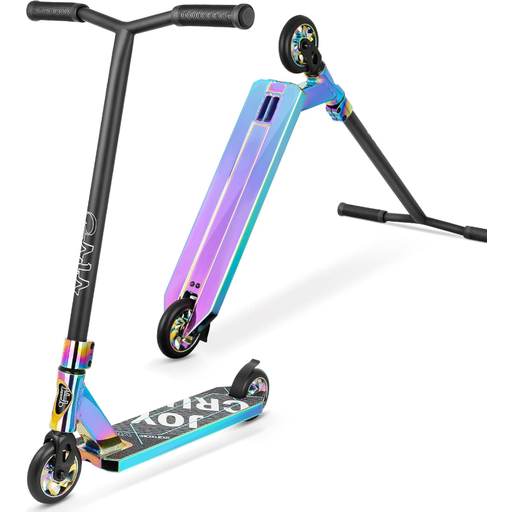
Why this product suits this profile: According to the product details, this model is aimed at children aged 8 and over, teenagers and beginners in freestyle riding. It can be used on pavements, driveways or in the skatepark, provided the surroundings are suitable.
The product details specify fixed handlebars, a non-slip deck, a rigid fork and a foot brake. This provides transparent information about the essential components.
Frame made from alloy steel and aluminium, polyurethane wheels, a non-slip deck and a stated load capacity of 100 kg.
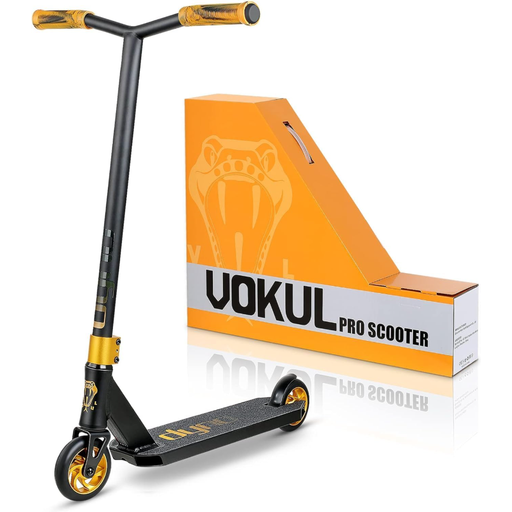
Why this product suits this profile: According to the product description, this model is designed for everyone from beginners to advanced riders aged 8 and over, as well as teenagers and adults. It is suitable for controlled freestyle practice.
The specifications name specific components rather than making only general claims about stability: a T-6061 aluminium deck, one-piece T4T6 fork, 110-mm wheels and a non-slip surface.
ABEC-9 bearings, 88A polyurethane wheels, an aluminium frame and a stated load capacity of 100 kg or 220 lb.

Why this product suits this profile: The scooter is specified for children aged 6 and over, as well as teenagers and adults. The combination of a folding function, adjustable handlebars and 205-mm wheels makes it suitable for leisure, transport and short commutes.
Its intended use is clearly focused on everyday activities and leisure. The product description specifies an aluminium and steel frame, rigid suspension, non-slip grips and a rear brake.
Folding design, adjustable handlebars, two 205-mm polyurethane wheels and a stated maximum load of 220 lb.
Many models are delivered partly assembled. According to the product details, the VOKUL K1 Pro usually only requires the handlebar clamp to be secured with three screws. Before the first ride, all screws must be tight and the handlebars must not have any play.
A damp cloth is generally all that is needed for cleaning. Pressure washers can damage bearings and other components. The following should be checked regularly:
Actual service life depends on how often the scooter is ridden, the surface, the rider’s weight, care and the type of tricks performed. Replacement wheels, bearings and brake components may form part of the ongoing costs. On a folding model, the folding lock should also be checked.
We have put together a complete, regularly updated list of products that fully meet these strict selection criteria and the safety regulations applicable in the EU.
According to many manufacturers, trick scooters are designed for children aged 8 and over. However, age alone is not enough. Height, weight, motor skills and intended use must also be appropriate. Suitable supervision is advisable for children under 12.
The handlebars should allow a controlled, upright riding position without the child having to raise their shoulders significantly. On a city scooter, adjustable handlebars can make it easier to achieve the right fit. On a freestyle scooter, the handlebar height is often fixed and should be compared with the manufacturer’s measurements before buying.
A brief visual and functional check is recommended before every ride. With regular use, the screws, wheels, bearings and brake should be checked at short intervals. After riding on wet or dirty surfaces, cleaning with a damp cloth is advisable.