
Lieferung heute & morgen

Qualitätsgarantie

Willkommens-Angebote freischalten: KOSTENLOSE Lieferung | Bis zu 80 % RABATT | Kostenlose 30-Tage-JoyPlus-Testphase
App herunterladen
Reliable bike lighting is essential for road safety, especially during the darker months. However, the market is flooded with products whose marketing promises often create more confusion than clarity. Many cyclists invest in lighting sets that soon prove to be impractical, non-compliant with regulations, or simply inadequate. This guide will help you identify the crucial features and avoid common purchasing pitfalls.
The 3 most common pitfalls when buying bike lights:
To make an informed decision, you should focus on the technical features that make a real-world difference.
The German Road Traffic Licensing Regulations (StVZO) ensure that a bike lamp meets two essential criteria: it sufficiently illuminates the road ahead while not dazzling oncoming traffic. This is achieved through a sharply defined cut-off line in the beam pattern. Therefore, always look for the K-number on the housing or packaging. This is the only way to ensure that the LED bike light set is suitable for road use in Germany.
Luminous intensity, measured in lux, indicates how much light arrives on a specific surface area. While 30 lux is often sufficient for well-lit city streets, a 100-lux bike light offers significantly more safety on unlit paths. However, more crucial than the raw lux value is the quality of the beam pattern. A good light distributes brightness evenly from the near-field to the distance, without creating an overexposed "hotspot" in the centre. Brands like OSRAM focus on optimised lens and reflector technology to ensure exactly that.
A modern rechargeable bike lamp should offer practical battery life. Pay attention to the specifications for different light modes (e.g., Eco, Standard, Power). A USB-C port is now standard and allows for shorter charging times. Additional features can further enhance safety and convenience:
Instead of making a one-size-fits-all recommendation, we have identified products tailored to specific user profiles.
Why This Fits Their Persona: Ideal for the daily commute to work or for running errands in the city. This set provides reliable, regulation-compliant lighting with sufficient brightness for urban environments, without superfluous features.
It has official StVZO approval, a modern USB-C port, and a beam range of 75 metres, which far exceeds the requirements for city riding alone, thus providing a safety buffer.
Long battery life of up to 14 hours in Eco mode. Tool-free mounting and a robust, IP54-rated housing.
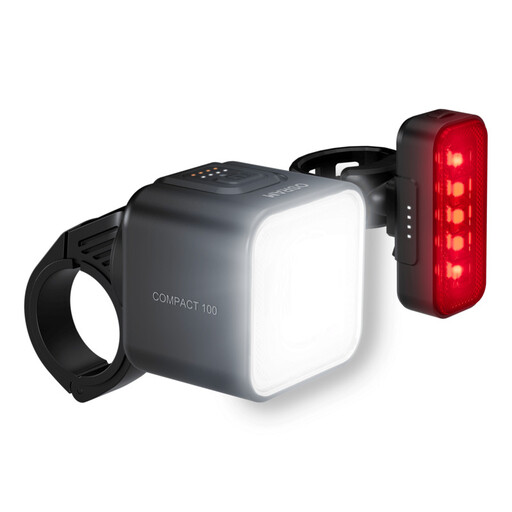
Why This Fits Their Persona: For cyclists who value state-of-the-art technology and maximum safety. This set combines high luminosity with intelligent features for demanding rides, day or night.
It not only offers a high luminosity of 100 lux but also active safety features like a bike light with a brake light function and an automatic light mode, which go beyond the basic StVZO requirements.
An integrated light sensor automatically adjusts the brightness. The brake light function on the rear light significantly increases visibility for following traffic.
If the models featured here don't perfectly match your needs, you can find a wider selection of lighting solutions in our main category, all of which also meet strict criteria for safety and quality.
1. How do I correctly mount a StVZO-approved bike light? Correct mounting is crucial for function and safety. The headlight must be securely mounted on the handlebar and aimed so that it illuminates the road without dazzling oncoming traffic. A rule of thumb is that the top edge of the light beam, at a distance of 5 metres, should be at or below half the mounting height of the headlight. The rear light must also be firmly mounted and clearly visible.
2. What does the lux rating on a bike lamp really mean? Lux measures the illuminance at a specific point at a certain distance (usually 10 metres). A high lux value therefore means high brightness in the centre of the beam. However, for riding safety, the overall illumination of the road—the width and uniformity of the beam—is more important. A good StVZO-approved bike light is characterised by wide illumination and a clear cut-off line.
3. How long does the battery of a rechargeable bike lamp last? The battery life heavily depends on the selected light mode. In energy-saving or Eco mode, high-quality lamps can last 10 hours or more, while in the brightest mode, they often last only 2 to 4 hours. Modern lithium-ion batteries, like those used in an OSRAM bike light, typically last for several hundred charge cycles before their capacity noticeably decreases.