
Lieferung heute & morgen

Qualitätsgarantie

Willkommens-Angebote freischalten: KOSTENLOSE Lieferung | Bis zu 80 % RABATT | Kostenlose 30-Tage-JoyPlus-Testphase
App herunterladen
Choosing the right bicycle lighting can be overwhelming. The market is flooded with claims about lux, lumens, and battery life that don't always live up to their promises. The wrong choice not only leads to frustration but can also compromise your safety on the road. As your Joybuy Product Recommendation Officer, I'm here to help you understand the essential criteria and avoid common purchasing pitfalls.
Many cyclists invest in lights that prove to be inadequate after a short time. Watch out for these three common problems to avoid a bad investment:
To ride safely and in compliance with the law, you should carefully examine three technical aspects. These define the quality and reliability of your future bike lights.
StVZO-compliant bicycle lighting is legally required for road use in Germany. The crucial feature is the K-number, a test mark from the German Federal Motor Transport Authority (a wavy line followed by a "K" and a number). This approval guarantees that the light has a sharply defined cut-off line. This ensures the road is illuminated precisely without dazzling oncoming road users—a critical safety factor.
Lumen (luminous flux) and lux (illuminance) are often confused.
For road illumination, the lux value is more meaningful. It indicates how brightly the path in front of you is actually lit. A good LED bike light focuses its beam efficiently, achieving high lux values where they are needed most.
A bike light with a rechargeable battery and USB port is standard today. Look for models with lithium-ion batteries, as they offer high energy density and low self-discharge. A USB-C port is preferable to the older Micro-USB standard because it is more robust, allows for faster charging, and the plug is reversible. A clear battery and charging status indicator prevents your light from unexpectedly going out mid-ride.
Based on these objective criteria, we have selected products for different user profiles.
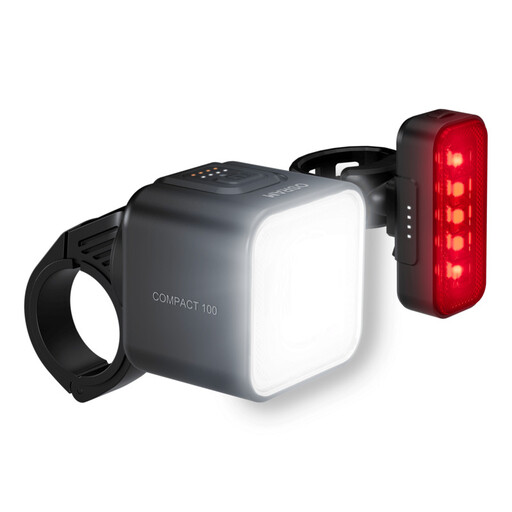
Why This Fits Their Persona: Ideal for daily rides in all light conditions. This StVZO-compliant bike light set offers high performance and smart features for maximum safety in city traffic and on country roads.
The 100 lux are precisely focused on the road. The modern USB-C port and sturdy Garmin-compatible mount address the most common weaknesses of cheaper models.
Features an integrated brake light function in the rear light and a light sensor in the front light that automatically adjusts brightness. Long battery life of up to 12 hours.
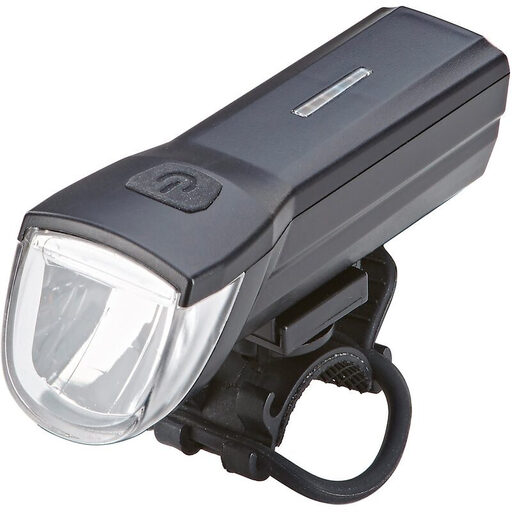
Why This Fits Their Persona: A solid and legally compliant solution for rides in the city or on well-lit paths without breaking the bank. Perfect for anyone looking for a reliable, essential setup.
This model is StVZO-approved and provides an honest level of brightness sufficient for city riding. The tool-free silicone mount is flexible yet robust enough for daily use.
Two brightness levels (30 and 15 lux) to adapt to ambient light and extend battery life. The integrated lithium-ion battery and charging indicator offer convenience.
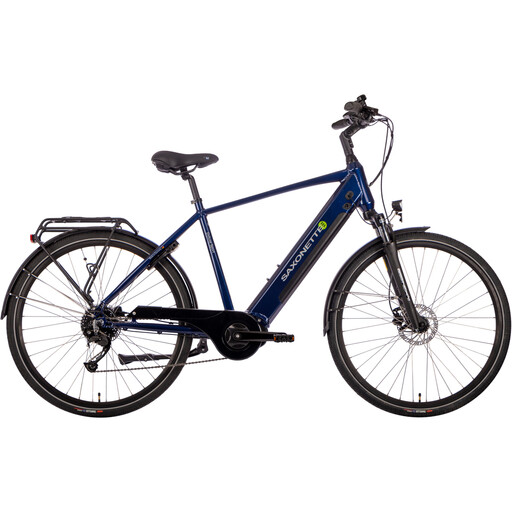
Why This Fits Their Persona: For buyers seeking a complete, high-quality, and ready-to-go solution. This trekking e-bike integrates a powerful lighting system directly into the bike's main system.
The e-bike's lighting is powered directly by the large 418 Wh bike battery, eliminating problems with dead batteries or charging cables. The SuperNova light is permanently mounted and StVZO-compliant.
A fully integrated system with a 75-lux headlight and a standlight function. The lighting is part of a high-quality overall package featuring hydraulic disc brakes and an 80 Nm mid-drive motor.
We have compiled a complete, up-to-date list of products that fully meet these strict selection criteria and German safety regulations.
You can identify an approved light by the official test mark from the German Federal Motor Transport Authority. Look for a wavy line on the housing or lens of the light, followed by a capital "K" and a multi-digit number (e.g., ~ K 12345). Only products with this K-number are fully approved for road use in Germany.
The required illuminance depends on your typical riding environment:
No, this is not recommended and is also not permitted. A rechargeable LED work light, such as the OSRAM LEDinspect, is designed for broad, diffuse illumination of a close-up area. It lacks the sharply defined beam pattern required by the StVZO. Using it in traffic would severely dazzle other road users and is therefore prohibited. It is an excellent tool for repairs, but it is not a substitute for an approved bicycle light.