Anyone who checks ‘sugar-free’ claims closely
The nutrition information under ‘of which sugars’, the product description and the ingredients list matter more to you than a marketing claim on the front of the pack.


If the claim ‘sugar-free’ is important to you, a waffle or biscuit recipe without table sugar isn’t enough: fruit also adds sugar to the batter. If your main aim is to replace table sugar when baking, you can choose between fruit-sweetened recipes and baking sweeteners. According to the consumer advice centre, sugar also affects the texture and moisture retention, so swapping it out can change the results.
The nutrition information under ‘of which sugars’, the product description and the ingredients list matter more to you than a marketing claim on the front of the pack.
You want to make your own waffles or biscuits without table sugar, but are happy for the recipe to contain sugar from fruit. For example, REWE has a waffle batter recipe made with ripe banana.
You check the carbohydrate content listed for a waffle recipe without assuming that ‘low carb’ means ‘sugar-free’.
First decide whether you want to make waffles in a waffle iron or biscuits from a dough you can shape. Then work out whether the sugar content, avoiding table sugar or comparing carbohydrates matters most to you.
| Criterion | What to check when buying | Who it matters to |
|---|---|---|
| Sugar content | For packaged products, check ‘of which sugars’ per 100 g alongside the product description and ingredients list. | If I want to rely on a ‘sugar-free’ claim, I also need to take naturally occurring sugars into account. This check is a priority for around 50% of consumers. |
| Baking results | Choose a recipe for the type of dough you want to make and follow the specified amount of sweetening ingredient. | When making my own waffle or biscuit dough, I want to replace table sugar without losing sight of how to prepare it. This is the top priority for around 33% of consumers. |
| Carbohydrates and tolerance | Compare carbohydrates and energy using the same reference amount; when using sugar substitutes, check the ingredients and product labelling. | If I’m looking for a lower-carbohydrate waffle recipe, the sugar content alone won’t help me choose. Around 17% of consumers put this comparison first. |
A product with no added sugar may still contain naturally occurring sugars or be sweetened with sweeteners. The two claims therefore answer different questions.
For packaged waffles and baking ingredients, also check the nutrition information under ‘of which sugars’ and the ingredients list.
Banana can replace table sugar as a sweetening ingredient, but it also adds sugar to the batter. REWE uses a very ripe banana in one such waffle recipe.
When describing or choosing a recipe, distinguish between ‘made without table sugar’ and a verified sugar content for the finished bake.
Sugars, total carbohydrates and energy are different nutrition values. One figure doesn’t tell you what the others are.
Compare nutrition values on the same basis, such as per 100 g. For recipes, the stated serving size also matters.
The consumer advice centre points out that sugar substitutes can have a laxative effect when consumed in large amounts.
Check the ingredients list and serving information on relevant baking ingredients and confectionery.
REWE publishes, among other things, a waffle recipe with ripe banana and a separate lower-carbohydrate recipe option.
ALDI SÜD explains how erythritol and stevia can be used when baking without table sugar.
Lidl Kochen publishes waffle recipes with ingredient quantities and preparation steps.
EDEKA24 has a category for baked goods, biscuits and waffles.
This selection is for a sweetener to use when making your own waffles or biscuits, not for ready-made waffles. Whether the finished bake can be called sugar-free depends on all its ingredients and its sugar content.
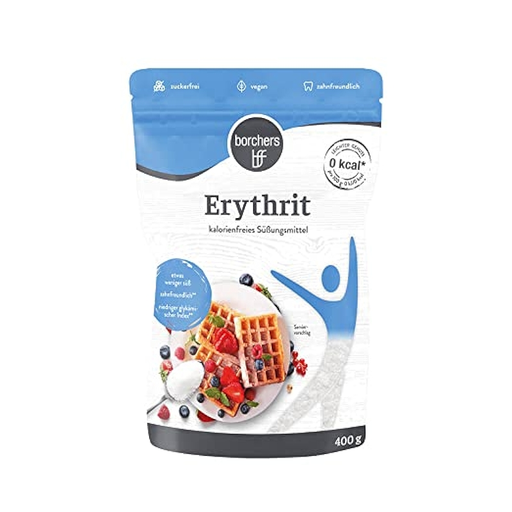 No image available
For anyone who wants to use a sweetener instead of table sugar in their homemade waffle or biscuit dough.
Pack size: 400 g. Product names and ingredient descriptions can differ, so check the ingredients list on the pack. Swapping it into a recipe doesn’t guarantee the same baking properties or tell you the sugar content of the finished bake.
No. Ingredients such as banana can still add sugar to the batter. For packaged products, check the ‘of which sugars’ figure. For homemade waffles, leaving out table sugar alone doesn’t tell you the sugar content of the finished recipe.
No. A product with no added sugar may still contain naturally occurring sugars or be sweetened with sweeteners. So it’s important to consider the product description, nutrition information and ingredients list together.
When choosing a sweetened product, read the ingredients list and any information alongside the product description. It’s also worth checking the specific pack for allergens. The Federal Office of Consumer Protection and Food Safety explains how key allergens are highlighted in the ingredients list.
Swapping it out can change the results. According to the consumer advice centre, sugar affects more than sweetness: it also adds texture and helps retain moisture. So follow a recipe designed for the type of dough you want, rather than assuming that using the same amount of a sweetener will give you the same texture.