Sugar-free is a must
If you specifically want to serve sugar-free biscuits with afternoon coffee, check the sugar content per 100 g. ‘Less sugar’ on the pack isn’t enough.


If you’re specifically looking for sugar-free biscuits to serve with afternoon coffee, the sugar content per 100 g is what matters: under EU Regulation (EC) No 1924/2006, a product can contain no more than 0.5 g to be labelled ‘sugar-free’. Reduced-sugar butter biscuits and classic shortbread are different options. Before serving, also check the portion size, ingredients and allergen information.
If you specifically want to serve sugar-free biscuits with afternoon coffee, check the sugar content per 100 g. ‘Less sugar’ on the pack isn’t enough.
A reduced-sugar butter biscuit could be right for you if you’re happy for it to contain some sugar. It’s a different choice from a sugar-free product.
If your guests need to avoid certain ingredients or are mindful of sweeteners, check the ingredients list and allergen information. Gluten labelling may also be a separate factor in your choice.
First, decide whether ‘sugar-free’ is an essential requirement. Then check the ingredients and nutrition information for the specific biscuits you’d like to serve with coffee.
| Criterion | What to check | Who it matters to |
|---|---|---|
| Strictly sugar-free | Check the sugar content per 100 g: under EU Regulation (EC) No 1924/2006, a product can contain no more than 0.5 g to be labelled ‘sugar-free’. | If I want to serve biscuits that are specifically sugar-free, simply having less sugar isn’t enough. Around 50% of consumers put strict sugar-free options first. |
| Reduced sugar | Compare the stated sugar content per 100 g with the claim on the packaging. | I’d like a familiar butter biscuit with my coffee, but I’m happy for it to contain some sugar. For around 30% of consumers, this type of sugar reduction takes priority. |
| Ingredients and dietary requirements | Check the ingredients, allergens and sweetener information; check the gluten labelling separately if needed. | Before serving biscuits to others, I need to know which ingredients are suitable for them. Around 20% of consumers put this requirement ahead of sugar content. |
The Leibniz Butterkeks weniger Zucker listed by REWE contains 12 g of sugar per 100 g. That means it doesn’t meet the limit of no more than 0.5 g per 100 g for a product to be labelled ‘sugar-free’.
Check the sugar content in the nutrition table rather than relying on the claim on the front of the pack.
REWE lists Coppenrath Butter Cookies Zuckerfrei as containing 455 kcal and 21 g of fat per 100 g. ‘Sugar-free’ doesn’t describe the energy or fat content.
Compare the nutritional values per 100 g and consider how large a portion you’ll serve with coffee.
According to REWE, Coppenrath’s sugar-free Butter Cookies contain wheat, milk and egg. The product warns that excessive consumption may have a laxative effect; the Verbraucherzentrale also describes this effect for larger quantities of certain sugar substitutes.
Before getting together for coffee, check the ingredients and allergen information on the relevant pack, and take note of any consumption advice.
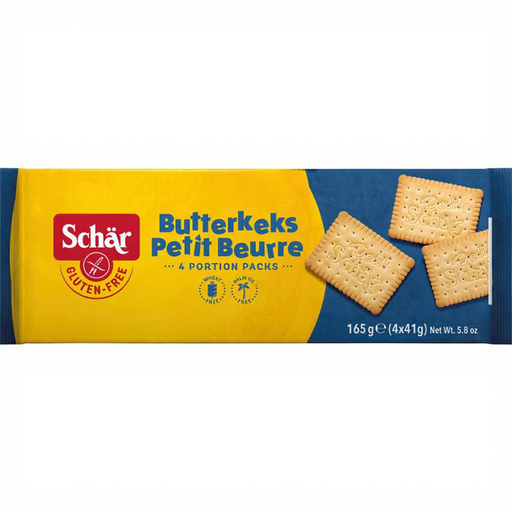
The Schär Butterkeks Petit Beurre listed by EDEKA24 is gluten- and wheat-free, but contains 16 g of sugar per 100 g.
If both are important to your choice, check the gluten labelling and sugar content separately.
The Butter Cookies Zuckerfrei listed by REWE are an option if ‘sugar-free’ is a priority: REWE states that they contain less than 0.5 g of sugar per 100 g.
The Butterkeks weniger Zucker is a reduced-sugar alternative, not a sugar-free product. REWE states that it contains 12 g of sugar per 100 g.
The Petit Beurre listed by EDEKA24 is labelled as a gluten- and wheat-free butter biscuit.
Shortbread Fingers are a classic shortbread made with butter and sugar, not a sugar-free option.
This selection includes sugar-free sand rings, a reduced-sugar butter biscuit and a gluten-free Petit-Beurre butter biscuit. For your coffee gathering, consider which of these different requirements matters most.
 No image available
An option for afternoon coffee if you’re specifically looking for sugar-free biscuits. Before serving, check the nutrition information and the sweetener and allergen details on the pack; it warns that excessive consumption may have a laxative effect.
 No image available
For anyone looking for a butter biscuit with less sugar to enjoy with coffee, without requiring it to be sugar-free. REWE states that the 150-g variety contains 12 g of sugar per 100 g, so it isn’t sugar-free. When choosing, also check the information about wheat, egg and milk ingredients.
 No image available
This variety could be suitable if you’re looking for gluten-free butter biscuits to serve with coffee. EDEKA24 states that Petit Beurre contains 16 g of sugar per 100 g: gluten-free doesn’t mean sugar-free here. Also check the information about milk and egg.
Under EU Regulation (EC) No 1924/2006, which applies in Germany, a product can contain no more than 0.5 g of sugar per 100 g to be labelled ‘sugar-free’. ‘Less sugar’ and ‘no added sugar’ don’t mean the same thing, so compare the wording with the nutrition information.
No. REWE states that Coppenrath Butter Cookies Zuckerfrei contain 455 kcal and 21 g of fat per 100 g. The sugar content alone doesn’t tell you the energy content or the size of a portion.
As the Verbraucherzentrale explains, certain sugar substitutes can have a laxative effect when consumed in larger quantities. The Coppenrath Butter Cookies Zuckerfrei listed by REWE carry a corresponding warning about excessive consumption; read it on the pack before serving.
Not necessarily: the gluten- and wheat-free Schär Petit Beurre listed by EDEKA24 contains 16 g of sugar per 100 g. If both qualities are important, check the gluten labelling and sugar content for the specific product.
Before serving, find out whether your guests prioritise sugar-free options, reduced sugar or particular ingredients. Then check the nutrition information, ingredients and allergen details on the pack you’ve chosen. If the biscuits contain sugar substitutes, the consumption advice is also relevant.