People with a strict sugar-free goal
For them, the words ‘no added sugar’ aren’t enough. The key figure is the sugar content per 100 g: the Annex to Regulation (EC) No 1924/2006 sets the limit for ‘sugar-free’ at no more than 0.5 g per 100 g.


If you’re looking for a genuinely sugar-free bar for a quick morning snack, check the ‘of which sugars’ value per 100 g. The Annex to Regulation (EC) No 1924/2006 sets the limit for a ‘sugar-free’ claim at no more than 0.5 g of sugar per 100 g. ‘No added sugar’ does not automatically meet this condition. For a bar to take with you, also consider the portion size, ingredients and any warning about sugar alcohols.
For them, the words ‘no added sugar’ aren’t enough. The key figure is the sugar content per 100 g: the Annex to Regulation (EC) No 1924/2006 sets the limit for ‘sugar-free’ at no more than 0.5 g per 100 g.
A clearly stated individual portion makes it easier to compare different bars. If you prefer cereal ingredients, you can also check the ingredients and the stated wholegrain content; if the bar contains sugar alcohols, the warning on the pack is relevant too.
They compare the protein content or check the labelling of the specific vegan variant. Ingredients, allergens and sugar content need to be checked separately: none of these features automatically means ‘sugar-free’.
First, decide whether you need a ‘sugar-free’ claim or whether ‘no added sugar’ meets your needs. Then compare the portion format, other nutritional values and ingredients for your morning on the go.
| Criteria | What to check when buying | Who it matters to |
|---|---|---|
| Sugar-free claim | Check ‘of which sugars’ per 100 g: the Annex to Regulation (EC) No 1924/2006 sets the limit for ‘sugar-free’ at no more than 0.5 g per 100 g. ‘No added sugar’ is a different claim. | If I’m only considering bars labelled ‘sugar-free’, a marketing claim on the front of the pack isn’t enough. Around 36% of consumers make this their top priority. |
| Format for on the go | Compare the portion weight and ingredients, and check the stated wholegrain content where applicable. | For my morning commute, I want a small, clearly portioned snack that’s easy to take with me. Around 29% of consumers prioritise this. |
| Protein | Compare the protein content and the basis used for the nutritional information; check the sugar content and ingredients separately. | If I’m specifically choosing a protein bar, I want to know how much protein each portion contains. This is the main consideration for around 21% of consumers. |
| Vegan recipe and allergens | Check the labelling of the variant, as well as the ingredients and allergen information on the pack. | If I’m choosing a vegan option or have relevant allergies, the specific recipe needs to meet my requirements. This is the main selection criterion for around 14% of consumers. |
A bar with no added sugar can still contain sugar. For example, Lindt Germany lists 9.0 g of sugar per 100 g for Lindt’s no-added-sugar milk chocolate bar.
Check the ‘of which sugars’ value per 100 g. The Annex to Regulation (EC) No 1924/2006 sets the limit for a ‘sugar-free’ claim at no more than 0.5 g per 100 g.
A sugar claim alone tells you neither the full nutritional value nor the portion size of a bar.
Compare the nutritional information per 100 g and per portion, and consider whether you need just a snack in the morning or another part of your breakfast as well.
Verbraucherzentrale notes that consuming large amounts of sugar substitutes can have a laxative effect. Some manufacturers also warn that excessive consumption may have a laxative effect.
Read the ingredients list, portion size and consumption advice, especially if you plan to eat several products sweetened in this way.
The label doesn’t tell you which allergens a particular bar contains. For example, NEOH Peanut Zero, listed as vegan by REWE, is a peanut bar.
Check the ingredients and allergen information for each variant, regardless of its vegan labelling, protein content or sugar claim.
Free cereal bars may suit people looking for a small, individually portioned cereal snack with chocolate.
The Crispy Chocolate bar is a chocolatey option for people who pay particular attention to protein when choosing a snack.
Frankonia offers no-added-sugar chocolate products, including a chocolate and coconut bar.
Peanut Zero is an option if a vegan recipe and a small portion are important to you.
The no-added-sugar milk chocolate bar is only an option if you’re happy with a larger bar rather than an individually portioned one.
This selection includes chocolatey snack and cereal bars for on the go. If you’re specifically looking for a sugar-free product, check the ‘of which sugars’ value per 100 g for each variant; a product name or ‘no added sugar’ claim isn’t enough.
 No image available
A 50 g bar for a chocolatey snack on the go. Despite the sugar-free wording in the original product name, check the sugar content per 100 g and the ingredients. If it contains maltitol, the consumption advice is important too.
 No image available
This pack of twelve 45 g bars is a good choice if you’re looking for individually portioned snacks with vanilla and white chocolate flavour. The product name states 30% protein and ‘no added sugar’; check the sugar content per 100 g and allergen information separately.
 No image available
These six 20 g bars are a small, individually portioned option for on the go. ‘No added sugar’ in the product name doesn’t mean ‘sugar-free’; to check, compare the nutritional information per 100 g and read the ingredients.
 No image available
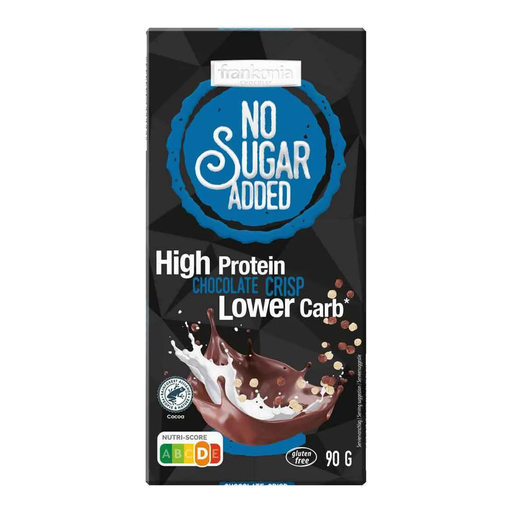
This 90 g bar may suit you if you’d like to portion a larger format yourself. Check the nutritional information per portion and per 100 g separately; ‘no added sugar’ in the original product name doesn’t prove that it’s sugar-free.
 No image available
This pack of six 20 g bars is handy for a small snack with white chocolate flavour on the go. For this variant, check the sugar content per 100 g, ingredients and allergen information rather than assuming that ‘no added sugar’ means ‘sugar-free’.
No. The Annex to Regulation (EC) No 1924/2006 sets the limit for a ‘sugar-free’ claim at no more than 0.5 g of sugar per 100 g or 100 ml. A food with no added sugar may still contain sugar, so for a bar, the key figure is ‘of which sugars’ per 100 g.
The claim ‘no added sugar’ doesn’t tell you whether a bar is suitable as a complete breakfast for your needs. Compare the portion and nutritional information. The German Nutrition Society recommends a varied diet with a range of food groups, including wholegrains, fruit and vegetables.
Some bars sweetened in this way contain sugar alcohols. Verbraucherzentrale notes that consuming large amounts of sugar substitutes can have a laxative effect. So check the ingredients, portion size and warning on the relevant pack.
Not just because it’s labelled vegan. NEOH Peanut Zero, listed as vegan by REWE, is a peanut bar. If you have allergies, check the ingredients and allergen information for the specific product.