For shoppers with a strict sugar-free requirement
The “of which sugars” figure per 100 g is what matters. “No added sugar” and “less sugar” don’t answer your question: the key is the “sugar-free” threshold set out in EU Regulation (EC) No 1924/2006.


If you’re looking for a genuinely sugar-free chocolate breakfast, check the nutrition information first. Under EU Regulation (EC) No 1924/2006, a solid food can contain no more than 0.5 g of sugar per 100 g to be labelled “sugar-free”. Dr. Oetker Vitalis ohne Zuckerzusatz Knusper Schoko, on the other hand, contains 1.3 g per 100 g. A claim such as “30% less sugar” refers to a comparison, not to being sugar-free. So, when choosing a cereal for a weekday breakfast, it’s important to consider which of these criteria matters to you and whether the ingredients and sweeteners suit your needs.
The “of which sugars” figure per 100 g is what matters. “No added sugar” and “less sugar” don’t answer your question: the key is the “sugar-free” threshold set out in EU Regulation (EC) No 1924/2006.
You’d like a chocolatey muesli for breakfast and compare the nutrition information to help you choose. Depending on the product, you could opt for a no-added-sugar variety with sweeteners or one that clearly states its sugar reduction compared with a standard product.
As well as the sugar content, you check the sweeteners and the labelling on the specific pack. For Dr. Oetker Vitalis ohne Zuckerzusatz Knusper Schoko, maltitol and the allergen and may-contain information are particularly relevant.
First, decide whether “sugar-free” is an absolute must for your chocolatey weekday breakfast. If it isn’t, compare the sugar content per 100 g, then check what the product is sweetened with.
| What you’re looking for | What to check when buying | Who it matters to |
|---|---|---|
| Genuinely sugar-free | To be labelled “sugar-free”, a product can contain no more than 0.5 g of sugar per 100 g. Don’t assume this means the same as “no added sugar”. | If sugar-free is a must for me, a claim on the front of the pack isn’t enough. Around 42% of consumers put this criterion first when choosing. |
| Less sugar in breakfast muesli | Compare the sugar content per 100 g. If the label says “less sugar”, check which product it’s being compared with. | For my weekday breakfast, I want to choose a chocolate muesli without mistaking a relative reduction for a sugar-free product. This is the main priority for around 33% of consumers. |
| Sweeteners and allergens | Read the ingredients list, sweetener labelling and allergen and may-contain information on the pack. | If I need to avoid sugar alcohols or check for allergens, the ingredient labelling determines my choice. This is the main thing to check for around 25% of consumers. |
These claims don’t mean the same thing. Dr. Oetker states that Vitalis ohne Zuckerzusatz Knusper Schoko contains 1.3 g of sugar per 100 g – above the 0.5 g per 100 g limit for “sugar-free” under EU Regulation (EC) No 1924/2006.
If being sugar-free is essential, check the “of which sugars” figure per 100 g on the specific pack.
According to the manufacturer, Kölln’s “30% less sugar” claim refers to its standard chocolate muesli. On its own, it doesn’t mean that the oat muesli is sugar-free.
Check the nutrition information and ingredients list as well as the comparison claim.
Dr. Oetker uses maltitol syrup and maltitol in Vitalis ohne Zuckerzusatz Knusper Schoko. The product labelling warns that excessive consumption may have a laxative effect.
For products with no added sugar, check which sweeteners and consumption advice are listed on the pack.
Vitalis ohne Zuckerzusatz Knusper Schoko lists oats and wheat, as well as possible traces of other allergens. A lower sugar content doesn’t replace these checks.
If you have an allergy or intolerance, check the labelling on the pack you’re actually buying.
Vitalis ohne Zuckerzusatz Knusper Schoko is a chocolatey crunchy muesli for anyone looking to avoid added sugar. It is not sugar-free.
Kölln Schoko 30 % weniger Zucker Hafer-Müsli is aimed at shoppers looking for a relative reduction in sugar without sugar alcohols.
Choco Krispies Chocos are included as an example of classic chocolate cereal for comparison, not as a sugar-free option.
These products showcase different chocolate muesli options for weekday breakfasts: a no-added-sugar variety and mueslis with descriptions that suggest a less sweet taste or a relative reduction in sugar. Don’t assume any of these descriptions mean “sugar-free” without checking the nutrition information.
 No image available
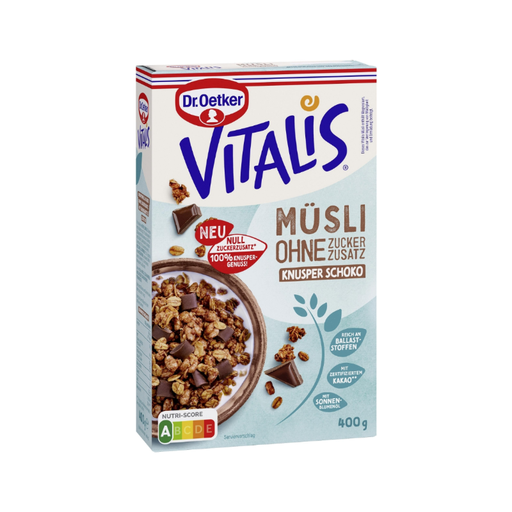
An option if you want to avoid added sugar in a chocolatey crunchy muesli and are happy with maltitol as a sweetener.
Dr. Oetker states that it contains 1.3 g of sugar and 11 g of fibre per 100 g, as well as 51% wholegrain oats. At 1.3 g of sugar per 100 g, it is not “sugar-free”. Check the allergen information and the warning that excessive consumption may have a laxative effect.
 No image available
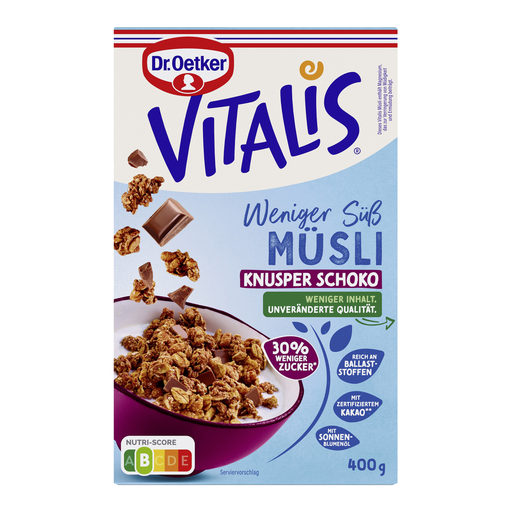
A chocolatey crunchy muesli for shoppers considering a variety described as “Less Sweet”.
The pack contains 400 g. Before choosing, compare the sugar content per 100 g and don’t take “Less Sweet” to mean sugar-free.
 No image available
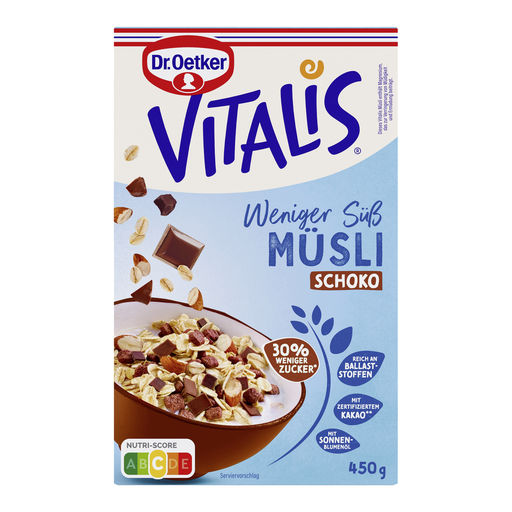
Another chocolate crunchy muesli to compare for weekday breakfasts if you’re looking for a variety described as “Less Sweet”.
This variety comes in a 450 g pack. The nutrition information per 100 g and, where relevant, the product used as the basis for any reduction claim are what matter when comparing sugar content.
 No image available
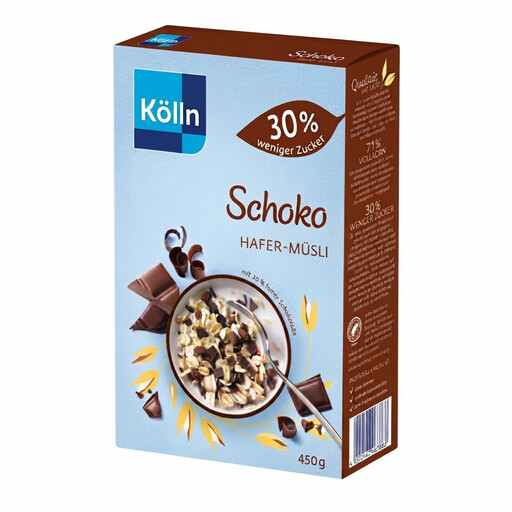
A chocolate oat muesli for shoppers who prefer a relative reduction in sugar without sugar alcohols.
According to Kölln, “30% less sugar” refers to the manufacturer’s standard chocolate muesli. This 450 g variety is not described as sugar-free; check the pack’s nutrition information for a direct comparison.
No. Under EU Regulation (EC) No 1924/2006, solid foods must contain no more than 0.5 g of sugar per 100 g to be labelled “sugar-free”. A food with no added sugar can still contain sugar, so check the “of which sugars” figure in the nutrition information too.
No. Dr. Oetker states that this muesli contains 1.3 g of sugar per 100 g. That’s above the 0.5 g per 100 g limit for the “sugar-free” claim under EU Regulation (EC) No 1924/2006.
Check the ingredients and consumption advice on the specific pack. Dr. Oetker Vitalis ohne Zuckerzusatz Knusper Schoko contains maltitol; the product labelling warns that excessive consumption may have a laxative effect.
Yes. The nutrition information for your chosen addition also counts towards the whole breakfast. The sugar content per 100 g on the muesli pack describes the muesli itself, so compare milk, yoghurt or a plant-based drink using its own nutrition information.