Guests who need a strictly sugar-free option
For this selection, the ‘of which sugars’ figure per 100 g is the deciding factor. A ‘no added sugar’ label is no substitute for checking this figure.


If you specifically need sugar-free chocolate for your garden party, check the ‘of which sugars’ figure: under EU Regulation (EC) No 1924/2006, it must be no more than 0.5 g of sugar per 100 g. The NO SUGAR SUGAR dark chocolate listed by REWE contains exactly 0.5 g; Lindt dark chocolate with no added sugar contains 1 g per 100 g, so it’s a different option. If you’re putting together a selection of snacks to share, check the ingredients, allergen information and sweetener warnings on the specific pack too.
For this selection, the ‘of which sugars’ figure per 100 g is the deciding factor. A ‘no added sugar’ label is no substitute for checking this figure.
You want to offer chocolate labelled accordingly, but don’t require it to meet the sugar-free limit as well. The sugar content of the specific variety still matters when choosing.
If several guests will be sharing the same selection of snacks, keep the ingredients and allergen information for each pack accessible. Sweetener warnings may also matter to individual guests when deciding what to eat.
First, decide whether you need a ‘sugar-free’ option or whether ‘no added sugar’ is enough. Then choose based on the information for the specific variety and your guests’ needs.
| Criterion | What to check when buying | Who it matters to |
|---|---|---|
| Sugar-free limit | For a selection specifically described as sugar-free, check that ‘of which sugars’ is no more than 0.5 g per 100 g, in accordance with EU Regulation (EC) No 1924/2006. | If I want a bar to be specifically sugar-free, I wouldn’t choose it based on the front of the pack alone. This is the main priority for around 42% of consumers. |
| Ingredients and allergens | Sweeteners, warnings about excessive consumption and the allergen information on the specific pack. | When sharing a snack platter, guests should be able to see for themselves which ingredients are relevant to them. Around 25% of consumers prioritise this information. |
| Type of chocolate | Dark or milk chocolate, cocoa content and sugar content for the specific variety. | I want to be able to choose between dark and milky chocolate without labelling both as sugar-free. Around 17% of consumers prioritise finding the right type. |
| Shopping and serving | Check the variety you want is available locally, and keep the packaging to hand when serving so guests can identify it. | For my garden party, I need the right pack in good time and want guests to be able to tell the varieties apart. This is the main concern for around 16% of consumers. |
Under EU Regulation (EC) No 1924/2006, a product can be labelled ‘sugar-free’ if it contains no more than 0.5 g of sugar per 100 g. Lindt Germany states that its dark chocolate with no added sugar contains 1 g of sugar per 100 g, while its milk chocolate version contains 9 g per 100 g.
If you need a strictly sugar-free option, check the ‘of which sugars’ line per 100 g on the pack you choose.
The bars described here, which contain maltitol or erythritol, carry a warning that excessive consumption may have a laxative effect. The type of sweetener used doesn’t tell you whether the chocolate is suitable for each individual.
Keep the packaging information accessible and let guests with specific dietary requirements check the ingredients and decide for themselves.
The information for the varieties covered here mentions possible traces of tree nuts and other potential allergens. A brand name or the description ‘dark chocolate’ is no substitute for this information.
Check the allergen information on the pack you actually bought before serving, and keep the pack available for guests to see.
A variety being listed doesn’t confirm that it’s available in every branch. If you need a particular bar for your garden party, don’t rely on the product description alone to make sure you can get it.
Check the variety you want is available from your chosen branch or in your delivery area well in advance.
The dark chocolate listed by REWE is a dark chocolate bar for a selection where meeting the sugar-free limit is essential.
The dark and milk chocolate bars covered here are options with no added sugar, but they don’t meet the strict sugar-free requirement.
Here, REWE is a retailer providing product information for the bars mentioned, not a chocolate brand or a guarantee that a variety will be available in every branch.
These two bars are options for guests who are happy with chocolate that has no added sugar. They don’t meet the strict sugar-free requirement, for which the limit of 0.5 g of sugar per 100 g remains the deciding factor.
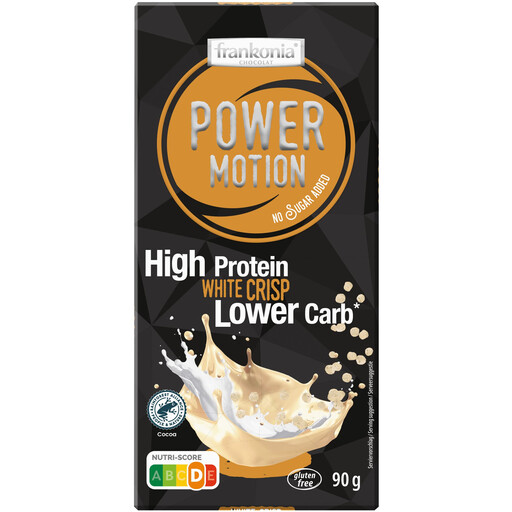 No image available
A separate option if ‘no sugar added’ is enough; this variety isn’t suitable for a selection specifically described as sugar-free.
Before serving, check the sugar content, the maltitol warning and the allergen information on the pack.
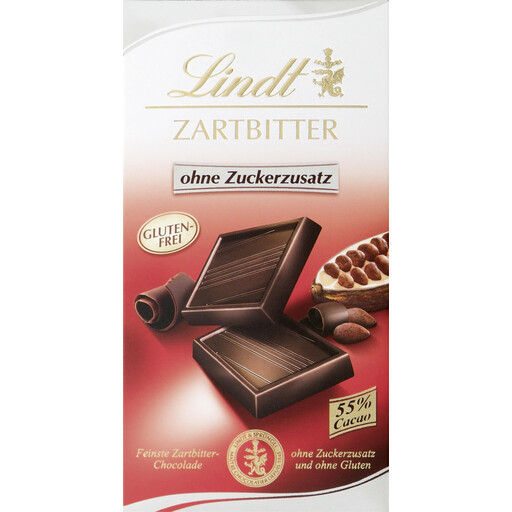 No image available
A dark chocolate option for guests who are happy with ‘no added sugar’, but not for a selection specifically described as sugar-free.
Lindt Germany states that this dark chocolate bar contains at least 55% cocoa and 1 g of sugar per 100 g. It contains maltitol; check the ingredients and allergen information on the pack before serving.
No. Under EU Regulation (EC) No 1924/2006, a food can only be labelled ‘sugar-free’ if it contains no more than 0.5 g of sugar per 100 g. Lindt Germany states that its dark chocolate with no added sugar contains 1 g of sugar per 100 g, and its milk chocolate version contains 9 g per 100 g; neither variety meets the sugar-free limit.
The NO SUGAR SUGAR dark chocolate listed by REWE contains 0.5 g of sugar per 100 g, meeting the upper limit for ‘sugar-free’ set out in EU Regulation (EC) No 1924/2006. When buying, check the nutritional and allergen information on the specific pack.
The bars described here that contain maltitol or erythritol carry a warning that excessive consumption may have a laxative effect. Make the ingredients, warning and allergen information available to guests, rather than assuming a product is suitable for an individual just because it’s labelled ‘sugar-free’ or ‘no added sugar’.