What should you look for when buying?
For a German hotel breakfast buffet, start by deciding how you plan to label your products: ‘sugar-free’, lower total sugar and ‘no added sugar’ are different selection criteria. Then check that the ingredients and packaging information suit the intended use on your buffet.
| What you’re looking for |
What to check when buying |
Who it matters to |
| Sugar-free labelling |
Check the ‘of which sugars’ figure per 100 g and the labelling on the pack. Under EU Regulation (EC) No 1924/2006, products labelled ‘sugar-free’ may contain no more than 0.5 g of sugar per 100 g. |
If I want to offer something explicitly labelled ‘sugar-free’ on my buffet, the label must match the total sugar content. This is a priority for around 36% of consumers. |
| Lower total sugar |
Compare the sugar content per 100 g rather than choosing based only on claims on the front of the pack. |
I’m mainly looking for a muesli with a lower total sugar content for my buffet; it doesn’t need to be labelled sugar-free. This is the main priority for around 36% of consumers. |
| Fruity option with no added sugar |
Check the ‘no added sugar’ claim against the total sugar content, ingredients and allergen information on the specific pack. |
Guests should be able to choose a fruity option with no added sugar, even though dried fruit contains sugar. This is the main priority for around 28% of consumers. |
Crunchy muesli for a sugar-conscious buffet
These Joybuy products are crunchy mueslis for hotels weighing up flavour and pack size alongside how they plan to label their buffet. The claims ‘no added sugar’ and ‘less sugar’ do not mean that a product can be labelled ‘sugar-free’.
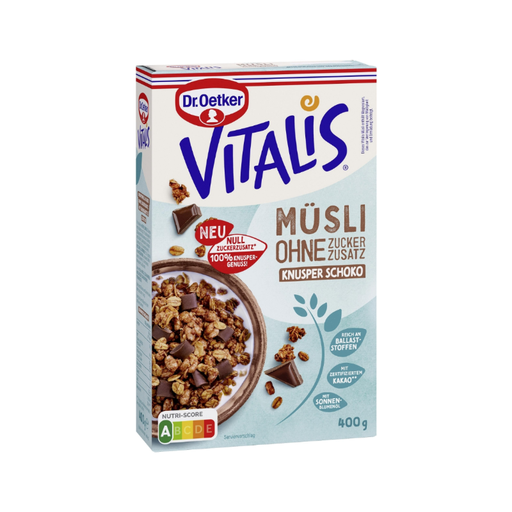 Image unavailable
Dr. Oetker Vitalis No Added Sugar Crunchy Chocolate Muesli, 400 g
A chocolate option for a crunchy muesli buffet. Before labelling it, check the total sugar content and allergen information on the current pack.
The product description warns that excessive consumption of the maltitol it contains may have a laxative effect. Bear this in mind when choosing and serving the product.
View at Joybuy
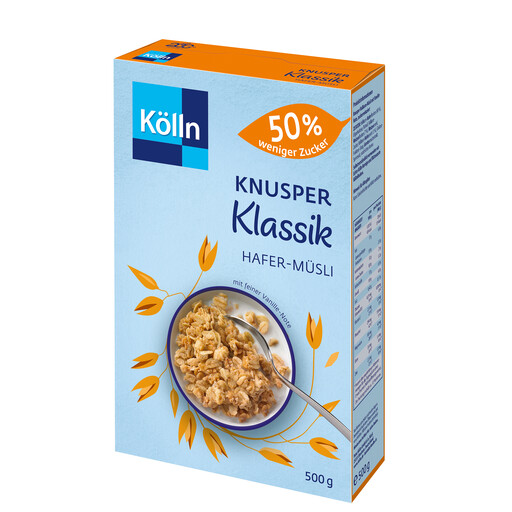 Image unavailable
Kölln Crunchy Oat Muesli 50% Less Sugar, 375 g
A crunchy oat option for buffets where you’re looking for a product with a stated sugar comparison rather than a sugar-free option.
Before labelling it, check what the pack’s comparison refers to, along with the total sugar content and allergen information for the specific product.
View at Joybuy
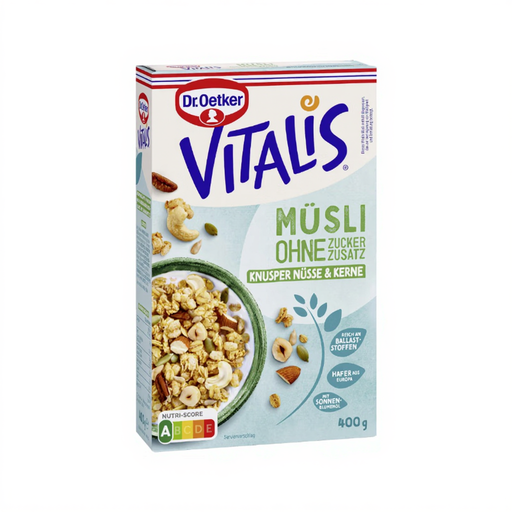 Image unavailable
Dr. Oetker Vitalis No Added Sugar Crunchy Nut Muesli, 400 g
A nutty option for guests looking for crunchy muesli with no added sugar at the buffet. The claim alone does not allow you to label it ‘sugar-free’.
Before serving, check the ingredients and allergen information on the current pack, particularly the details about nuts and possible traces.
View at Joybuy
 Image unavailable
Dr. Oetker Vitalis Less Sweet Pure Crunchy Muesli, 600 g
A crunchy muesli for buffets looking for a variety described as less sweet, rather than one labelled sugar-free.
Before serving, check the total sugar content, ingredients and allergen information on the specific pack.
View at Joybuy
Frequently asked questions
Does ‘no added sugar’ mean ‘sugar-free’ on a hotel breakfast buffet?
No. Under EU Regulation (EC) No 1924/2006, a product can only be labelled ‘sugar-free’ if it contains no more than 0.5 g of sugar per 100 g. A product labelled ‘no added sugar’ may still contain sugar from its ingredients. That’s why both the claim on the pack and the total sugar content matter when labelling your buffet.
Which of the mueslis compared has the lowest stated sugar content?
Of the mueslis compared here, the product information lists the lowest figure for Seitenbacher low-sugar muesli, at 1 g of sugar per 100 g. Service-Bund lists 16.4 g per 100 g for the Brüggen fruit muesli considered here, while EDEKA24 lists 22 g per 100 g for the Kölln variety. The Seitenbacher muesli still does not meet the requirements for a ‘sugar-free’ claim.
How should you label fruity muesli with no added sugar?
Only use the words ‘no added sugar’ if they appear on the pack for the product you’re actually serving. Don’t label it ‘sugar-free’ on that basis alone. According to EDEKA24, the Kölln fruit oat muesli considered here contains 22 g of sugar per 100 g despite this claim.
What allergen information should you check before decanting muesli for the buffet?
Check the ingredients and allergen information on the current pack of the muesli you’re serving, and make sure the information provided at the buffet matches. For the Brüggen product considered here, Service-Bund lists cereals containing gluten and hazelnuts, as well as possible traces of other allergens. For the Kölln variety considered here, EDEKA24 lists possible traces of various nuts and milk.
How should you store opened muesli for the buffet?
Follow the storage instructions on the relevant pack and bear them in mind when decanting the muesli. For the Kölln variety considered here, EDEKA24 recommends storing it in a dry place, away from heat. Instructions may differ for other products.


