Families with a strict sugar limit
If you’re looking for a product that is explicitly sugar-free, check the ‘of which sugars’ figure per 100 g. A ‘no added sugar’ label isn’t enough.


If you want granola or muesli for the family to be genuinely sugar-free, first check the ‘of which sugars’ figure per 100 g: according to Lebensmittelklarheit, a solid food labelled ‘sugar-free’ can contain no more than 0.5 g of sugar per 100 g. ‘No added sugar’ does not automatically meet this requirement, as fruit, for example, can contribute sugars. For a larger pack, the ingredients, allergen information and quantity also need to suit everyone who will be eating it.
If you’re looking for a product that is explicitly sugar-free, check the ‘of which sugars’ figure per 100 g. A ‘no added sugar’ label isn’t enough.
If sugars from grains or fruit are acceptable, the ingredients list and the stated sugar content can help you assess a muesli with no added sugar.
When buying a pack of breakfast cereal to share, consider the ingredients and allergen information as well as the quantity. Not every recipe will suit everyone at the table.
First decide whether you need a ‘sugar-free’ product or whether ‘no added sugar’ meets your needs. Then compare the nutritional information, and only after that check the pack size and ingredients for your family shop.
| Criterion | What to check | Who it matters to |
|---|---|---|
| Sugar-free | Check the ‘of which sugars’ figure per 100 g. Lebensmittelklarheit sets the limit for a ‘sugar-free’ claim at no more than 0.5 g of sugar per 100 g. | If only a sugar-free product will do for family breakfasts, I don’t want to rely on a similar-sounding claim; around 33% of consumers prioritise this limit. |
| Added sugar | Read the ingredients list and compare the sugar content per 100 g, even when the pack says ‘no added sugar’. | Fruit ingredients are fine by me, as long as no sugar has been added; around 27% of consumers care most about this. |
| Pack size | Match the pack weight to the needs of the people who regularly eat it. | When several people have breakfast, I want to choose a quantity that’s easy to use up in everyday life; this is the top priority for around 20% of consumers. |
| Ingredients and allergens | Check the current ingredients and allergen information, as well as any sweeteners included. | A muesli to share needs to suit the household’s preferences and intolerances; around 20% of consumers put this check first. |
Ingredients such as dried fruit can still contain sugar. The Rhineland-Palatinate Rural Area Service Centre points out that fruit muesli with no added sugar can therefore still have a considerable sugar content.
Compare the ‘of which sugars’ figure per 100 g with your requirements, rather than judging by the front of the pack alone.
EDEKA describes its GUT&GÜNSTIG ‘less sweet’ crunchy muesli as containing 30% less sugar than conventional crunchy mueslis. This comparison does not mean the product is sugar-free.
Also check the stated sugar content per 100 g and the ingredients list for the specific product.
A low sugar content doesn’t tell you whether nuts, gluten-containing grains or sweeteners are suitable for everyone who’ll be eating it.
Before buying a pack for the whole household, check the full ingredients and allergen information.
A fruit-free muesli option for households looking for a low stated sugar content.
Muesli options with no added sugar for households happy to include fruit ingredients.
Oat muesli options for households looking to distinguish between fruity recipes and claims about added sugar.
A retailer with a range of muesli and cereal products, whose claims need to be compared individually.
A retailer and own-brand range where you can compare specific crunchy muesli recipes.
A muesli manufacturer that also makes products for retailers, rather than offering one standard recipe for the family shop.
These two Dr. Oetker Vitalis crunchy mueslis may suit households comparing options labelled ‘No Added Sugar’. If you need a product that is legally classed as sugar-free, check the sugar content per 100 g on the current pack for each option.
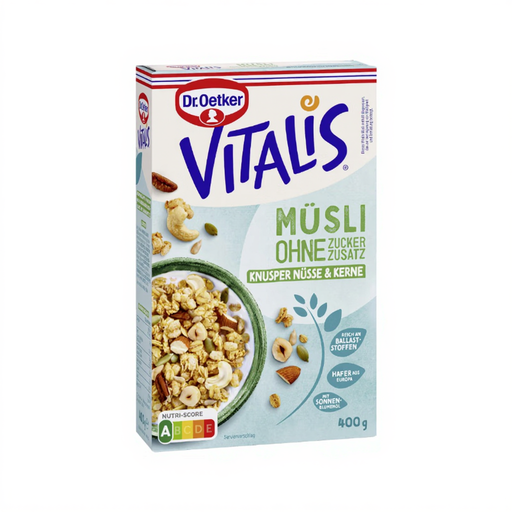 No image available
For households looking for a crunchy muesli labelled ‘No Added Sugar’ in a nut variety. The pack contains 400 g; check the sugar content per 100 g, along with the ingredients and allergen information, before choosing it for several people.
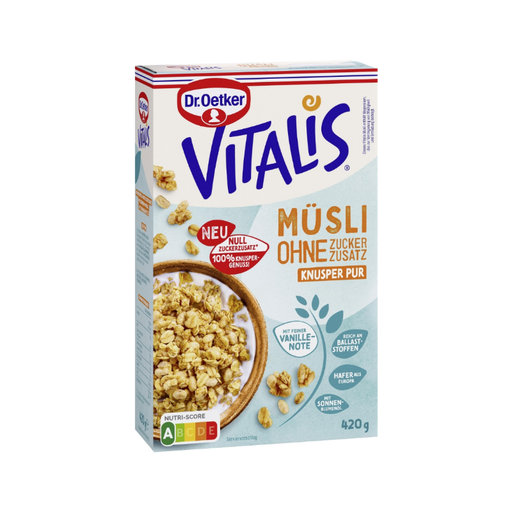 No image available
For households looking to compare a crunchy muesli labelled ‘No Added Sugar’. The pack contains 420 g; use the current nutritional information, ingredients and allergen details to decide whether this option meets your needs.
No. Muesli with no added sugar can still contain sugars from its ingredients, such as fruit. According to Lebensmittelklarheit, a ‘sugar-free’ claim on solid foods, by contrast, means they contain no more than 0.5 g of sugar per 100 g.
Look at the ‘of which sugars’ figure per 100 g in the nutritional information and compare it with the limit of 0.5 g per 100 g set by Lebensmittelklarheit. Also check the ingredients if sweeteners or allergens matter to your household.
Yes. Fruit ingredients can contribute to the total sugar content, even when no sugar has been added. The Rhineland-Palatinate Rural Area Service Centre therefore recommends checking the stated sugar content of these mueslis.
Choose a quantity your household is likely to use up, and check in advance that the ingredients suit everyone who regularly eats it. Follow the storage instructions on the pack.