If you want a clear sugar limit
The sugar figure per 100 g matters more than the wording on the front of the pack. Lebensmittelklarheit distinguishes between “sugar-free”, “low sugar” and “no added sugar”.


If you want to keep sugar to a minimum at the weekend breakfast table, start by comparing the “of which sugars” figures per 100 g on cereal packs. “No added sugar” and “less sugar” don’t answer the same question. Lebensmittelklarheit defines “sugar-free” as no more than 0.5 g of sugar per 100 g, and “low sugar” as no more than 5 g per 100 g for solid foods. What you add to your bowl is a separate consideration.
The sugar figure per 100 g matters more than the wording on the front of the pack. Lebensmittelklarheit distinguishes between “sugar-free”, “low sugar” and “no added sugar”.
You’d like to start with a less sweet base at the weekend, then add your own fruit, yoghurt or nuts. Compare the sugar content of the dry mix and check its ingredients.
Flakes or crunchy muesli could still be right for you, even if they aren’t low in sugar. So a relative claim such as “less sugar” shouldn’t distract you from the nutrition information.
First decide whether you need a “sugar-free” product or are looking for a low-sugar base. Then compare the recipe and ingredients for your breakfast bowl.
| Criterion | What to check | Who it matters to |
|---|---|---|
| Sugar limit | Compare the “of which sugars” figure per 100 g. Lebensmittelklarheit sets a maximum of 0.5 g for “sugar-free” and, for solid foods, a maximum of 5 g for “low sugar”. | I want to stick to a clear limit and not rely on the front of the pack alone; around 38% of consumers put clear sugar information first. |
| A muesli base you can customise | Compare the sugar content of the dry mix and read the ingredients and allergen information, especially for grains and nuts. | At the weekend, I want to choose how much fruit or other ingredients to add, rather than buying a pre-sweetened mix; around 38% of consumers prioritise this freedom to customise. |
| Crunchiness | For “less sugar” claims, check what the comparison is based on and the absolute sugar content per 100 g. | I prefer familiar crunchy muesli or flakes, even if that means accepting a higher sugar content; around 24% of consumers put this preference first. |
A mix can still contain sugar from its ingredients, such as dried fruit, even if no sugar has been added. The two claims don’t mean the same thing.
As well as checking the wording on the pack, look at the “of which sugars” figure per 100 g and the ingredients list.
This kind of claim compares products; on its own, it doesn’t tell you whether the crunchy muesli is low in sugar.
Check what the comparison is based on, then compare the sugar content per 100 g with that of a less sweet base.
Low-sugar muesli may contain gluten-containing grains or nuts. Seitenbacher lists spelt, barley malt and almonds among the ingredients in its “Müsli zuckerarm”.
If you need to avoid certain ingredients, check the current ingredients and allergen information on the specific pack.
If you’re looking for a less sweet muesli base, the specific varieties “Müsli zuckerarm” and “Spezial-Müsli 2 – zuckerarm” are worth considering. Seitenbacher lists 1 g of sugar per 100 g for each.
Kellogg's may suit consumers who want to compare crunchy granola with a relative sugar claim.
Nestlé Cereals offers a range of cereal lines, including Cornflakes and Cini Minis. You’ll need to check the specific variety to assess its sugar content.
Cini Minis is a Nestlé Cereals brand and a point of comparison for consumers looking for flavour-led cereals.
These cornflakes and mueslis offer different starting points for your weekend bowl: a variety labelled unsweetened, a crunchy muesli labelled “No Added Sugar” and a “Less Sweet” option. To check whether a particular pack meets your preferred sugar limit, look at the nutrition information per 100 g.
 Image unavailable
A cornflakes base for adding your own toppings. “Unsweetened” doesn’t mean “sugar-free”, so if you want to stick to a clear sugar limit, check the “of which sugars” figure per 100 g on the pack.
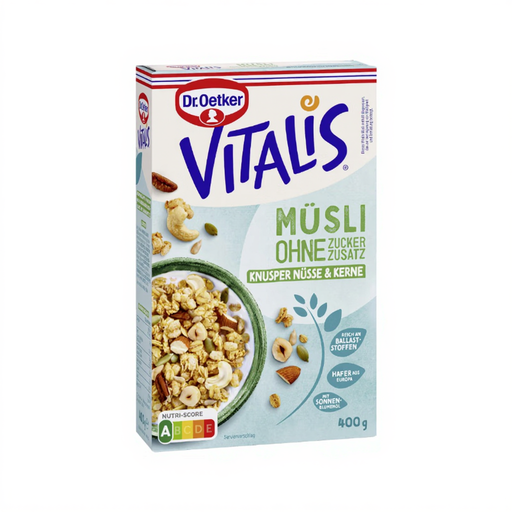 Image unavailable
A crunchy muesli with nuts and the product claim “No Added Sugar”. This claim doesn’t set a maximum sugar content, so compare the “of which sugars” figure per 100 g and check the allergen information on the pack.
 Image unavailable
A crunchy muesli option if you value this texture more than a guarantee of a specific sugar limit. “Less Sweet” doesn’t indicate a particular sugar content, so check the “of which sugars” figure per 100 g before classifying it as low sugar.
No. “No added sugar” doesn’t rule out sugars that occur naturally in ingredients. Lebensmittelklarheit defines “sugar-free” as no more than 0.5 g of sugar per 100 g, so always check the nutrition information on cereal packs too.
Lebensmittelklarheit sets a maximum of 5 g of sugar per 100 g for “low sugar” claims on solid foods. Compare the “of which sugars” figures on the packs, rather than relying on serving information or claims on the front alone.
No. Seitenbacher lists 1 g of sugar per 100 g for both “Müsli zuckerarm” and “Spezial-Müsli 2 – zuckerarm”. That’s below the “low sugar” limit set by Lebensmittelklarheit, but above its “sugar-free” limit.
If you need to avoid certain grains or nuts, check the ingredients and allergen information on the specific pack. Seitenbacher lists spelt, barley malt and almonds in its “Müsli zuckerarm”; a low sugar content doesn’t tell you anything about these ingredients.