Households with a strict sugar limit
If ‘sugar-free’ is a must, compare the ‘of which sugars’ value per 100 g. Under the Annex to EU Regulation (EC) No 1924/2006, a product can only be labelled this way if it contains no more than 0.5 g per 100 g.


If you specifically need sugar-free muesli, check the sugar content rather than relying on the words ‘no added sugar’ alone. Under the Annex to EU Regulation (EC) No 1924/2006, a product can only be labelled ‘sugar-free’ if it contains no more than 0.5 g of sugar per 100 g. Seitenbacher’s Müsli zuckerarm contains 1 g, which is above this limit; Kölln Früchte Hafer-Müsli ohne Zuckerzusatz, listed by REWE, contains 22 g of sugar per 100 g. So, if you have a larger household, first check the sugar content and ingredients against your requirements, then consider pack size and storage.
If ‘sugar-free’ is a must, compare the ‘of which sugars’ value per 100 g. Under the Annex to EU Regulation (EC) No 1924/2006, a product can only be labelled this way if it contains no more than 0.5 g per 100 g.
A larger pack may suit regular consumption if you’re happy with sugar from fruit ingredients. REWE lists Kölln Früchte Hafer-Müsli ohne Zuckerzusatz in a 1.7 kg pack with 42 stated portions; it contains 22 g of sugar per 100 g.
With crunchy recipes, it’s worth checking sweeteners, oils and allergen information as well as the sugar content. According to the product information, the Dr. Oetker Vitalis Knusper Pur ohne Zuckerzusatz listed by REWE contains a sweetener.
First, decide whether your family’s breakfast cupboard needs to meet a strict sugar limit or whether fruit sweetness is acceptable. You can then compare ingredients and pack sizes to suit how much you get through.
| Criteria | What to check | Who it matters most to |
|---|---|---|
| Strict sugar limit | Check the ‘of which sugars’ value per 100 g. Under EU Regulation (EC) No 1924/2006, a product can only be labelled ‘sugar-free’ if it contains no more than 0.5 g per 100 g. | If the only option for our family is muesli that is explicitly sugar-free, ‘no added sugar’ on the front isn’t enough for me. Around 31% of consumers put this strict sugar limit first. |
| Pack size | Compare the net weight and stated number of portions with how much you actually eat; check the storage instructions for larger packs. | For lots of breakfasts, I want to buy an amount we can get through regularly. This is a priority for around 25% of consumers. |
| Fruit with no added sugar | Read the ‘no added sugar’ claim alongside the sugar content and ingredients list. REWE states that Kölln Früchte Hafer-Müsli contains 22 g of sugar per 100 g. | If fruit flavour matters more to us than a strict sugar limit, we’re happy with sugar from the ingredients. Around 25% of consumers prioritise this preference for fruit muesli with no added sugar. |
| Ingredients and texture | Check the allergen information and ingredients list for the specific variety, including the sweeteners used in crunchy muesli. | Before I buy a supply for several people, the recipe needs to suit their ingredient requirements and texture preferences. This is a priority for around 19% of consumers. |
Muesli with no added sugar can still contain sugar from its ingredients. REWE states that Kölln Früchte Hafer-Müsli contains 22 g of sugar per 100 g.
If you have a strict requirement, check the ‘of which sugars’ value. Under EU Regulation (EC) No 1924/2006, a product can only be labelled ‘sugar-free’ if it contains no more than 0.5 g per 100 g.
According to REWE, the 1.7 kg pack of Kölln Früchte Hafer-Müsli contains 42 portions, but also 22 g of sugar per 100 g. The pack size doesn’t change whether the mix meets your preferred sugar limit.
Compare the sugar content and ingredients first, then choose a pack size that suits your household’s consumption. Once opened, follow the storage instructions on the pack.
Seitenbacher’s Müsli zuckerarm contains almonds and several types of grain. The Dr. Oetker Vitalis Knusper Pur ohne Zuckerzusatz listed by REWE contains a sweetener.
Before buying a supply, check the ingredients, highlighted allergens and any ‘may contain’ warnings on the specific pack for everyone in your household.
Fruity oat mueslis with no added sugar, including a 1.7 kg pack listed by REWE.
Müsli zuckerarm is a mix without fruit.
The brand makes a range of muesli recipes, including basic and Bircher muesli.
The Swiss muesli brand has a product category called ‘Lower Sugar’.
The retailer provides product information for different types of muesli and pack sizes.
Brüggen makes muesli for retailer own brands and bespoke product ranges, among other things.
These two crunchy mueslis are options for households considering a variety with no added sugar. Whether a pack meets a strict sugar limit and suits your household’s consumption depends on the nutritional information and ingredients for the specific variety.
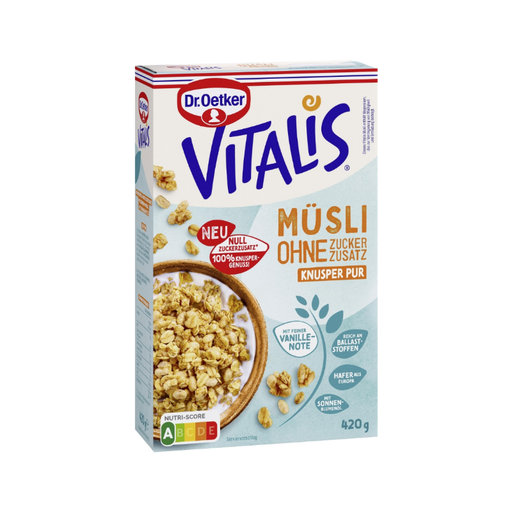 Image unavailable
An option if you’re looking for crunchy muesli with no added sugar. Before buying, compare the sugar content per 100 g and check which sweetener is used in the ingredients list for the specific pack.
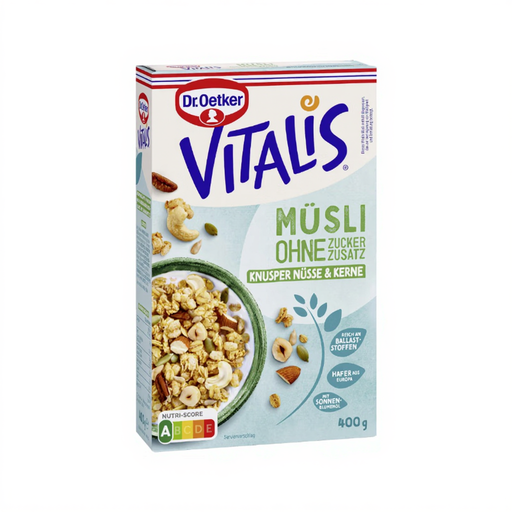 Image unavailable
An option for households looking for crunchy muesli with nuts and no added sugar. Check the allergen information for everyone who’ll be eating it, as well as the sugar content of the specific pack. ‘No added sugar’ doesn’t mean ‘sugar-free’.
No, the terms don’t mean the same thing. Under the Annex to EU Regulation (EC) No 1924/2006, a product can only be labelled ‘sugar-free’ if it contains no more than 0.5 g of sugar per 100 g. Muesli with no added sugar can still contain sugar from its ingredients.
According to Seitenbacher, the muesli contains 1 g of sugar per 100 g. That means it doesn’t meet the ‘sugar-free’ limit of no more than 0.5 g per 100 g under EU Regulation (EC) No 1924/2006. Also check the ingredients, particularly if almonds or certain types of grain are relevant to your household.
For sugar content, first compare the ‘of which sugars’ value per 100 g, then read the ingredients and allergen information. If you have a larger household, the net weight, any stated portion count and storage instructions can also help you choose the right pack.
Not simply because it’s a large pack or labelled ‘no added sugar’. REWE states that the 1.7 kg pack of Kölln Früchte Hafer-Müsli ohne Zuckerzusatz contains 22 g of sugar per 100 g. If you need to stick to a specific limit, check this figure before choosing a larger pack.