For those who need strictly sugar-free muesli
The total sugar per 100 g is what matters. A label such as ‘no added sugar’ is no substitute for checking the nutrition information.


If you’re looking for genuinely sugar-free muesli to take with you, check the ‘of which sugars’ figure per 100 g. The Verbraucherzentrale defines ‘sugar-free’ as no more than 0.5 g of sugar per 100 g; ‘no added sugar’ does not meet this requirement on its own. A fruit-free mix with a low sugar value may be a better choice if you don’t need to meet that limit. For fruity muesli, compare the total sugar as well as the preparation instructions and allergen information.
The total sugar per 100 g is what matters. A label such as ‘no added sugar’ is no substitute for checking the nutrition information.
You want to portion out muesli to take with you or to the office, and are happy with a low sugar value even if the mix isn’t sugar-free. Whether you want to eat it dry is also part of your decision.
You prefer a fruity taste without added sugar, while bearing in mind that dried fruit contributes to the total sugar shown.
First, decide whether ‘sugar-free’ is essential or whether a lower sugar value is enough for you. Then consider the fruit ingredients and how you want to prepare your muesli to see which options are easy to take with you in the morning.
| What you’re looking for | What to check | Who it matters to |
|---|---|---|
| Genuinely sugar-free | Check the ‘of which sugars’ figure per 100 g and whether the product is labelled ‘sugar-free’. The Verbraucherzentrale sets the limit at no more than 0.5 g of sugar per 100 g. | I only want to choose muesli whose total sugar meets the ‘sugar-free’ limit; around 50% of consumers put this requirement first. |
| Low sugar value and easy to take with you | Check the sugar value per 100 g and the ingredients for dried fruit. If you plan to eat it dry, check the preparation instructions. | When setting off early, I want a portionable mix with a low sugar value, without needing it to be labelled sugar-free. This is the main priority for around 30% of consumers. |
| Fruity flavour with no added sugar | Compare the total sugar, fruit ingredients and allergen information on the specific pack. | Fruity flavour matters more to me than a very low total sugar value; around 20% of consumers put this first. |
Muesli with no added sugar can still contain sugar from its ingredients. Kölln lists 22 g of sugar per 100 g for its fruit muesli with no added sugar.
If you need a sugar-free option, check the product description and total sugar per 100 g rather than relying on the front of the pack.
Total sugar varies between fruity mixes: familia lists 12 g per 100 g for Original Swiss Müesli No Added Sugar, while Kölln lists 22 g per 100 g for its fruit muesli with no added sugar.
If sugar content is what matters most to you, compare the nutrition information for fruity mixes with that of a fruit-free base.
Bircher muesli may not be ready to eat straight away in the way you’d like to take it with you. Alnatura recommends mixing its Bircher muesli with milk or yoghurt and leaving it to soak for ten minutes.
Before buying, check whether you want to eat your muesli dry or have time and liquid to prepare it.
Even mixes with a low sugar value can contain allergens. REWE lists sesame in its Bio 5-Korn-Müsli and possible traces of, among other things, soya, nuts and milk products.
If you have an allergy or coeliac disease, the ingredients list and allergen information on the specific pack are essential.
Kölln offers a fruit and oat muesli with no added sugar, which is worth considering if you’re choosing a fruity mix.
The Seitenbacher mixes considered here offer a useful guide to choosing by sugar value and how you plan to eat your muesli.
Bio 5-Korn-Müsli is a base mix without dried fruit, so you can choose what else to add.
Original Swiss Müesli No Added Sugar is a mix of grains, fruit and nuts with no added sugar.
Bircher muesli is intended to be prepared as a breakfast, so don’t choose it based solely on whether it can be taken with you dry.
This muesli may suit anyone looking for a crunchy nut mix with no added sugar. To find out whether it’s genuinely sugar-free and how you can eat it while out and about, check the information on the specific pack.
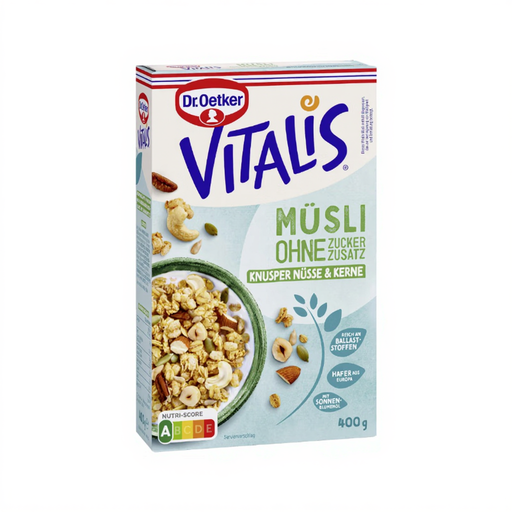 No image available
If you’re choosing a crunchy nut mix with no added sugar, compare the total sugar per 100 g if you need sugar-free muesli. Also check the ingredients, allergen information and preparation instructions if you plan to eat it dry while out and about.
No. According to the Verbraucherzentrale, ‘sugar-free’ means no more than 0.5 g of sugar per 100 g. Muesli with no added sugar can still contain sugar from ingredients such as dried fruit, so check the ‘of which sugars’ figure in the nutrition information.
Compare the ‘of which sugars’ figure per 100 g and check the ingredients. REWE lists 0.9 g of sugar per 100 g for its Bio 5-Korn-Müsli, while Seitenbacher lists 1 g per 100 g for Müsli zuckerarm. Both figures are above the ‘sugar-free’ limit given by the Verbraucherzentrale.
Decide whether it’s right for your chosen mix by checking the serving and preparation instructions. Seitenbacher also describes Spezial-Müsli 2 as a snack to eat on its own, while Alnatura recommends mixing its Bircher muesli with milk or yoghurt and leaving it to soak for ten minutes.
Always check the ingredients list and allergen information for the specific muesli. For example, REWE lists sesame in its Bio 5-Korn-Müsli, as well as possible traces of, among other things, soya, nuts and milk products. You can’t assume the same applies to other mixes.