People with a strict sugar limit
For them, the total sugar per 100 g matters, not just whether sugar has been added. So it’s important to check that the labelling and nutrition information match.


If you’re specifically looking for sugar-free porridge that’s easy to chew, check the nutrition information: according to Lebensmittelklarheit, “sugar-free” means no more than 0.5 g of sugar per 100 g; “no added sugar” does not automatically meet this requirement. The texture also depends on the type of flakes, any chunky ingredients and the soaking time. If you’ve been advised to follow a particular diet for chewing or swallowing, consult a healthcare professional to establish the right consistency for you.
For them, the total sugar per 100 g matters, not just whether sugar has been added. So it’s important to check that the labelling and nutrition information match.
They want to make porridge that takes little effort to chew, so pay particular attention to the type of flakes, soaking time and ingredients such as nuts, seeds or larger pieces of fruit.
They prefer to choose the liquid and other ingredients themselves. They also check whether the specific mix contains anything relevant to their dietary needs.
First, work out whether you need to stay below a limit for total sugar or simply want to avoid added sugar. Then check whether you can prepare the specific mix to get the texture you want.
| Criteria | What to check when buying | Who it matters to |
|---|---|---|
| Total sugar | Compare the “of which sugars” figure per 100 g with your preferred limit. Don’t treat “no added sugar” as the same as “sugar-free”. | If I need to stay below a strict limit for total sugar, a list of ingredients with no added sugar isn’t enough. Around 42% of consumers prioritise this distinction. |
| Ease of chewing | Check the type of flakes, any chunky ingredients and the preparation instructions, including soaking time. | If I want a meal that takes little effort to chew, I don’t want any unexpectedly firm pieces in my prepared porridge. A soft texture is the top priority for around 33% of consumers. |
| Ingredients you can customise | Read the ingredients list and allergen information for the specific variety, then choose a suitable liquid and other ingredients. | If I want to choose the taste and texture myself, I need a base with ingredients that suit my needs. Around 25% of consumers focus mainly on this. |
Naturally occurring sugars are still included in the total sugar figure. According to Lebensmittelklarheit, a product labelled “sugar-free” may contain no more than 0.5 g of sugar per 100 g.
Compare the “of which sugars” figure with your requirements, and check the ingredients list too.
The texture of the flakes doesn’t tell you everything about the mix: according to Kölln, its Hafer-Porridge Nuss also contains chopped hazelnuts.
If you want porridge that takes as little effort to chew as possible, check the ingredients for nuts, seeds and larger pieces of fruit.
The specific variety may contain other ingredients; Kölln Hafer-Porridge Nuss, for example, lists hazelnuts. The German Coeliac Society also points out that ordinary oats may contain gluten.
Check the allergen information on every pack. If you need to follow a gluten-free diet for medical reasons, check the labelling on the specific product.
The information below relates to the products and preparation methods described, not every porridge made by each brand.
Kölln offers porridge mixes with different ingredients and types of flakes.
Seitenbacher provides porridge recipes and offers oats as a simple base.
Alnatura describes its Kinder-Porridge Hafer-Banane, for children aged 1 and over, as soft and easy to chew.
These fine oat products could work as a base for homemade porridge if you want to adjust the liquid and soaking time to get the consistency you’re after. If you have a strict sugar limit, always check the figure per 100 g on the pack. These products are not described here as “sugar-free”.
 No image available
For homemade porridge where you can adjust the consistency by changing the amount of liquid and the soaking time. If you have a strict sugar limit, compare the nutrition information per 100 g on the pack.
 No image available
A suitable base for porridge if you want to choose the other ingredients yourself. Preparation and allowing enough time to soak are important for achieving the texture you want; check the sugar figure per 100 g too.
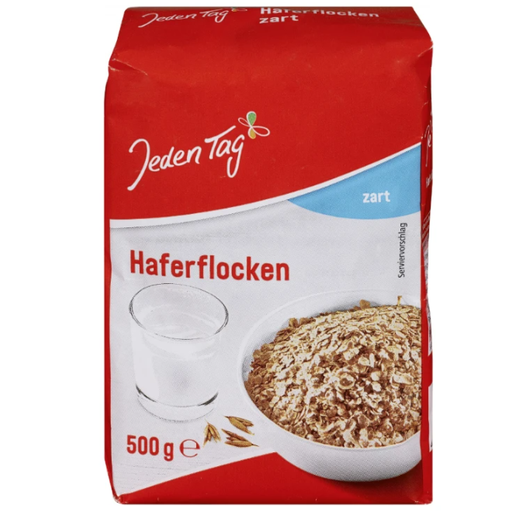 No image available
Designed as an oat base for homemade porridge. If the texture is particularly important to you, check before buying whether the specific product is made from flakes or oat flour. Check the sugar figure per 100 g too.
No. According to Lebensmittelklarheit, a food described as “sugar-free” must contain no more than 0.5 g of sugar per 100 g. A product with “no added sugar” may still contain naturally occurring sugars. If total sugar is what matters to you, compare the nutrition information per 100 g.
Check the type of flakes, the soaking time and whether there are any chunky ingredients. Nuts, seeds or larger pieces of dried fruit can take more effort to chew, even in an otherwise creamy mix. Try a small portion to see what consistency you get when you prepare it as directed.
Yes, as long as the product’s preparation instructions allow for water. Kölln lists water as a possible liquid, while Seitenbacher describes porridge made with water as less creamy and less pronounced in flavour.
No. The German Coeliac Society points out that ordinary oats may contain gluten. If you need to follow a gluten-free diet for medical reasons, check the labelling on the specific product rather than relying on the word “oat” alone.