Consumers with a strict sugar target
You want to find chocolate that can genuinely be classed as ‘sugar-free’. Compare the sugar content per 100 g with the limit set out in the EU regulation, rather than relying on the front of the pack alone.


If the total sugar content is your main consideration when choosing chocolate to enjoy with coffee, check the nutritional information per 100 g. Under the EU regulation published on EUR-Lex, solid chocolate can only be labelled ‘sugar-free’ if it contains no more than 0.5 g of sugar per 100 g. A milk chocolate bar labelled ‘no added sugar’ can still contain sugar. For cakes, look for chocolate that is specifically described as suitable for the way you plan to use it, and remember that the other recipe ingredients matter too.
You want to find chocolate that can genuinely be classed as ‘sugar-free’. Compare the sugar content per 100 g with the limit set out in the EU regulation, rather than relying on the front of the pack alone.
You want to enjoy a sweet milk chocolate bar with your coffee. For the varieties described by Lindt and Frankonia, maltitol, the stated sugar content and any information about tolerance all factor into your choice.
You need chocolate for a cake, icing or dessert, so you check how the manufacturer says it can be used. Whether the finished recipe contains added sugar also depends on the other ingredients.
First, decide whether ‘sugar-free’ is a firm requirement for you. Then choose between a bar to enjoy with coffee and chocolate for baking. Check the ingredients and serving size for the specific variety you’re considering.
| Criterion | What to check | Who it matters most to |
|---|---|---|
| Sugar labelling | Compare the sugar content per 100 g with the claim you’re looking for. For solid chocolate to be labelled ‘sugar-free’, the EU regulation published on EUR-Lex sets a limit of 0.5 g per 100 g. | When I’m looking for a sugar-free bar, ‘no added sugar’ on the pack isn’t enough for me. Around 33% of consumers prioritise a verifiable sugar limit. |
| Milk chocolate to enjoy with coffee | Check the sugar content and sweeteners in the specific variety. Lindt states that its milk chocolate bar with no added sugar contains 9.0 g of sugar per 100 g, while Frankonia gives 11 g per 100 g for its milk chocolate variety. | I want a milk chocolate bar with my coffee, even if ‘no added sugar’ doesn’t mean ‘sugar-free’. Around 27% of consumers put this preference first. |
| Ingredients and tolerance | Read the information about sweeteners, allergens and warnings for your chosen variety. According to Verbraucherzentrale, consuming large amounts of sugar substitutes can have a laxative effect. | Before serving chocolate and cake, I want to know which ingredients and warnings are relevant to me or my guests. For around 20% of consumers, this is their main buying consideration. |
| Using chocolate in cakes | Check the uses described and the pack size. Callebaut says MALCHOC-D can be melted and tempered, among other uses, and comes in 1 kg and 5 kg packs. | When I bake, I need chocolate that’s suitable for my recipe, and I need to be able to use the whole pack. Around 20% of consumers put this use first. |
The two claims don’t mean the same thing. Under the EU regulation published on EUR-Lex, solid chocolate labelled ‘sugar-free’ must contain no more than 0.5 g of sugar per 100 g. According to their manufacturers, Lindt and Frankonia’s milk chocolate bars with no added sugar contain 9.0 g and 11 g of sugar per 100 g respectively.
Check the nutritional information per 100 g if the total sugar content is what matters most to you.
According to Verbraucherzentrale, consuming large amounts of sugar substitutes can have a laxative effect. The milk chocolate bars with maltitol described here carry a warning about excessive consumption, according to their manufacturers.
Check which sweetener is used and read the warning on the pack before deciding on a serving size.
Using chocolate with no added sugar doesn’t make a cake sugar-free if the batter, filling or decoration contains sugar, for example. When melting or tempering chocolate, you should also follow the uses described for the specific product.
Check the whole recipe and choose a pack size to suit.
If you only bake occasionally, you could have a lot left over from a 1 kg or 5 kg pack.
Ingredients and ‘may contain’ statements vary between products. For the milk chocolate varieties described, Lindt and Frankonia list milk and soya, among other ingredients; other information is specific to each product.
Check the ingredients and allergen information on the pack of the variety you’re planning to buy.
Lindt offers both a milk chocolate bar with no added sugar and EXCELLENCE Cacao Pur, which is made without added refined sugar. Neither claim means the chocolate is ‘sugar-free’.
Frankonia offers milk chocolate with no added sugar, made with maltitol and inulin.
Callebaut describes MALCHOC-D as dark chocolate with no added sugar, made with maltitol for baking and desserts.
If you’re looking for a dark chocolate bar with no added sugar to enjoy with coffee, you can check the sugar content and ingredients of the following variety. For a baking recipe, the product’s instructions for use are important too.
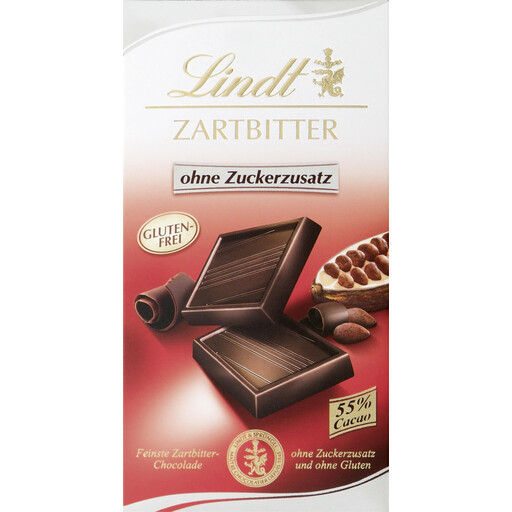 No image available
This dark chocolate bar could suit you if you’re looking for chocolate with no added sugar to enjoy with coffee, but don’t require it to be labelled sugar-free.
This specific variety is listed as containing maltitol and 1.0 g of sugar per 100 g. That’s above the limit for the ‘sugar-free’ claim set out for solid chocolate in the EU regulation published on EUR-Lex.
Milk and soya are listed, and traces of hazelnuts, almonds and other nuts may be present. Check the allergen information on the pack.
No. Under the EU regulation published on EUR-Lex, solid chocolate can only be labelled ‘sugar-free’ if it contains no more than 0.5 g of sugar per 100 g. ‘No added sugar’ means that no sugar has been added, but it doesn’t mean the product contains no sugar or sweeteners. Lebensmittelklarheit also points this out.
The claim ‘no added sugar’ doesn’t set a limit on the total sugar content. Lindt states that its milk chocolate bar with maltitol contains 9.0 g of sugar per 100 g. So, if total sugar is an important factor in your choice, check the nutritional information.
Check the ingredients, serving size and warning on the specific pack. According to Verbraucherzentrale, consuming large amounts of sugar substitutes can have a laxative effect. Lindt and Frankonia both include a warning about excessive consumption on the maltitol milk chocolate bars described here.
For melting or tempering, choose chocolate that the manufacturer specifically says is suitable for that use. Callebaut lists these uses for MALCHOC-D. Also check how much you need, which pack sizes are available and whether the other recipe ingredients contain sources of sugar.