For shoppers with a strict sugar-free requirement
If you plan to eat a wafer on your commute or during your first break, check the sugar content per 100 g. The words ‘no added sugar’ alone are not enough to meet this requirement.


If you want your wafer to be genuinely sugar-free, start by checking the ‘of which sugars’ figure in the nutrition information: Lebensmittelklarheit sets the limit at no more than 0.5 g per 100 g. ‘No added sugar’ does not mean the same thing. For a breakfast you can take with you, also consider portion packaging, ingredients, allergens and any warnings about sugar substitutes.
If you plan to eat a wafer on your commute or during your first break, check the sugar content per 100 g. The words ‘no added sugar’ alone are not enough to meet this requirement.
Wafers labelled ‘no added sugar’ may suit you, even if they contain naturally occurring sugars. Compare the ingredients and nutrition information for the specific variety.
For a quick grab-and-go snack, check the ingredients list, allergen information and any warnings about sugar substitutes, as well as the packaging. Always rely on the information on the pack you choose.
First decide whether ‘sugar-free’ is a firm requirement or whether ‘no added sugar’ is enough for you. Then check which portion you can take with you without any preparation, and what it contains.
| Criteria | What to check | Who it matters to |
|---|---|---|
| Sugar-free or no added sugar | Check the ‘of which sugars’ figure per 100 g. Lebensmittelklarheit sets the limit for ‘sugar-free’ at no more than 0.5 g per 100 g; ‘no added sugar’ describes a different attribute. | If I’m only considering wafers that are genuinely sugar-free, ‘no added sugar’ isn’t enough for me. For around 46% of shoppers, this sugar figure is the main reason for their choice. |
| Ready to take with you | Check the portion size, individual wrapping, and the storage and shelf-life information for the pack on offer. | On my way to work, I want to take a ready-to-eat portion with me rather than prepare wafers in the morning. Around 27% of shoppers make this their main priority. |
| Ingredients and suitability | Read the ingredients list, allergen information and any warnings about sugar substitutes on the specific pack. | If I need to avoid certain ingredients or keep an eye on sugar substitutes, the labelling on the pack determines what I choose. For around 27% of shoppers, this check is a priority. |
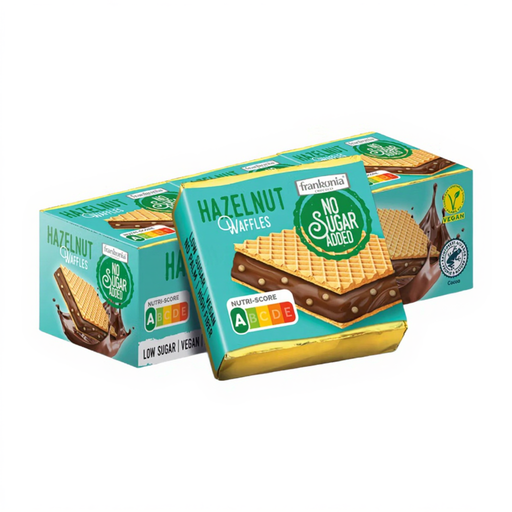
A wafer with no added sugar may still contain sugar. Frankonia lists 3.0 g of sugar per 100 g for its Hazelnut Crisp Waffles.
If ‘sugar-free’ is a requirement, compare the ‘of which sugars’ figure per 100 g with the 0.5 g limit set by Lebensmittelklarheit.
The Verbraucherzentrale (Consumer Advice Centre) notes that sugar substitutes can have a laxative effect when consumed in large quantities. The Gullón and Frankonia wafers described here carry warnings about excessive consumption.
Read the ingredients list and warnings on the relevant pack before choosing a portion to take with you.
The wafer varieties described may contain ingredients such as wheat, soya or nuts. A statement about sugar is no substitute for allergen information.
If you need to avoid certain ingredients, always check the specific variety and the information on its pack.
According to the nutrition information listed by EDEKA24, Lotus Biscoff caramel biscuits contain 38.1 g of sugar per 100 g. They are neither sugar-free wafers nor a substitute for checking the sugar content.
Don’t rely on the product category shown in a search result alone; check the product type and nutrition information.
The chocolate wafer described by Shop Apotheke is aimed at shoppers looking for a clearly labelled sugar-free portion in individual wrapping.
Frankonia’s Hazelnut Crisp Waffles may suit shoppers who are happy with ‘no added sugar’, but not those looking for a sugar content of no more than 0.5 g per 100 g.
NEOH offers wafers labelled ‘ZERO Added Sugar’ for an on-the-go snack.
NICK'S offers chocolate and protein wafers labelled ‘no added sugar’.
These hazelnut wafers may suit you if you’re looking for a no-added-sugar snack to take with you. If you need a strictly sugar-free wafer, also check the sugar content on the pack on offer.
 No image available
A handy option if you’re looking for wafers with no added sugar, but don’t assume they’re sugar-free based on this claim alone.
Check the sugar content, ingredients and allergens for the pack on offer, and whether the wafers are individually wrapped.
The terms describe different attributes: Lebensmittelklarheit sets the limit for ‘sugar-free’ at no more than 0.5 g of sugar per 100 g, while ‘no added sugar’ refers to added sugars and other sweetening ingredients. According to the Verbraucherzentrale (Consumer Advice Centre), a wafer with this label may still contain naturally occurring sugars, so check the ‘of which sugars’ figure.
Check the ‘of which sugars’ figure per 100 g for the specific wafer. Lebensmittelklarheit sets the limit for the ‘sugar-free’ claim at 0.5 g per 100 g. Also read the ingredients, allergen information and any details about sweeteners.
The Verbraucherzentrale (Consumer Advice Centre) says that sugar substitutes can have a laxative effect when consumed in large quantities. The Gullón and Frankonia products described carry relevant warnings; check the information on the pack before buying.
No. The Lotus Biscoff product listed by EDEKA24 is a caramel biscuit and, according to its nutrition information, contains 38.1 g of sugar per 100 g. It therefore isn’t suitable if you’re looking for sugar-free wafers.