If the wafers in your office biscuit tin need to be explicitly sugar-free, look for no more than 0.5 g of sugar per 100 g. “No added sugar” does not automatically meet this requirement. For a shared tin, portion size, allergens, sweeteners and any warning labels also matter. A low sugar content alone tells you nothing about these other aspects.
Who is this guide for?
People looking for strictly sugar-free options
If you want your office biscuit tin to contain only explicitly sugar-free wafers, the “of which sugars” figure per 100 g is key. Lebensmittelklarheit sets the threshold for labelling a food “sugar-free” at 0.5 g of sugar per 100 g.
Teams with different dietary requirements
If you’re providing wafers for several people, check allergens and dietary requirements separately from the sugar content. A sugar-free recipe is not automatically gluten-free or vegan.
People stocking the biscuit tin
For a shared tin, handy portion sizes and easy-to-access ingredient and allergen information are important. Individually wrapped portions can make it easier to take wafers separately, but they also mean more packaging.
What should you look for when buying?
First, decide whether “sugar-free” is a firm requirement. Then check the features that matter to the people sharing the biscuit tin and how they’ll use it.
| Criterion | What to check | Who is it important for? |
|---|
| Sugar content |
For “sugar-free”, check the “of which sugars” figure per 100 g: it must be no more than 0.5 g. “No added sugar” means something different. |
If I want to stock the tin specifically with sugar-free wafers, the actual sugar content matters more than other features. Around 36% of consumers put this criterion first. |
| Allergens and sweeteners |
Check the ingredients, highlighted allergens, may-contain warnings and, where relevant, warnings about sugar alcohols. |
If colleagues with different requirements will be choosing wafers, I want to be able to tell which ones are suitable for them. For around 29% of consumers, this is their main concern. |
| Portions and storage |
Check the pack size and storage instructions against how you plan to use the tin. |
If the tin will be used over several working days, I want to be able to take out wafers a portion at a time and keep the packaging information accessible. This is a priority for around 21% of consumers. |
| Other recipe features |
Check claims such as vegan, gluten-free or palm oil-free on the specific product, and assess the sugar content separately. |
If a plant-based recipe or gluten-free wafer is essential for me, I look specifically for the relevant label. Around 14% of consumers give these features priority. |
Which mistakes can you avoid?
-
Assuming “no added sugar” means “sugar-free”
A wafer with no added sugar can still contain more than 0.5 g of sugar per 100 g. NICK’S says its chocolate wafer with no added sugar contains 12 g of sugar per 100 g.
If “sugar-free” is your buying criterion, compare the “of which sugars” figure per 100 g with the threshold explained by Lebensmittelklarheit.
-
Overlooking sweeteners and warning labels
Sugar-free wafers may contain sugar alcohols such as maltitol or isomalt. The Hamburg Consumer Advice Centre notes that products containing these sweeteners may carry a warning about possible laxative effects if eaten in excess.
Before stocking a shared tin, read the ingredients list and any warnings, and leave the packaging information accessible to others.
-
Assuming “sugar-free” means allergen-free
Sugar labelling tells you nothing about wheat, soya or other allergens. For some people, may-contain warnings on wafers offered for everyone to share can also be important.
Check the allergen information for each variety and keep its packaging by the tin.
-
Checking a familiar brand instead of the specific wafer
A brand or retailer name does not confirm either the product category or its sugar content. Lotus Biscoff, as described by EDEKA24, is a biscuit; EDEKA24 lists its sugar content as 38.1 g per 100 g.
Choose based on the specific wafer variety and its current ingredients and nutritional information.
Brands to help you choose
Gullón
The Chocolate-Flavour wafer described by Shop Apotheke is a specific option for a strictly sugar-free choice: it contains less than 0.5 g of sugar per 100 g and comes in twelve 60 g packs.
- The individually wrapped portions can be taken separately from a shared tin.
- According to the product information, the wafer contains wheat and soya; other allergens may also be present in traces. Sweeteners and the warning about excessive consumption should also be checked before buying.
Frankonia
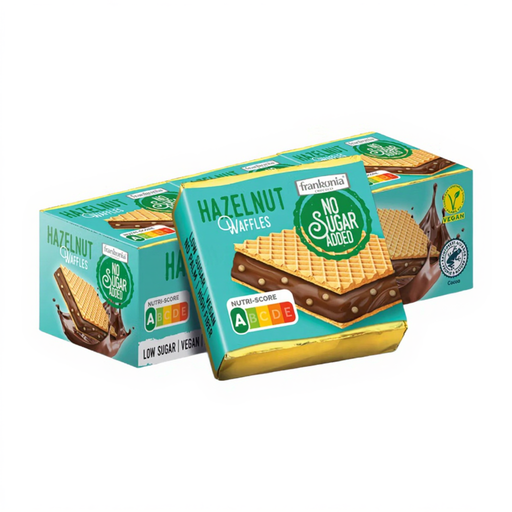
Frankonia describes its Hazelnut Crisp Waffles as wafers with no added sugar, and as vegan and palm oil-free.
- These claims from the manufacturer can help if you’re choosing based on recipe features.
- “No added sugar” does not confirm that the product meets the “sugar-free” threshold. To check, look at the “of which sugars” figure per 100 g on the pack you’re considering.
NICK’S
NICK’S describes its chocolate wafer as gluten-free and made with no added sugar.
- The manufacturer’s “gluten-free” claim is useful for people specifically looking for this feature.
- The stated sugar content is 12 g per 100 g, so this chocolate wafer is not suitable for a strictly sugar-free selection. NICK’S also notes that traces of nuts and peanuts may be present.
Diablo Sugar Free
Diablo Sugar Free lists a 150 g wafer with coconut cream flavour as having “no added sugar”.
- This claim can help you find a wafer with no added sugar.
- If you specifically need a sugar-free wafer, also check the sugar content per 100 g on the specific pack.
Wafers at Joybuy
This selection features hazelnut wafers with no added sugar for the office biscuit tin. Check the sugar content per 100 g on the pack to see whether they also meet the “sugar-free” requirement.
 No image available
Frankonia No Sugar Added Hazelnut Wafers, 9x19.4g
A hazelnut wafer to consider if you’re looking for a product labelled “no added sugar”.
Pack size: 9x19.4g. If you’re specifically looking for sugar-free wafers, check the “of which sugars” figure per 100 g before buying. The threshold is 0.5 g.
If you have requirements relating to allergens or sweeteners, check the ingredients, may-contain information and warnings on the specific pack too.
View at Joybuy
Frequently asked questions
What does “sugar-free” mean for wafers?
As Lebensmittelklarheit explains, solid foods can be labelled “sugar-free” if they contain no more than 0.5 g of sugar per 100 g. It’s the total stated sugar content that counts, not just added sugar.
Are wafers with no added sugar automatically sugar-free?
No. “No added sugar” and “sugar-free” mean different things. For example, NICK’S says its chocolate wafer with no added sugar contains 12 g of sugar per 100 g. If you want a strictly sugar-free biscuit tin, always check the sugar content per 100 g.
Why do some sugar-free wafers carry a warning?
Sugar-free confectionery may contain sugar alcohols, which can require a warning about possible laxative effects if eaten in excess. The Hamburg Consumer Advice Centre explains this warning for the relevant confectionery, so check the ingredients and packaging information for your chosen wafer.
How should you store wafers for an office biscuit tin?
Follow the storage instructions on the specific pack, and keep the ingredients and allergen information accessible by the shared tin. For the Gullón wafer described by Shop Apotheke, the recommendation is to store it in a cool, dry place away from sunlight.


