
Lieferung heute & morgen

Qualitätsgarantie

Willkommens-Angebote freischalten: KOSTENLOSE Lieferung | Bis zu 80 % RABATT | Kostenlose 30-Tage-JoyPlus-Testphase
App herunterladen
Sugarcane disposable tableware is often presented as a practical alternative to conventional plastic products. This usually refers to bagasse, a fibrous material left over from processing sugarcane. For barbecues, picnics, catering events, snack bars and takeaway services, this tableware can be a suitable solution – provided its size, shape and material properties match the intended use.
However, various marketing claims and unclear product details can lead to poor purchasing decisions. Three points in particular are often overlooked:
Sugarcane tableware is often referred to as bagasse tableware or tableware made from sugarcane fibres. According to the respective product descriptions, the plates and bowls featured here are made from sugarcane or sugarcane-fibre material. The term “paper” is also used in retail, even though these products are not necessarily made from conventional wood-fibre paper.
The material name is therefore not the only factor to consider. Look for:
Bowls with sufficient capacity are useful for soups, stews, salads and desserts. 500 ml disposable bowls provide a clear guideline for individual portions, but should not be filled to the brim. For liquid food, leaving some space below the rim reduces the risk of spills during transport.
For main courses, plates with a diameter of around 23 cm are versatile. Smaller 15 cm plates are more suitable for cake, fruit, snacks or desserts. Three-compartment plates or serving platters make it easier to serve side dishes and main courses separately.
The material construction is particularly important when serving hot or fatty foods. Product descriptions may mention properties such as grease-resistant disposable tableware, “oil proof”, “water resistant” or “leak resistant”. These claims should not automatically be applied to all sugarcane products.
Also check whether microwave use is expressly permitted. Good heat insulation can make the tableware easier to handle, but it does not replace specific manufacturer information about the maximum temperature or heating time.
Sugarcane burger boxes should provide enough space for burgers, sandwiches or pasta and close securely. For catering and buffets, compostable three-compartment plates can simplify serving by keeping different parts of a meal separate.
For large events, it is worth planning quantities carefully:
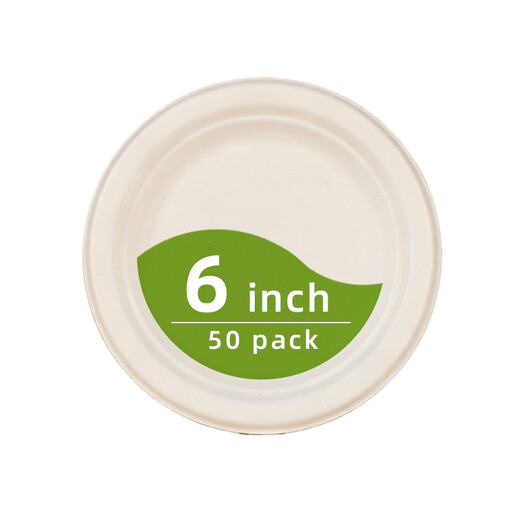
Why this product suits this profile: The pack of 50, with a diameter of 15 cm, is designed for desserts, snacks, cake and smaller portions at private celebrations, barbecues and picnics.
The clearly stated size prevents small plates from accidentally being planned for large main courses.
50 pieces per pack; according to the product name, made from biodegradable sugarcane material and intended for parties, barbecues and picnics.
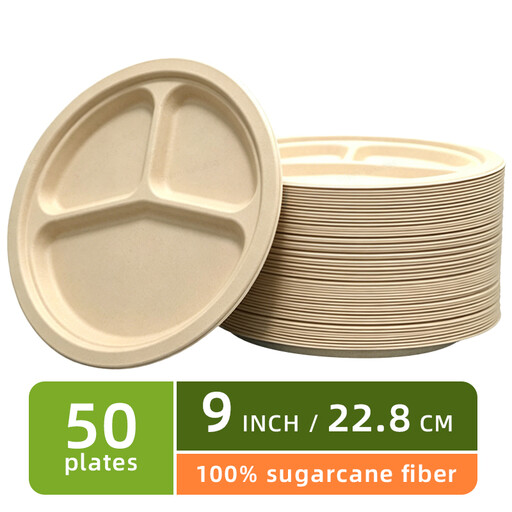
Why this product suits this profile: The 23 cm format with three compartments is designed for portioned main courses, buffets, catering and celebrations with several side dishes.
The separate compartments reduce food mixing, while the product name also states that the plates are oil-resistant for their intended use.
50 pieces; three compartments; 23 cm diameter; according to the product details, intended for catering, celebrations and food service.
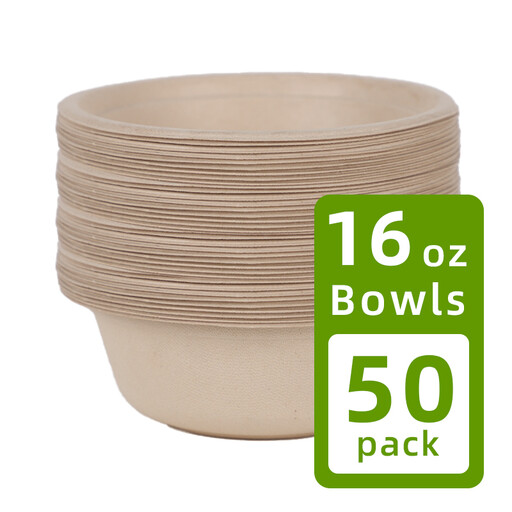
Why this product suits this profile: The 500 ml capacity is suitable for soups, stews, salads and other liquid or semi-solid foods at outdoor events and larger gatherings.
The stated capacity makes portion planning more straightforward; the product description also mentions leak protection and heat insulation.
50 pieces; 500 ml capacity; according to the product details, made from biodegradable sugarcane material and intended for hot food.
Before first use, the tableware should be stored in a dry place protected from dust. Moisture can affect the shape retention of bagasse products in particular. Hot food should ideally be added shortly before serving. For transport, suitable lids or sturdy transport boxes are useful, provided they are available for the relevant format.
After use, the tableware cannot automatically be placed in every food waste bin. First remove any large food residues and check the requirements of your local waste disposal provider. Some municipal systems do not accept certified compostable products in the food waste bin because their industrial composting facilities are not designed to process them. The term “compostable” should therefore be considered alongside clear, verifiable disposal instructions.
That depends on the individual product. Bowls and plates may be designed for warm food, but temperature limits and microwave suitability must be stated explicitly in the product description. For soups, bowls with sufficient capacity and specified leak protection are more practical than flat dessert plates.
When stored dry, clean and protected from direct moisture, unused sugarcane tableware can be kept for an extended period. However, no general shelf life can be specified for all products. For catering and commercial use, storage in the original packaging is recommended, along with regular checks for deformation or moisture damage.
The product name may include the terms “compostable” or “biodegradable”. This does not automatically mean that the tableware can be processed in a home compost bin or a municipal food waste bin. The decisive factors are the specific certification, the manufacturer’s information and local waste disposal regulations.