If your chocolate cereals need to be sugar-free, start by checking the ‘of which sugars’ figure in the nutrition information. According to the Verbraucherzentrale, solid foods can contain no more than 0.5 g of sugar per 100 g to qualify. ‘Reduced sugar’ and ‘no added sugar’ do not answer the same question. Before ordering online, also compare the ingredients and allergens for the specific variety, and check whether it can be delivered to your address.
Which checks matter to you
People who need their food to be sugar-free
A simple sugar-reduction claim won’t be enough for you. What matters is whether the ‘of which sugars’ figure is no more than 0.5 g per 100 g – the threshold for ‘sugar-free’ claims on solid foods, as explained by the Verbraucherzentrale.
Chocolate fans looking to cut down on sugar
You’d like to choose a chocolatey muesli or cereal without insisting on it being completely sugar-free. Compare the sugar values per 100 g; a claim such as ‘reduced sugar’ initially tells you only how it compares with another product.
People who have groceries delivered
When ordering online, check the ingredients, highlighted allergens and nutrition information for your chosen variety. After entering your address, check whether that exact pack can be delivered to you.
What to look for when buying
First decide whether you need a product to be strictly ‘sugar-free’ or simply want one with less sugar. Then you can compare the recipe and the specific online listing more effectively.
| Criteria |
What to check when buying |
Who it matters to |
| Sugar-free |
Compare ‘of which sugars’ per 100 g with the 0.5 g threshold; don’t treat other sugar claims as equivalent. |
If I’ll only consider a product that is genuinely sugar-free, a label such as ‘reduced sugar’ isn’t enough. Around 42% of consumers put this strict requirement first. |
| Lower sugar content |
Check the actual sugar value per 100 g and, for ‘reduced sugar’ claims, note what the product is being compared with. |
I want to cut down on sugar at breakfast without necessarily choosing a sugar-free product. This is the main priority for around 33% of consumers. |
| The right online listing |
Check the ingredients, allergens, nutrition information and pack size for the selected variety, as well as whether it can be delivered to your address. |
When product names are similar, I want to be sure which recipe and pack I’ll receive before ordering. Around 25% of consumers make this their top priority. |
Common pitfalls
-
Assuming ‘no added sugar’ means ‘sugar-free’
A product with no added sugar may still contain naturally occurring sugars. According to the Verbraucherzentrale, solid foods can contain no more than 0.5 g of sugar per 100 g to qualify as ‘sugar-free’.
If being sugar-free is essential, compare the wording on the pack with the ‘of which sugars’ figure in the nutrition information.
-
Treating a sugar-reduction claim as the actual sugar content
‘30% less sugar’ refers to a comparison product. On its own, it tells you neither the sugar content per 100 g nor whether the product is sugar-free.
Also check the nutrition information for the specific variety and see what it is being compared with.
-
Ordering based only on the product image or name
Chocolate mueslis with similar names can have different recipes and pack sizes. And just because a product is listed online doesn’t mean that the chosen variety can be delivered to your address.
Before ordering, open the product details and check the ingredients, allergens, sugar value per 100 g, pack size and delivery availability.
Brands to consider
mymuesli
mymuesli offers Bio Low Sugar Choco Crunch, a chocolatey crunchy muesli.
- The manufacturer promotes this variety as containing less than 5 g of sugar per 100 g.
- This does not mean ‘sugar-free’. If you need a product to meet a strict sugar-free requirement, check the value on the specific pack.
Kölln
Kölln makes a chocolate oat muesli with a sugar-reduction claim; REWE lists one variety in its online range.
- Kölln describes its chocolate oat muesli as having 30% less sugar than conventional chocolate muesli.
- This comparison doesn’t replace checking the sugar value per 100 g or whether the product can be delivered to your address.
Allos
Allos offers Ungesüßtes Crunchy Kakao, a cocoa-flavoured crunchy cereal.
- The manufacturer describes the recipe as having ‘no extra sugar’.
- This doesn’t prove that it is sugar-free. Check the ingredients and the ‘of which sugars’ figure on the pack you’ve chosen.
Kellogg’s
Choco Krispies Chocos is a chocolatey cereal from Kellogg’s.
- Kellogg’s publishes nutrition information for this variety.
- The manufacturer lists 22 g of sugar per 100 g, so this variety does not meet the sugar-free threshold.
Nestlé Cereals
Nestlé Cereals offers chocolatey Nesquik breakfast cereals.
- Nutrition information is available for Nesquik Knusper-Frühstück.
- Nestlé Cereals lists 22.1 g of sugar per 100 g, so this variety is not sugar-free.
Chocolate mueslis with sugar-reduction claims at Joybuy
This selection is for people who want to compare chocolatey muesli labelled ‘Less Sweet’ or ‘reduced sugar’. These claims don’t replace checking the sugar value per 100 g and don’t prove that a product is sugar-free.
 No image available
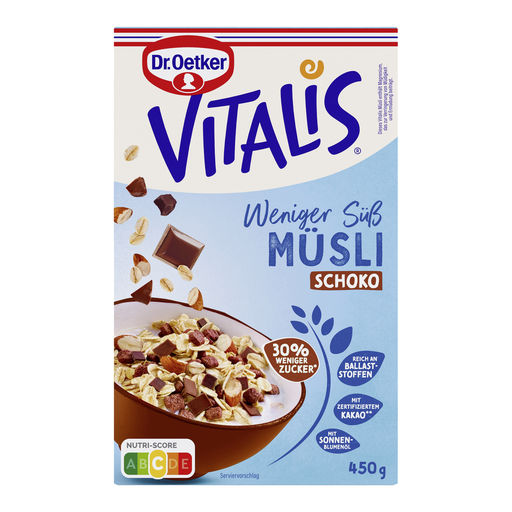
Dr. Oetker Vitalis Less Sweet Chocolate Crunchy Muesli, 450 g
A chocolatey crunchy muesli labelled ‘Less Sweet’. You can only tell whether it meets your sugar limit by checking the nutrition information per 100 g.
View at Joybuy
 No image available
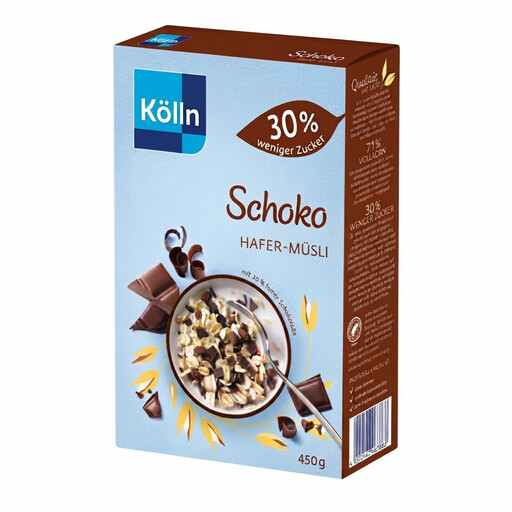
Kölln Chocolate Oat Muesli, 30% Less Sugar, 450 g
For anyone looking for chocolate oat muesli with a sugar-reduction claim. ‘30% less sugar’ tells you how it compares with another product, not its actual sugar content per 100 g.
View at Joybuy
 No image available
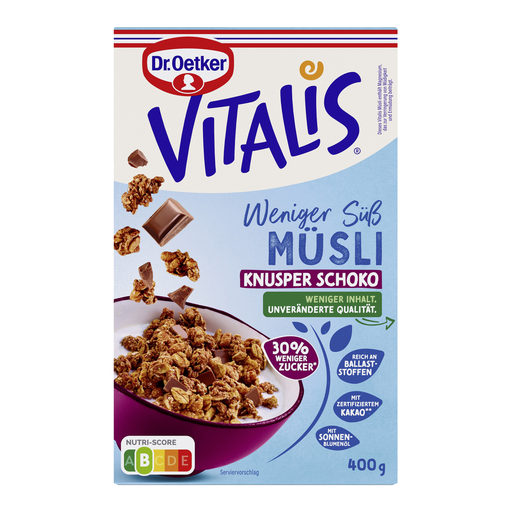
Dr. Oetker Vitalis Less Sweet Crunchy Chocolate Muesli, 400 g
Another chocolatey crunchy option to compare with mueslis labelled ‘Less Sweet’. Check the nutrition information for this 400 g pack separately from other Vitalis varieties.
View at Joybuy
Frequently asked questions
What does ‘sugar-free’ mean for chocolate cereals?
As explained by the Verbraucherzentrale, solid foods must contain no more than 0.5 g of sugar per 100 g to qualify as ‘sugar-free’. So check the ‘of which sugars’ line in the nutrition information for the specific variety.
Do ‘no added sugar’ and ‘sugar-free’ mean the same thing?
No. A food can contain naturally occurring sugars even if no sugar has been added. Its sugar value per 100 g will tell you whether it is also sugar-free.
Is ‘30% less sugar’ enough if I need a sugar-free product?
No. This claim describes a reduction compared with another product. Also check the ‘of which sugars’ value per 100 g; solid foods must contain no more than 0.5 g per 100 g to qualify as ‘sugar-free’.
What product information should I check before ordering online?
Check the ingredients, highlighted allergens and nutrition information for the variety you actually want to order. Under EU food information rules, mandatory information about food sold at a distance must generally be available before you complete your purchase.
Can a chocolate muesli listed online be delivered to my address?
A product listing alone doesn’t confirm that delivery is available to your address. After entering your delivery area in the shop, check that your chosen variety and pack size are in stock and available for delivery.


