When choosing granola or muesli for diabetes, don’t rely on a claim on the front of the pack alone: ‘sugar-free’, ‘low sugar’ and ‘no added sugar’ mean different things. You should also consider the carbohydrates in the portion you actually eat, the ingredients and, where relevant, your individual treatment plan. A fruity muesli with no added sugar is not the same as a sugar-free product.
Which considerations matter to you?
Consumers with a strict sugar limit
If you’re specifically looking for a sugar-free product, compare the ‘sugar-free’ claim with the sugar content per 100 g. Ingredients such as dried fruit, syrup and honey also matter when making your choice. The Verbraucherzentrale explains that nutrition claims such as ‘sugar-free’ are subject to defined limits.
People with diabetes who count carbohydrates
When planning breakfast, what matters is the amount of carbohydrate in the portion you actually eat – not just the sugar content per 100 g. diabetesDE – Deutsche Diabetes-Hilfe stresses the importance of knowing the carbohydrate content of a meal, particularly for people with type 1 diabetes.
Consumers who prefer fruit muesli
If you’re looking for a fruity flavour, a muesli with no added sugar may be an option. However, dried fruit can still contribute to the stated sugar content, so check the sugar and carbohydrate values for your portion. REWE describes Kölln fruit muesli with no added sugar as getting its natural sweetness from dried fruit and grains.
What should you look for when buying?
First, decide whether you specifically need a sugar-free product or would also consider one with no added sugar. Then compare the carbohydrates per 100 g and work out how much that means for your usual portion.
| What you’re looking for |
What to check when buying |
Who it matters to |
| Sugar limit |
If you have a strict limit, check for the ‘sugar-free’ claim and the sugar content per 100 g. According to the Verbraucherzentrale, ‘sugar-free’ means no more than 0.5 g of sugar per 100 g. |
I want to stick to a clear sugar limit, rather than treating ‘less sugar’ or ‘no added sugar’ as meaning the same thing. Around 42 % of consumers may consider this their main buying priority. |
| Carbohydrates in your portion |
Compare the carbohydrates per 100 g with the amount you actually eat. If you have diabetes treated with insulin, follow your individual treatment plan. |
I need to know how many carbohydrates are in my bowl at breakfast. For around 33 % of consumers, being able to plan this may be the main priority. |
| Fruity flavour |
For muesli with no added sugar, check the ingredients for dried fruit and compare the sugar and carbohydrate values in the nutrition information. |
I want fruit in my muesli, but need to factor in its natural sweetness when choosing a portion. This may be the main priority for around 25 % of consumers. |
Common misunderstandings
-
‘No added sugar’ means ‘sugar-free’
That’s not the case: dried fruit can contribute to the sugar content even when no sugar has been added. REWE’s product information for Kölln fruit muesli with no added sugar lists 22 g of sugar per 100 g.
If ‘sugar-free’ is a firm requirement, check for the relevant claim and the sugar content per 100 g. With fruit muesli, compare the carbohydrates too.
-
‘Less sugar’ means a low sugar content
‘Less sugar’ is a comparison, not a set sugar limit. EDEKA’s ‘less sweet’ crunchy muesli still contains 12.8 g of sugar per 100 g, despite the reduction claim. Its ingredients include glucose-fructose syrup, sugar and honey.
Check the actual sugar content and the ingredients list rather than assuming a comparison claim means ‘sugar-free’.
-
Only the sugar content matters for your portion
Even a low-sugar muesli can contain a substantial amount of carbohydrate: Seitenbacher lists 1 g of sugar and 55 g of carbohydrates per 100 g for its low-sugar muesli.
Work out the carbohydrates for the portion you actually eat. If you have diabetes treated with insulin, follow your individual treatment plan when planning your intake.
-
A sugar claim also tells you about allergens
The sugar content tells you nothing about the allergens in a product. For example, the Seitenbacher muesli mentioned above contains oats, spelt and almonds.
If you have an allergy or intolerance, check the ingredients, highlighted allergens and precautionary allergen statements on the current pack.
Brands and ranges to help you compare
Seitenbacher
A specific low-sugar muesli to compare sugar and carbohydrate values.
- Seitenbacher lists 1 g of sugar and 55 g of carbohydrates per 100 g for its ‘low-sugar muesli’.
- The muesli contains oats, spelt and almonds. ‘Low sugar’ means neither ‘sugar-free’ nor ‘low carbohydrate’.
Kölln
A fruit muesli option for consumers who want to distinguish between no added sugar and the total sugar content.
- REWE’s product information lists 40 % fruit for Kölln fruit muesli with no added sugar.
- The same product information lists 22 g of sugar and 64 g of carbohydrates per 100 g. It is therefore not a sugar-free alternative.
EDEKA
A range where plain muesli and crunchy muesli can be assessed separately by looking at their ingredients and nutrition information.
- EDEKA describes its wholegrain basic muesli as containing 88 % wholegrain cereals, with no raisins and no added sugar.
- According to EDEKA, GUT&GÜNSTIG ‘less sweet’ crunchy muesli contains 12.8 g of sugar per 100 g. Always check the information on the specific pack you’re buying.
REWE
A retailer’s platform where you can compare the information for individual muesli products.
- REWE’s product information for Kölln fruit muesli with no added sugar lists its ingredients and nutritional values.
- Assess each product using its own information; being part of a particular range tells you nothing about its sugar or carbohydrate content.
Alnatura
An organic-focused brand where the nutrition information for each granola or muesli needs to be checked individually.
- Alnatura describes products in its range as having no added sugar.
- Organic and ‘no added sugar’ claims alone tell you neither that a product is sugar-free nor its carbohydrate content.
Brüggen
A cereal manufacturer that also produces muesli for retailer own-label ranges.
- Brüggen describes traditional, crunchy and organic mueslis, as well as bespoke blends.
- Brüggen says its crunchy varieties are made using syrup. You should therefore check the ingredients and nutrition information for the specific product.
Muesli to suit you on Joybuy
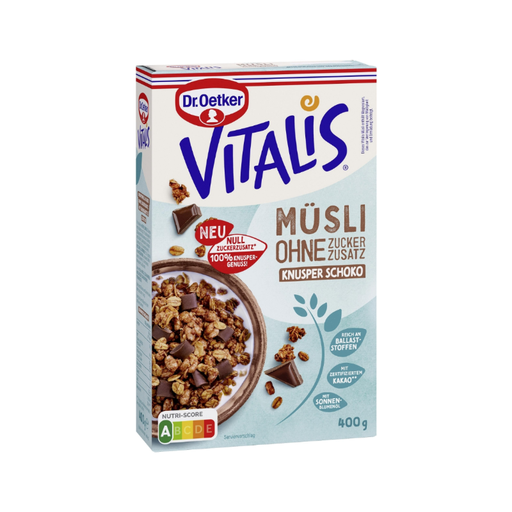
If you’re considering a crunchy chocolate muesli as well as granola, here’s one option. The words ‘No Added Sugar’ don’t replace checking the sugar, carbohydrates and ingredients on the current pack.
 No image available
Dr. Oetker Vitalis No Added Sugar Crunchy Chocolate Muesli, 400 g
An option if you’re considering a crunchy chocolate muesli instead of granola. Before buying, compare the sugar and carbohydrate values on the pack and take the portion you actually eat into account.
View on Joybuy
Frequently asked questions
Does ‘no added sugar’ mean the same as ‘sugar-free’?
No. According to the Verbraucherzentrale, ‘sugar-free’ means no more than 0.5 g of sugar per 100 g; ‘no added sugar’ does not rule out naturally occurring sugar. So when choosing granola or muesli, check the nutrition information, especially if it contains dried fruit.
Do I need special granola for diabetes?
You don’t need a product labelled ‘diabetic granola’. diabetesDE – Deutsche Diabetes-Hilfe explains that there is no special diet or food that is generally forbidden for people with either type 1 or type 2 diabetes. When choosing a product, consider the ingredients, sugar, carbohydrates and portion size as part of your individual treatment plan.
Which nutrition value is particularly important if I have diabetes treated with insulin?
The amount of carbohydrate in the portion you actually eat is important. diabetesDE – Deutsche Diabetes-Hilfe emphasises this particularly for people with type 1 diabetes. How you factor that amount into your insulin planning depends on your individual treatment plan.
Do I also need to check allergens in low-sugar muesli?
Yes. ‘Low sugar’ says nothing about allergens: Seitenbacher lists oats, spelt and almonds in its low-sugar muesli. If you have an allergy, check the labelling on the current pack, including any precautionary allergen statements.


