People who need to follow a strict sugar-free requirement
You’re looking for a wafer labelled ‘sugar-free’ that meets the limit of no more than 0.5 g of sugar per 100 g. A ‘no added sugar’ claim alone isn’t enough for you.


If you’re specifically looking for a sugar-free wafer for a sweet breakfast, look for the claim ‘sugar-free’ and no more than 0.5 g of sugar per 100 g. If you simply want to avoid added sugar, a wafer labelled ‘no added sugar’ may be suitable – but it can still contain sugar and sweeteners. So compare the nutritional information and ingredients, and check the allergens and any consumption advice.
You’re looking for a wafer labelled ‘sugar-free’ that meets the limit of no more than 0.5 g of sugar per 100 g. A ‘no added sugar’ claim alone isn’t enough for you.
You’d like a wafer with no added sugar and are happy to accept that it may still contain sugar or sweeteners. The specific sugar content and ingredients are what matter to you.
Before choosing a recipe, you check the sweeteners, allergens and consumption advice for sweet wafers.
First, decide whether you’re looking for a sugar-free wafer or one with no added sugar. Then check the ingredients for the specific variety. If you’re baking them yourself, a recipe title alone won’t tell you how much sugar the finished wafer contains.
| Criterion | What to check | Who it matters to |
|---|---|---|
| Sugar-free | Check for the ‘sugar-free’ claim and the ‘of which sugars’ figure per 100 g. Under EU Regulation (EC) No 1924/2006, this claim is only permitted for products containing no more than 0.5 g of sugar per 100 g. | If I specifically need a sugar-free breakfast wafer, ‘no added sugar’ isn’t enough. For around 42% of consumers, this strict requirement comes first. |
| No added sugar | Check the exact claim on the pack against the sugar figure per 100 g and the ingredients list. | It matters to me that no sugar has been added; I judge any remaining sugar content from the nutritional information. Around 33% of consumers prioritise this distinction when making their choice. |
| Ingredients and advice | Check the sweeteners, any declared allergens and any warning about a possible laxative effect if consumed in excess. | Before choosing a wafer, I need its recipe to suit the ingredients I want to keep an eye on. For around 25% of consumers, this check takes priority over the sugar claim. |
The claims mean different things. According to Frankonia, Frankonia Hazelnut Crisp Waffles contain 3.0 g of sugar per 100 g despite being labelled ‘no added sugar’; REWE lists 4.7 g per 100 g for NEOH Crisp n Cream.
If you’re looking for a sugar-free wafer, check for the relevant claim and compare the ‘of which sugars’ figure with the limit of no more than 0.5 g per 100 g.
A claim about added sugar doesn’t tell you which sweeteners have been used or how much sugar the finished wafer contains.
Read the nutritional information per 100 g and the full ingredients list for the specific variety.
The wafers described contain different sweeteners. Gullón wafers and NEOH Crisp n Cream carry a warning about a possible laxative effect if consumed in excess.
Before buying, check the sweeteners, allergens and warnings listed on the pack rather than choosing on the basis of the sugar content alone.
ZERO Sugar Free Chocolate Wafer is a wafer variety described as sugar-free. The German retailer’s product description lists less than 0.5 g of sugar per 100 g.
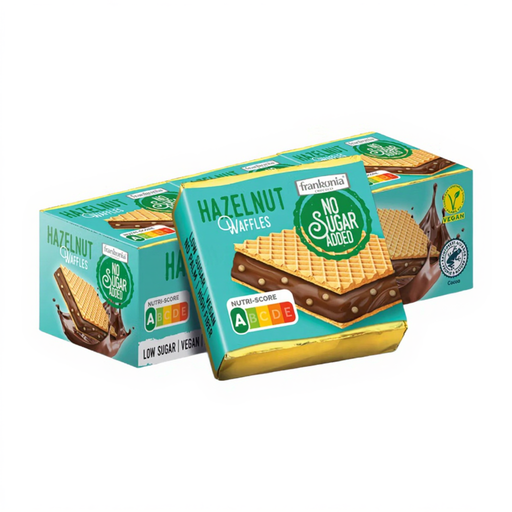
Hazelnut Crisp Waffles are wafer bars with a hazelnut crisp cocoa filling, labelled ‘no added sugar’.
Crisp n Cream is a wafer listed by REWE with a milk and hazelnut cream filling and labelled ‘no added sugar’.
These wafer bars are an option if you want to avoid added sugar at breakfast. They’re not suitable if you need to follow a strict sugar-free requirement.
 No image available
For a sweet breakfast with no added sugar, if you don’t need a wafer that is specifically sugar-free.
The pack contains 9 wafer bars, each weighing 19,4 g. Frankonia lists 3.0 g of sugar per 100 g for its hazelnut wafer bars, and names maltitol and erythritol as sweeteners.
Before buying, check the ingredients and allergen information on the pack, particularly if wheat, soya or hazelnuts are relevant to you.
Under EU Regulation (EC) No 1924/2006, a food carrying this claim may contain no more than 0.5 g of sugar per 100 g. When buying, compare the ‘of which sugars’ figure in the nutritional information per 100 g.
No. The claim ‘no added sugar’ doesn’t mean a wafer meets the sugar-free limit. It may still contain sugar and be made with sweeteners, as Lebensmittelklarheit explains in its guidance on the meaning of the claim.
It warns that the product may have a laxative effect if consumed in excess. This warning appears, among other places, in the product information for Gullón Sugar-Free Wafers Chocolate Flavour and NEOH Crisp n Cream. Read it alongside the ingredients list.
Follow the instructions on the relevant pack. For the Gullón wafers described, the German product description recommends storing them in a cool, dry place away from sunlight, and resealing the pack after each serving.