People with delicate summer dresses
For a delicate dress, first check whether the care label says to dry it hanging or flat. GINETEX symbols distinguish between these drying methods.


For summer dresses in a shared drying room, an unheated clothes airer is the obvious choice if you want to dry clothes without using electricity, provided the care label allows the chosen drying method and there’s enough time and ventilation. A heated model may be worth considering if you regularly have a short drying window and the available space, suitable power socket and care instructions all line up. Extra heat doesn’t guarantee a particular drying time or mean the airer is suitable for every dress.
For a delicate dress, first check whether the care label says to dry it hanging or flat. GINETEX symbols distinguish between these drying methods.
Look for a design that fits the available space while in use and can be put away afterwards. You’ll also need to make sure there’s adequate ventilation and a suitable power socket.
If you’re considering switchable heat, think about the hanging space, rated power and intended running time together, rather than assuming the wattage tells you how long drying will take.
Start by checking the care label and suitable drying method, then consider the available space, time and ventilation.
A good fit if: you want to hang several suitable dresses separately and have room for the airer when fully opened.
Things to weigh up: The airer needs electricity and floor space while it’s in use, and you’ll still need to ventilate the room.
A good fit if: you only need to dry a few suitable items and a smaller footprint matters more than having lots of separate hanging spaces.
Things to weigh up: There may not be enough hanging space for several long dresses.
A good fit if: air-drying is practical for the time available, heat isn’t suitable for the dress in question, or there’s no suitable power socket.
Things to weigh up: You’ll still need space and ventilation. Drying may take longer if the room conditions aren’t ideal.
| What matters when buying | What to check | Who may find it particularly important |
|---|---|---|
| Suitable drying method | Care label and hanging or flat-drying space; distance from heated bars. | For a delicate dress, I want to match the care label with the right drying position, rather than assume heat is always gentle. Around 29% of consumers put caring for clothes correctly first. |
| Space and hanging options | Dimensions when open, available height, clear walkways and storage options. | When sharing a drying room, I need enough room to set up the airer and want to be able to put it away afterwards. Around 29% of consumers prioritise space-saving use. |
| Short drying window | Switchable heat, separate hanging spaces, rated power and instructions for use. | When I have a short drying window, I might consider extra heat, but I wouldn’t use the wattage to predict a set drying time. Around 24% of consumers prioritise the time available. |
| Electricity and moisture | Ventilation options, local rules for use, rated power and planned running time. | When weighing up electricity use and indoor moisture, I factor in ventilation and the actual running time. Around 18% of consumers give priority to the effort involved in using the airer. |
The temperature specification describes the appliance, not whether it’s suitable for a particular fabric. Care symbols distinguish between drying methods, including hanging and flat drying.
Check the dress’s care label first, then choose how to hang it and whether to use the heat setting.
When open, a winged airer takes up more space than it does when folded away, and may block walkways or limit other drying space.
Measure the space available using the airer’s dimensions when in use, and allow for the cable route.
Drying clothes on a heated airer still releases moisture into the room. The Verbraucherzentrale (German Consumer Advice Centre) notes that moisture which isn’t regularly removed can encourage mould growth.
Before using the airer, check how the shared room can be ventilated.
The rated power alone doesn’t tell you how long a summer dress will take to dry or how much electricity the airer will use overall.
Consider the rated power and planned running time together, and follow the instructions for use without assuming a guaranteed drying time.
Heated clothes airers in a range of designs to suit different space and hanging needs.
Unheated clothes airers with adjustable tiers or flat-drying space for delicate items.
An unheated winged airer that could suit long summer dresses and a shared drying space.
This selection includes foldable winged airers for hanging summer dresses, including a heated model for use when the care instructions and available space allow.
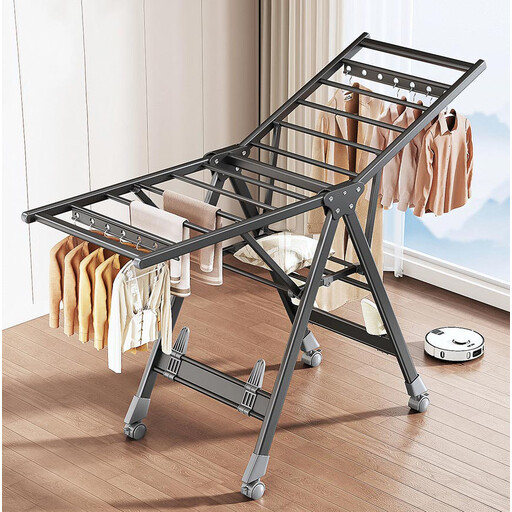 No image available
May suit you if the care label allows hanging and you want to put the airer away after use.
The product title lists height-adjustable wings and a folding design.
 No image available
An option if extra heat is suitable for the dress in question and there’s room to use the airer, along with a suitable power socket.
The product title lists a heating function, 45–55 °C and dimensions of 144 × 53 × 96 cm. The temperature specification doesn’t mean it’s automatically suitable for every dress, so check the care label. You’ll still need to ventilate the room when drying clothes indoors.
No. A heating temperature doesn’t mean the airer is suitable for every dress. Check the care label: GINETEX symbols distinguish between drying methods, including natural drying while hanging or lying flat.
Yes. Moisture released as clothes dry needs to be removed from the room. Check how the shared space can be ventilated; heating the airer won’t do this for you. The Verbraucherzentrale (German Consumer Advice Centre) notes that moisture which isn’t regularly removed can encourage mould growth.
Multiply the rated power in kilowatts by the planned running time in hours. This gives a calculated energy use in kilowatt-hours, assuming the rated power remains constant throughout. It isn’t a measurement of actual consumption and doesn’t predict drying time.
No. The European Commission explains that the CE mark is the manufacturer’s declaration that the product meets the relevant EU requirements. It doesn’t mean the specific appliance has been independently tested.