
Lieferung heute & morgen

Qualitätsgarantie

Willkommens-Angebote freischalten: KOSTENLOSE Lieferung | Bis zu 80 % RABATT | Kostenlose 30-Tage-JoyPlus-Testphase
App herunterladen
A summer duvet with feathers and down should be lightweight, breathable and pleasantly soft against the skin on warm nights. At the same time, products vary considerably in terms of filling weight, feather-to-down ratio, cover and certifications. Focusing solely on a low price or terms such as “hypoallergenic” can mean overlooking important details.
A lightweight duvet is not automatically suitable for every sleeping environment. What matters is how much filling is used per square metre and how evenly it is distributed throughout the duvet. A lightweight summer duvet with 200 g/m² may be suitable for warm bedrooms. In less heated rooms or for people who feel the cold easily, however, it may seem too thin.
With a feather and down duvet, the ratio affects its feel and weight. A high proportion of feathers can give the duvet more structure, while down keeps the weight low. The label should therefore clearly state whether it contains, for example, 90% feathers and 10% down. Vague descriptions make it harder to compare products.
An OEKO-TEX-certified duvet relates to specific tested materials or product components and is not automatically a medical statement. Likewise, the term hypoallergenic duvet does not replace individual medical advice in cases of allergies. Important factors include a closely woven cover, clear care instructions and clearly named testing or animal-welfare standards.
For warm nights, a filling weight of 200 g/m² is a useful guide. It describes the amount of filling per square metre, not the duvet’s total weight. Buyers should also consider the construction: cassette or quilted sections can help distribute the filling evenly and keep it securely in place over time.
If you are looking for a solution suitable for several seasons, you can choose a 2-in-1 all-season duvet. This combines a lighter summer duvet with a warmer transitional-season duvet. The combination of 200 g/m² and 450 g/m² creates a 4-season duvet, provided the product description explicitly states that it is designed for this use.
The standard sizes differ in sleeping surface and overhang:
Before buying, consider the mattress width, your height, the duvet cover and the storage space available. A 155x220-cm duvet, for example, requires a matching cover in the same size.
A cotton cover can feel comfortable and, when closely woven, helps limit direct contact between the filling and its surroundings. However, the term “breathable duvet” should always be considered in relation to the filling, cover and sleeping environment.
The following details can help guide your choice:
Certifications should be clearly linked to the product listing, label or documents provided. They are not a general guarantee of personal suitability or tolerance.
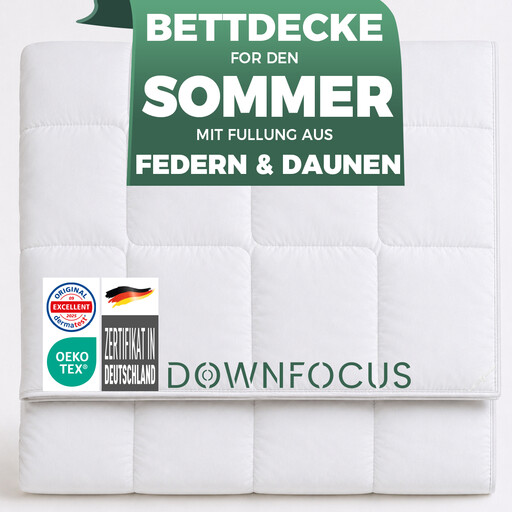
Why this product suits this profile: The summer version, measuring 155x220 cm with a filling weight of 200 g/m², is designed for warm nights and longer single beds.
The specific filling weight and 90% feather, 10% down composition make it easier to compare with products that have unclear descriptions.
According to the product details, it is OEKO-TEX and RDS certified, with a cotton cover and a specified summer filling.
Why this product suits this profile: The square format is suitable for double beds and people who prefer to share a duvet.
The size, filling weight and composition are clearly stated in the product description rather than being conveyed only through a marketing term.
200x200 cm, a 200 g/m² summer filling and, according to the product details, OEKO-TEX and RDS certification.
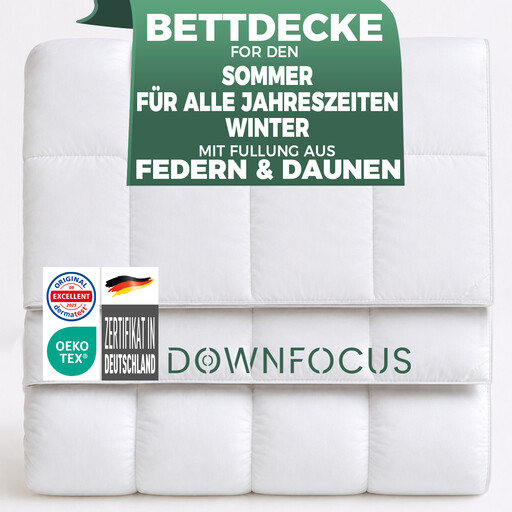
Why this product suits this profile: The two-part design is suitable for households that want to switch between summer and all-season use.
The two filling levels are specified as 200 g/m² and 450 g/m². This makes it easy to choose the preferred combination with confidence.
Two duvets measuring 155x220 cm, with a cotton cover and, according to the product details, OEKO-TEX and RDS certification.
Why this product suits this profile: The 135x200 cm single-bed size suits many standard beds and offers two combinable filling levels.
The duvet is not simply presented as a general all-season solution; it is described as having separate summer and all-season components.
135x200 cm, 200 g/m² plus 450 g/m² and, according to the product details, RDS and OEKO-TEX certification.
We have put together a complete, regularly updated list of products that fully meet these strict selection criteria and the safety regulations applicable in the EU.
A feather and down duvet should be aired regularly, preferably away from direct, intense sunlight. Moisture can put strain on the filling. For cleaning, always follow the instructions on the care label. Not every duvet is suitable for machine washing; larger sizes may require professional cleaning.
A correctly sized duvet cover protects the cotton cover from body oils and dirt. If you have sensitive skin or problems with house dust, the cover should be washed regularly according to the manufacturer’s instructions. A duvet suitable for allergy sufferers is also not automatically suitable for every allergy. If you have known allergies or symptoms, check the material details and your individual tolerance separately.
A filling weight of 200 g/m² is lightweight and, according to the product description, intended for summer nights. Whether it is sufficient depends on the room temperature, bed linen and your personal warmth requirements. For cooler transitional seasons, a combinable 2-in-1 design offers greater flexibility.
For a standard single bed, 135x200 cm is often suitable. Taller people or those with a wider bed may prefer 155x220 cm. The key point is that the duvet cover must fit the duvet exactly.
There is no fixed cleaning schedule. Regular airing and a clean duvet cover help reduce everyday build-up. A thorough clean should be based on the care label, how often the duvet is used and any visible soiling. The manufacturer’s temperature recommendations and drying instructions must not be changed.