Keeping an eye on fibre at breakfast
You want to compare the fibre content of different sweet mueslis in a meaningful way. The nutritional information per 100 g is a more useful guide than a highlighted serving-size figure.


When choosing a sweet muesli for its fibre content, first compare the stated grams per 100 g, then look at sugar, ingredients and your usual portion size. Crunchy, fruity and organic varieties each have different strengths. Neither the product description nor a single nutritional value is a substitute for checking the specific pack.
You want to compare the fibre content of different sweet mueslis in a meaningful way. The nutritional information per 100 g is a more useful guide than a highlighted serving-size figure.
You enjoy baked, crunchy muesli and want to know how much sugar it contains. Compare the figures per 100 g for similar products, and check the ingredients list too.
You prefer fruity or organic options and look out for particular ingredients. When it comes to nuts, sesame and other allergens, always check the labelling on the specific pack.
When choosing a sweet muesli, start with the fibre content per 100 g. Whether crunchiness, sugar or the ingredients list matters most after that depends on what you value at breakfast.
| Criteria | What to check | Who it matters to |
|---|---|---|
| Fibre | Compare fibre in grams per 100 g; use serving-size information as a supplementary guide. | If I’m specifically looking for more fibre in my sweet breakfast muesli, I need a figure I can compare across different packs. Around 42% of consumers put this first. |
| Crunchiness and sugar | For similar crunchy mueslis, check the sugar per 100 g and the sweetening ingredients. | I want my crunchy muesli to taste good without overlooking its sugar content. For around 33% of consumers, this combination is a key consideration when buying. |
| Ingredients and allergens | Check the ingredients list and allergen information on the specific pack against your own requirements. | When choosing a fruity muesli, I want to know whether the ingredients suit my preferences and dietary needs. This is a priority for around 25% of consumers. |
A description alone won’t tell you how much the fibre content differs between two mueslis. Kölln states that Knusper Klassik 50 % weniger Zucker contains 17 g per 100 g, while Seitenbacher gives 12 g per 100 g for Müsli Ballaststoff & Frucht. Both figures come from the respective manufacturers.
For a direct comparison, use the nutritional information per 100 g, then consider the products’ other features.
A comparative claim doesn’t tell you how much sugar the muesli contains in absolute terms. For Kölln Knusper Klassik 50 % weniger Zucker, the manufacturer states 8 g of sugar per 100 g.
Check the actual sugar figure and the ingredients list. Where possible, compare like with like.
These claims don’t tell you whether a muesli contains nuts or sesame, for example, or whether possible traces are labelled. According to the manufacturer, Alnatura Maxi-Müsli contains hazelnuts and sesame.
If you have an allergy or intolerance, always check the ingredients and allergen information on the specific pack.
How much you usually eat is also important when choosing a higher-fibre breakfast. The German Nutrition Society recommends that people who aren’t used to a high-fibre diet increase their intake gradually.
Take your usual portion size into account rather than choosing solely by the highest figure per 100 g.
Kölln offers oat-based mueslis in classic and crunchy varieties, among others. Nutritional information varies with each recipe.
According to Seitenbacher, Müsli Ballaststoff & Frucht combines wholegrain flakes and oat bran with fruit, seeds and almonds.
Alnatura offers fruity muesli and granola recipes with a variety of ingredients and textures.
REWE stocks both its own muesli products and products from other brands. So the retailer selling a listed muesli doesn’t tell you what’s in its recipe.
Brüggen makes classic and crunchy mueslis, among other products, and also manufactures products for retailer own-label ranges.
This selection includes crunchy and fruity mueslis for a sweet breakfast. For each product, compare the fibre and sugar content and check the ingredients on the specific pack. The selection alone can’t determine which variety is right for everyone.
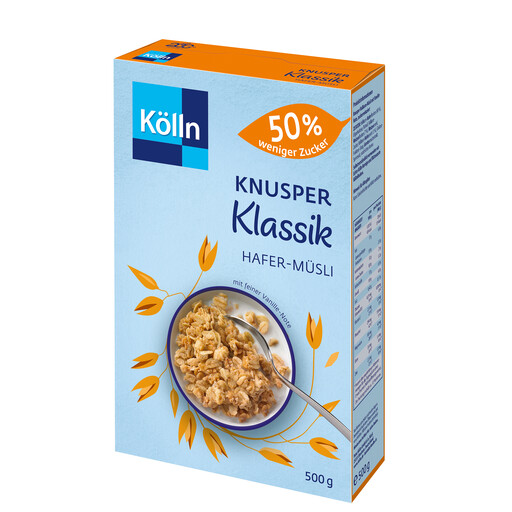 Image unavailable
A crunchy breakfast option for comparing fibre and the actual sugar content. Also check the allergen information and confirm the pack weight before buying.
 Image unavailable
A crunchy option for anyone who wants to consider sweetness alongside nutritional information. Check the sugar per 100 g, ingredients list and allergen information on the pack.
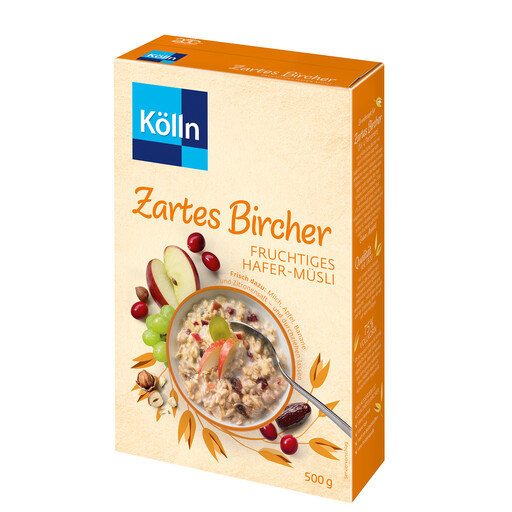 Image unavailable
A fruity breakfast option if you also want to compare fibre and sugar per 100 g. Pay particular attention to the labelling for hazelnuts and any other allergens.
 Image unavailable
A fruity option where the “No Added Sugar” claim doesn’t replace checking the total sugar content. Read the nutritional information per 100 g and check the allergen information.
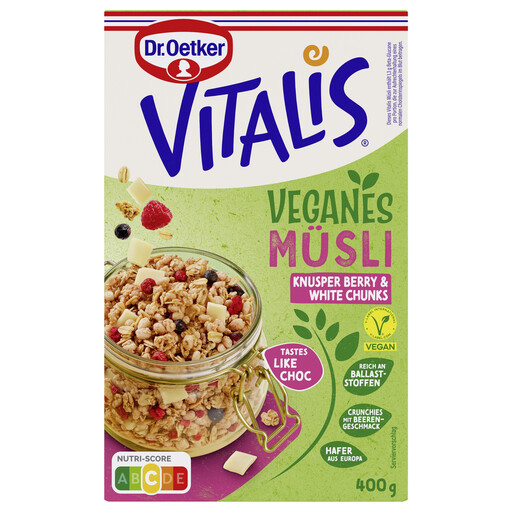 Image unavailable
A berry and chocolate option for a sweet, crunchy breakfast. Check the fibre and sugar content, along with the information about milk and other allergens on the specific pack. Don’t rely on the “Vegan” description alone.
EU Regulation (EC) No 1924/2006 sets the threshold at at least 6 g of fibre per 100 g, or at least 3 g per 100 kcal. The stated figure per 100 g provides a common basis for comparing different mueslis.
The German Nutrition Society recommends that people who aren’t used to a high-fibre diet increase their intake gradually. So, as well as checking the figure per 100 g, consider how much muesli you usually eat.
No. The Nutri-Score doesn’t replace the ingredients list or nutritional information. The consumer advice centre describes it as an additional guide. When choosing, you should also check the fibre and sugar per 100 g, along with any relevant allergens.
No. According to the manufacturer, Alnatura Maxi-Müsli contains hazelnuts and sesame, despite being described as vegan and organic. Check the ingredients and information about possible traces on the specific pack of each product.