Dry swimwear gently
If you mainly hang up delicate swimwear, you’ll want to avoid direct contact with a heater. LASCANA recommends air-drying swimwear with a high elastane content in the shade.


If you mainly dry swimwear, a well-ventilated, unheated drying space is usually enough. LASCANA recommends drying swimwear with a high elastane content in the shade and advises against contact with a heater. A heated airer is more suitable for other items whose care labels allow heat. Check the available space, electricity consumption and ventilation options before buying.
If you mainly hang up delicate swimwear, you’ll want to avoid direct contact with a heater. LASCANA recommends air-drying swimwear with a high elastane content in the shade.
If space is limited, make sure the airer’s footprint and height will fit in your chosen corner. Also consider where you could store a folding model or install a wall-mounted airer.
If you hang up other laundry as well as swimwear, a heated airer could be another option. Follow the care label for each item, and remember to ventilate the room regularly.
A good fit if: You mainly dry swimwear and want to avoid contact with a heater. A wall-mounted airer can work well if floor space is limited, provided the installation and location are suitable.
The trade-off: There’s no electric heating function, and you’ll still need to ventilate the room to remove moisture.
A good fit if: You also dry items whose care labels allow heat, and the airer will fit in the available space.
The trade-off: Heated bars don’t automatically make an airer suitable for delicate swimwear. You’ll still need to consider electricity consumption and ventilation.
A good fit if: You want to dry other items that can be exposed to heat, and have enough height as well as floor space for the tower.
The trade-off: A heated cover doesn’t mean every fabric can be exposed to heat, and it won’t replace ventilating the room.
| What matters | What to check before buying | Who it matters most to |
|---|---|---|
| Protecting fabrics | Follow the care label and hang swimwear somewhere airy, away from heated bars. | When I dry delicate swimwear, I want to follow the care label and avoid contact with a heater. Around 36% of consumers put fabric care first. |
| Available space | Check the width, depth and height when the airer is set up, as well as the space needed to hang items. | In a narrow laundry area, I need an airer that will genuinely fit when in use. Around 29% of consumers prioritise the available space. |
| Room humidity | Check whether you can ventilate the room regularly where the airer will stand; monitor humidity if needed. | When drying clothes indoors, I want to be able to remove moisture by ventilating the room. Around 21% of consumers say room humidity is their main concern. |
| Electricity consumption | Consider the rated power, actual running time and your own price per kilowatt-hour. | If I use a heating function, I want to be able to estimate the running costs. Around 14% of consumers prioritise running costs. |
A heating function doesn’t mean an item is safe to expose to heat. LASCANA advises against contact with a heater for swimwear with a high elastane content.
Check the care label first. If appropriate, use the heating function for other items whose care labels allow heat.
A folding airer still needs space when it’s in use. The Divit BH16 measures 146 × 54 cm when set up.
Measure the available floor space and height where you plan to put the airer with laundry hanging on it.
Even with a heated airer, moisture from the laundry still enters the room. The Verbraucherzentrale points out that a lack of regular air circulation can encourage mould growth.
Choose a location you can ventilate regularly. A hygrometer can help you keep an eye on humidity.
The wattage alone doesn’t tell you how much electricity a full drying cycle will use. The running time and your own price per kilowatt-hour also matter.
Estimate usage from the rated power and expected running time rather than using individual wattage figures to compare costs.
The 850-032 is a compact heated airer for households where a small footprint is important.
The heated, folding BH16 airer is designed for households that want to fold it away after use.
The range includes heated airers and an airer tower with a heated cover.
An unheated wall-mounted airer is one option if floor space is limited in your laundry area.
This selection at Joybuy includes unheated, folding and wall-mounted drying solutions for swimwear and other laundry that needs to air-dry.
 No image available
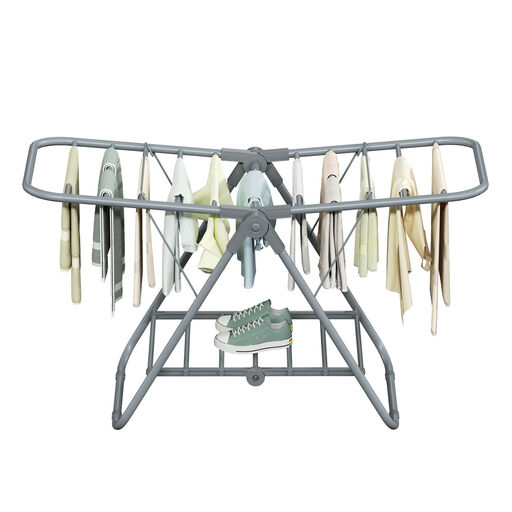
An unheated place to hang several items, with adjustable wings to suit different hanging needs.
Folds away for storage.
 No image available
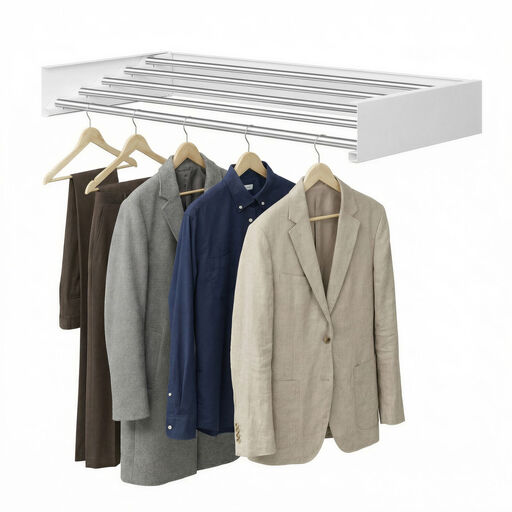
A wall-mounted place to hang laundry if you want to free up floor space.
Folds back against the wall; wall installation required.
 No image available
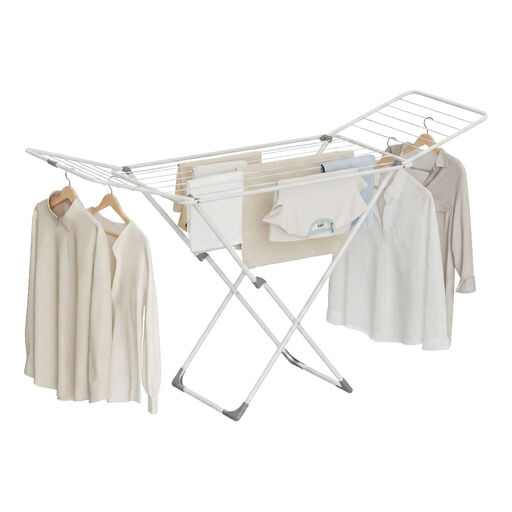
An unheated way to hang several items, which folds away after use.
The stated load capacity applies when the weight is distributed evenly.
 No image available
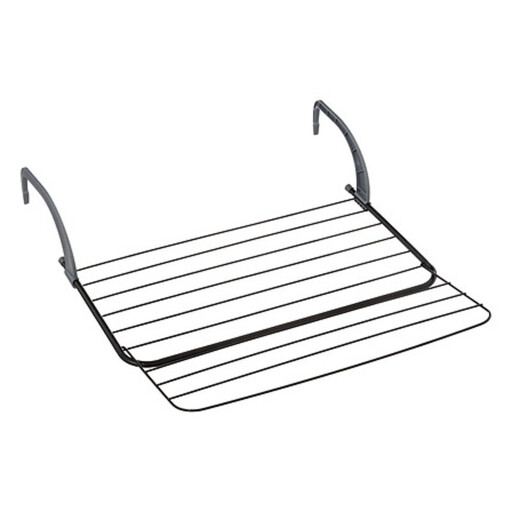
Adjustable clip arms offer a flexible way to hang lightweight items.
Secure it to a stable surface before use. Don’t attach it to a radiator when drying swimwear if this would bring the fabric into contact with the heat.
 No image available
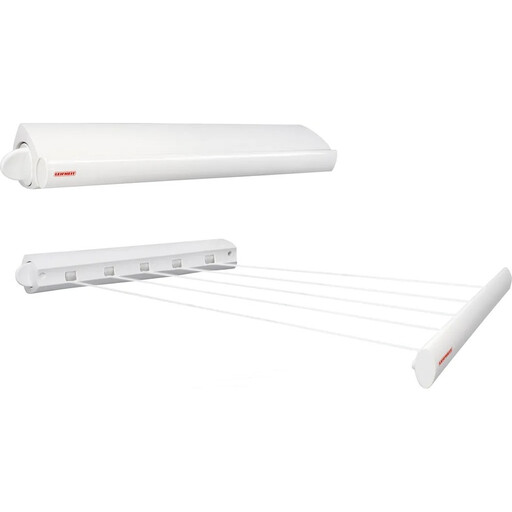
An unheated wall-mounted airer with retractable lines, if you want to free up floor space.
Designed for wall installation; take care that the lines don’t snap back when retracting them.
Not necessarily: check the care label for the specific item. LASCANA recommends air-drying swimwear with a high elastane content in the shade and advises against contact with a heater.
Yes. The Verbraucherzentrale points out that moisture can encourage mould growth if you don’t ventilate regularly. A hygrometer can help you keep an eye on humidity where the airer is set up.
Divide the rated power in watts by 1,000, then multiply the result by the running time in hours and your price per kilowatt-hour. This gives you an estimate assuming the airer runs continuously at its rated power, not the measured consumption for a drying cycle.
In Germany, consumers who buy new faulty goods can generally assert their statutory warranty rights against the seller within two years of receiving them. A voluntary guarantee is separate; the conditions for each claim still apply.
Mains-powered household appliances within the voltage range covered by the EU Low Voltage Directive must meet its safety requirements. The CE mark is the manufacturer’s declaration of conformity, not an independent quality mark. The Bundesnetzagentur also lists manufacturer details and a German instruction manual with the necessary warnings as points to check. Whether a particular location near water is suitable depends on the appliance’s instructions and the conditions on site.