
Lieferung heute & morgen

Qualitätsgarantie

Willkommens-Angebote freischalten: KOSTENLOSE Lieferung | Bis zu 80 % RABATT | Kostenlose 30-Tage-JoyPlus-Testphase
App herunterladen
A table lamp needs to do more than look good. The right features depend on where you use it: at a desk, even brightness and an adjustable lamp head are important; in the bedroom, pleasant light distribution matters; and when travelling, low weight is a key consideration. If you choose based solely on design or a high wattage, you can easily overlook important details.
For LED lights, wattage mainly indicates energy consumption. The value in lumens is a more meaningful measure of the actual amount of light produced. An LED desk lamp with 700 lumens can shine considerably brighter than an older light with a similar wattage. For reading, however, a small USB reading lamp can use a lower light output if its beam is directed straight onto the page.
Descriptions such as eye-friendly lamp or “Eye Protection” are not, on their own, proof of a defined quality standard. Buyers should check which technical details are actually provided. These may include glare reduction, different brightness levels, a suitable colour temperature and light that is as even as possible. Certification details should be taken from the product data sheet or the manufacturer’s information and should not be interpreted as evidence of a medical effect.
A decorative table lamp may fit nicely on a sideboard, but take up too much room beside the bed or on a small desk. Before buying, check the height, diameter, cable length and switch position. With a clip-on lamp, the maximum clip width is also important. A clip that is too weak or a poorly balanced centre of gravity can make the lamp difficult to use.
For focused work or studying, the beam should illuminate the work area as evenly as possible. A dimmable table lamp is useful if you want to use it both for writing and for softer evening lighting. Different colour temperatures can be adapted to your surroundings and activity:
The lamp’s suitability also depends on the distance, lampshade and room lighting. A high lumen output is not automatically more comfortable if the light shines directly into your eyes.
A desk lamp with an adjustable arm and lamp head lets you direct the beam onto paper, a keyboard or craft materials. For a bedside reading lamp, on the other hand, a compact, focused area of light is often more important, so that other people are disturbed as little as possible.
A clip-on lamp or USB reading lamp is useful when there is no permanent place to put a lamp. For travelling, weight, battery life and charging time are also important. With a table lamp featuring a European plug, consider the cable length and the position of the socket.
An E14 table lamp requires a separate bulb unless one is included. Before buying, make sure the fitting, maximum wattage and bulb shape are compatible. LED bulbs provide suitable brightness with comparatively low power consumption and are available in different colour temperatures.
Integrated LEDs eliminate the need for regular bulb replacement. However, the light source generally cannot be replaced in the same way as an E14 bulb. Treat stated lifespans as manufacturer specifications; actual service life depends, among other things, on operating time, heat dissipation and the surrounding environment.

Why this product suits the profile: This compact bedside lamp is just 27 cm high and 15 cm in diameter. The E14 fitting lets you choose an LED bulb with your preferred colour temperature and brightness.
The dimensions and maximum power of 28 W are clearly stated. It also makes transparent that the E14 bulb is not included.
Metal housing, pull-cord switch, 150 cm cable and a rounded shade designed to provide even light distribution, according to the product description.
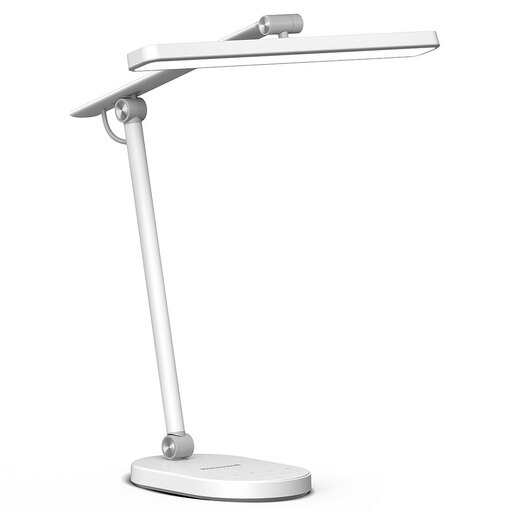
Why this product suits the profile: This table lamp is designed for regular working and study sessions. According to the product details, it offers 700 lumens, three colour temperatures, five brightness levels and an adjustable arm.
Rather than making a blanket eye-protection claim, the product description lists technical features such as CRI 97, an anti-glare design and an RG0 rating. These details should be checked against the manufacturer’s information before purchase.
Automatic brightness adjustment via an ambient light sensor, memory function, night-light mode and 60-minute timer, according to the product data.

Why this product suits the profile: This USB reading lamp is designed for reading in bed, while travelling or in places without a permanent surface for a lamp. It can be used freestanding or as a clip-on lamp.
Its design does not depend on having a large desk. Two brightness levels, 350° rotation and adjustable angles allow precise positioning instead of broad, room-wide illumination.
Weight of 37 g, integrated 200-mAh battery, USB charging port and up to eight hours of operating time, according to the product information.
We have put together a complete, regularly updated list of products that fully meet these strict selection criteria and the safety regulations applicable in the EU.
A desk lamp should be placed to the side and slightly in front of the work surface. Right-handed people often place it on the left, so their writing hand creates fewer shadows; for left-handed people, the opposite position is preferable. The lamp head should not shine directly at eye level. Reflections on monitors can be reduced by positioning the lamp to the side and using moderate brightness.
For children, a stable base is particularly important. Cables should not cross walkways, and small USB lamps should be kept out of reach if they are not designed for unsupervised use. You can find more models for study areas in the children’s desk lamps category.
This depends on the distance, beam angle and ambient brightness. For a desk lamp, several brightness levels and even illumination are often more important than a single maximum value. A small reading lamp can work with fewer lumens if it is positioned close to the book.
Yes, if you use the lamp at different times of day or for different tasks. A dimmable table lamp lets you adjust the brightness to suit the room lighting. With integrated LEDs, you should also check whether the controls are operated by touch, a switch or a remote control.
Costs depend on the power rating, daily operating time and electricity tariff. A 14-watt LED light uses 0.014 kilowatt-hours after one hour of operation. To calculate the cost accurately, multiply this consumption by the daily usage time and your own price per kilowatt-hour. For an E14 table lamp, the power consumption of the bulb being used is the deciding factor.