
Lieferung heute & morgen

Qualitätsgarantie

Willkommens-Angebote freischalten: KOSTENLOSE Lieferung | Bis zu 80 % RABATT | Kostenlose 30-Tage-JoyPlus-Testphase
App herunterladen
A table lamp should provide the right lighting for the room, take up little space and work reliably in everyday use. However, product images and marketing claims do not always lead to the right purchasing decision. Three points in particular are often underestimated:
Choosing the right lamp therefore depends on more than appearance alone. The room, intended use, power supply and technical specifications should all be considered together.
Colour temperature is measured in Kelvin:
A dimmable table lamp is useful if it will be used at different times of day. However, when comparing products, it should be clear whether the brightness can be adjusted continuously or only through fixed levels. Specifications in lumens are also helpful: a reading lamp generally needs more targeted and brighter illumination than a purely accent light.
With an LED table lamp, light distribution and the cover are also important. An acrylic or plastic diffuser can distribute the light more evenly. A slim lamp with 360-degree illumination is more suitable for a table where several people sit, while a desk lamp should direct its light precisely onto the work surface.
With a rechargeable table lamp, battery life should always be considered together with the brightness setting used. A specification such as “up to 48 hours” often refers to the lowest power setting. At high brightness, the operating time may be considerably shorter.
Check the following before buying:
A battery-powered table lamp with USB-C can be charged using many existing power adapters. A lamp with a contact charging station is convenient to position, but the station remains an additional component that is required. For use on a patio or while camping, you should also check the IP rating in the product details. “Suitable for outdoor use” does not replace information on whether the lamp is merely protected against splashes or can also withstand rain.
The height needs to suit the intended location. A 21 cm-high lamp is suitable for a bedside table, shelf or sideboard. Larger models measuring around 34 to 38 cm in height can make more of an impact on a dining table or larger chest of drawers.
Look for:
A traditional table lamp with a replaceable bulb offers different benefits from one with an integrated LED. With E14 or E27 models, check whether the bulb is included. According to the product information, for example, the Premier-Housewares model does not include a bulb; it is designed for an E27 bulb up to a maximum of 40 W.
The following recommendations categorise specific models according to their intended use and objectively stated product features.

Why this product suits this profile: The compact 21 cm-high lamp does not require a permanent mains connection and is suitable for a bedside table, desk or sideboard.
The product details specify a USB-rechargeable battery, three-stage touch dimming and a fixed colour temperature of 3000 K.
2 W LED, 210 lm, 3000 K and cordless operation in a compact metal housing.
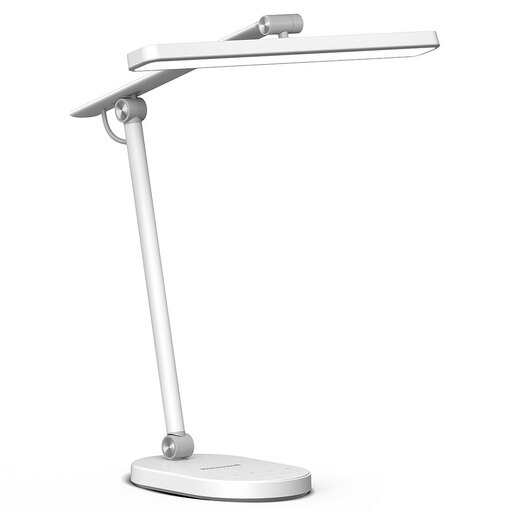
Why this product suits this profile: For longer periods of work or reading, this desk lamp offers an adjustable arm and lamp head, as well as several brightness and colour temperature settings.
Instead of making a blanket marketing claim, the product description provides specific details such as 700 lm, 3000–5000 K, five brightness levels and a 60-minute timer.
108 LED chips, touch controls, memory function and ambient light sensor according to the product details.
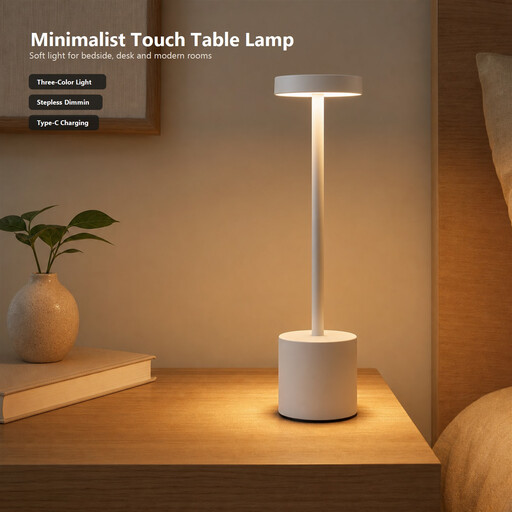
Why this product suits this profile: The 34 cm-high battery-powered table lamp can be used indoors, at the dining table or on the go, and operated via touch control.
The specifications distinguish between up to 48 hours at low power and up to 9 hours at high power. This gives a more realistic indication of the operating time.
3000, 4500 and 6000 K, continuous dimming by long touch and USB charging.

Why this product suits this profile: The clamp saves desk space and is suitable for desks, shelves or work surfaces with an edge up to 74 mm thick.
The clamp design is not merely described as “mobile”; the maximum edge thickness of 74 mm is specified clearly.
2.5 W, 160 lm, 4000 K, three brightness levels and a flexible gooseneck.
Running costs depend on the wattage, daily usage time and electricity tariff. The simple calculation is:
Power in kW × operating hours × electricity price per kWh = running costs
A 2 W LED light uses considerably less energy with four hours of daily use than a 40 W bulb. However, you should still check the energy efficiency class and the stated consumption per 1000 hours. With battery-powered models, charging losses may not always be included in the product data.
We have put together a complete, regularly updated list of products that fully meet these strict selection criteria and the safety regulations applicable in the EU.
For reading, targeted and sufficiently bright illumination is important. Lumen ratings, an adjustable lamp head and a dimming function make it easier to adjust the light. The lamp should be positioned so that your body does not cast a shadow over the reading surface.
The lifespan depends on the LED module, heat dissipation, electronics and usage. With integrated LEDs, replacing the bulb is often not possible. With a lamp featuring an E14 or E27 fitting, the bulb can be replaced separately. Product details and warranty conditions should therefore be checked before buying.
Only if the manufacturer explicitly states that it is suitable for outdoor use and specifies an appropriate IP rating. Even then, the lamp should be protected from heavy rain, prolonged damp and frost. An indoor table lamp should not be placed on an unprotected patio.