
Lieferung heute & morgen

Qualitätsgarantie

Willkommens-Angebote freischalten: KOSTENLOSE Lieferung | Bis zu 80 % RABATT | Kostenlose 30-Tage-JoyPlus-Testphase
App herunterladen
A table lamp should do more than complement your interior style. It needs to stand safely where intended, provide enough light and be easy to use day to day. However, there are clear differences between decorative table lamps, functional desk lamps and flexible clip-on lamps.
Many poor purchases result from three common marketing traps:
A table lamp with an E14 fitting is often suitable for compact bulbs. A table lamp with an E27 fitting offers a wider choice of LED bulbs in different shapes and brightness levels. According to the product information, the Premier Housewares model uses an E14 fitting for a maximum of 40 W at 240 V. The bulb is not included.
For an LED lamp, lumens are more informative than watts. Lumens describe the amount of light emitted, while watts indicate energy consumption. In many cases, moderate brightness is sufficient for a bedside lamp. A reading lamp or desk lamp, on the other hand, should be positioned so that the work surface or page is lit evenly.
The colour temperature in Kelvin affects how the light appears:
Before buying, compare the lamp’s height, shade diameter and depth with the space available. A bedside lamp should not block the light switch or other items. For a small shelf, a compact modern table lamp is often more practical than a model with a large shade.
For a height-adjustable table lamp, you should also check how far the stem can actually be adjusted and whether the construction remains stable in the desired position. A low desk may require a different lamp height from a tall bedside table.
A table lamp with a cable needs an accessible socket and a suitable cable length. An EU plug is practical for German households, but does not replace checking the product labelling, instructions and electrical specifications.
A rechargeable table lamp can be used without a permanently connected cable. The key factors here are battery capacity, charging connection, stated operating time and charging time. With a clip-on lamp, the maximum clamp width must suit the desk, bed frame or shelf. The clamp must also not damage the surface and needs to be secure enough to stay firmly in place.
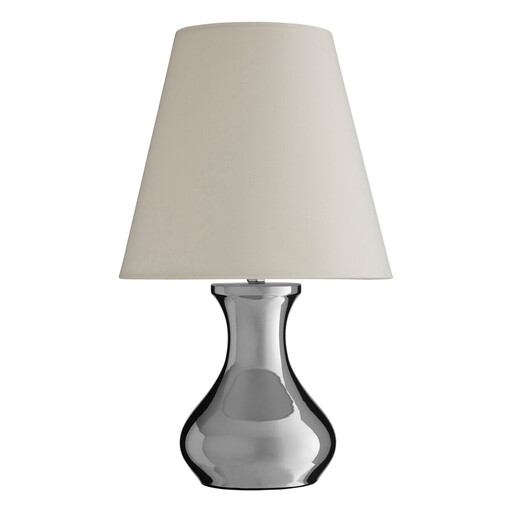
Why this product suits the profile: This compact lamp is designed for bedrooms, side tables or bedside tables, combining a metal base with a white fabric shade.
The product details specify the fitting, voltage, maximum wattage and dimensions. This makes it possible to check before buying whether the bulb and available space are suitable.
EU plug, 22 cm diameter and E14 fitting; the bulb must be selected separately.
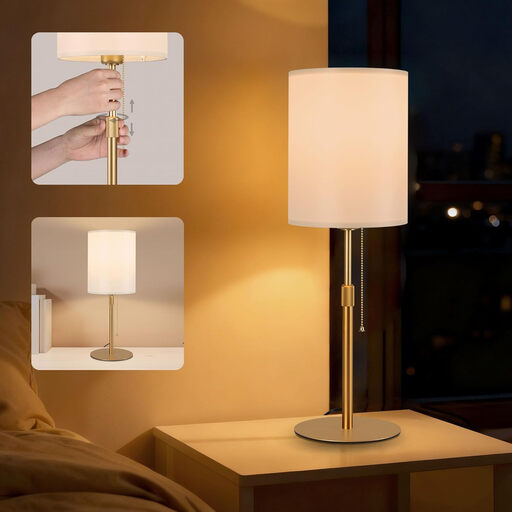
Why this product suits the profile: The height-adjustable stem and fabric shade suit bedside tables, consoles and desks of different heights.
The adjustable height reduces the risk of the shade sitting too low or too high in the wrong position. The E26 specification should be checked against the intended bulb before buying.
Telescopic stem, pull-chain switch, gold-coloured metal base and fabric shade; suitable for LED, CFL or incandescent bulbs according to the product description.

Why this product suits the profile: This clip-on lamp is suitable for flexible workspaces, shelves, bed frames or reading situations where keeping the surface clear is important.
The specifications state the clip-on design, 160 lm, 4,000 K, three brightness levels and a 1,200-mAh battery. This makes the lamp’s limits easier to assess.
2.5 W LED output, 5 V USB charging voltage, flexible silicone holder and stated operating times of 3, 7 or 30 hours.
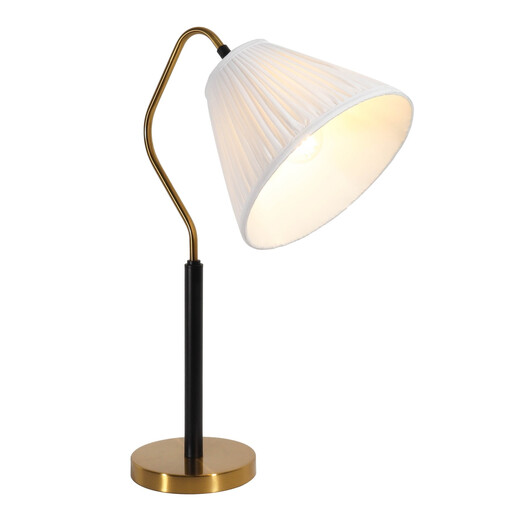
Why this product suits the profile: With its fabric shade, this table lamp combines a classic shape with an E27 fitting, making it suitable for living rooms or bedrooms with decorative lighting.
The maximum output of 40 W and the E27 fitting are specified. Before installation, you should still check whether the chosen bulb fits inside the shade.
Curved lamp arm, pleated fabric shade, wooden elements and a 1.6 m power cable with switch.
We have put together a complete, regularly updated list of products that fully meet these strict selection criteria and the safety regulations applicable in the EU.
Consumption depends on the wattage and how long the lamp is used each day. A 2.5 W LED table lamp uses less electricity over the same period than a 40 W bulb. You can use the following calculation for comparison: wattage in watts × operating hours ÷ 1,000 = kilowatt hours. To calculate running costs, multiply this figure by your electricity tariff.
A reading lamp should illuminate the book or work surface as evenly as possible. Neutral white light at around 4,000 K may be suitable for a desk, while warm white light often works better with a cosy bedside lamp. A flexible clip-on lamp or adjustable lamp arm makes it easier to direct the light.
With built-in LEDs, lifespan depends on the design, heat dissipation and usage. For a battery-powered lamp, charging cycles are an additional factor. Manufacturer specifications should therefore be treated as technical guidelines. With replaceable bulbs, the lamp can continue to be used independently of the bulb’s lifespan.