
Lieferung heute & morgen

Qualitätsgarantie

Willkommens-Angebote freischalten: KOSTENLOSE Lieferung | Bis zu 80 % RABATT | Kostenlose 30-Tage-JoyPlus-Testphase
App herunterladen
A table lamp should do more than look good. It needs to stand securely where you plan to use it, provide enough light and be easy to operate. Models can also vary considerably in their light colour, brightness, power supply and extra features.
It’s easy to run into problems when important details are overlooked. For example, a decorative table lamp may not provide enough light for reading. A desk lamp might look compact in product photos but take up more space than expected in real life. And terms such as ‘eye-friendly’ or ‘energy-saving’ should always be checked against the technical specifications.
A decorative table lamp for the living room or bedside table won’t necessarily work as a reading lamp. Key factors include the luminous flux in lumens, how the light is distributed and the position of the lamp head. For focused work, even lighting across the work surface matters more than an eye-catching shape.
Depending on the model, a dimmable table lamp may offer three, four or more brightness settings. Other lamps let you adjust the brightness continuously. This can make a difference in everyday use: a bedside lamp often needs a lower setting than a desk lamp in a home office.
A cordless table lamp gives you more flexibility, but it needs to be charged regularly. Check the stated battery capacity, charging time and run time at low and high brightness. A mains-powered table lamp doesn’t need charging, but you’ll need a socket nearby.
Luminous flux is measured in lumens (lm) and describes the amount of light emitted. A lower value is often enough for decorative lighting. For reading or working, you’ll want a focused, sufficiently bright light. The actual effect also depends on the lampshade, light distribution and distance from the work surface.
Colour temperature in kelvins (K) describes the appearance of the light:
An LED table lamp with adjustable colour temperature is a practical choice if you want to use it both at your desk and on your bedside table.
The CRI or Ra value indicates how naturally colours appear under the light. A high value can be useful for creative work, product photography or choosing clothes. However, it doesn’t replace checking the brightness and light distribution.
Touch controls are particularly handy on a touch table lamp beside the bed or on a small side table. Check whether a quick tap simply switches the lamp on and off or cycles through several brightness settings too. On some models, a longer touch lets you adjust the brightness continuously.
A memory function saves the last setting you chose. This is useful if you tend to use the lamp at the same brightness each time. A timer, calendar display or automatic brightness adjustment can add extra functionality, but not everyone will need these features.
For a bedroom or office, consider the cable length, plug and base. A rechargeable table lamp is suitable if you plan to move it between locations. Battery-powered models should only be used in the dry areas specified by the supplier. An IP rating such as IP20, for example, indicates that the lamp is intended for use in dry indoor spaces; it does not mean that it is protected against water.
Place every table lamp on a flat, stable surface. Don’t cover any ventilation openings. Unplug the lamp before cleaning it.

Why it suits this type of user: This compact LED table lamp combines 8 W power consumption with touch controls and a stated light output of around 400 lm. It’s suitable for simple tasks at your desk, on your bedside table or in the living room.
Details of its power, touch dimming and warm white light make its basic functions clearer than a design description alone. The USB port is a handy extra for use at your desk.
8 W, around 400 lm, touch controls, dimmable and USB charging port; stated to be intended for indoor use.
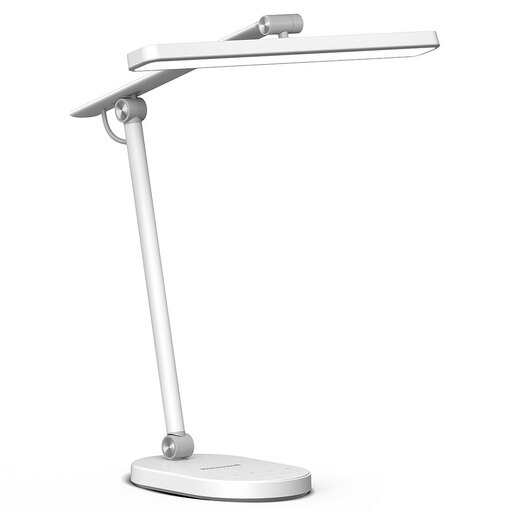
Why it suits this type of user: This model is aimed at people who want adjustable lighting while they work. According to the product description, it offers 700 lm, three colour temperatures between 3,000 and 5,000 K, and five brightness settings.
Its adjustable design helps you direct the beam onto your work surface. The brightness settings and colour temperatures are clearly specified, so you don’t have to guess from promotional images.
700 lm, touch controls, automatic brightness adjustment according to the product details, memory function and 60-minute timer.

Why it suits this type of user: This rechargeable table lamp is designed for anyone looking for portable, decorative lighting without a permanent mains cable. According to the product details, it has a 4,000-mAh battery and ten dimming settings.
The battery capacity and stated run time of up to 160 hours at the lowest brightness give you a useful guide. The product information states that the lamp isn’t intended for use around water or in damp areas.
Cordless use, 4,000-mAh battery, ten dimming settings and warm light at 2,400 K and 3,000 K, according to the product description.
We’ve put together a complete, regularly updated list of products that meet these strict selection criteria and fully comply with the safety regulations in force in the EU.
It depends on the distance, lampshade and light distribution. For reading, it’s worth choosing a model with a clearly stated light output and a focused beam. There’s no single lumen figure that suits every room. What matters is that the page of your book is lit evenly without glare from the light source.
Energy use depends on the wattage and how long the lamp is on each day. An 8 W lamp switched on for five hours a day uses a calculated 40 Wh per day. The actual cost depends on your electricity tariff. Dimmable models may use less power at a lower setting, if the manufacturer provides information on this.
Many suppliers state an expected LED lifespan, for example up to 50,000 hours. This is the manufacturer’s estimate, not a guarantee for every situation. The power supply, switch, battery and mechanical parts may have different lifespans. For a cordless table lamp, also check whether the battery can be replaced and how its run time changes with use.