
Lieferung heute & morgen

Qualitätsgarantie

Willkommens-Angebote freischalten: KOSTENLOSE Lieferung | Bis zu 80 % RABATT | Kostenlose 30-Tage-JoyPlus-Testphase
App herunterladen
A table lamp should do more than simply decorate a room; what you need from it depends on where you use it. In a home office, it should light your workspace evenly. On a bedside table, it should take up little room and avoid glare. For reading, the right brightness, a useful beam angle and easy controls are what count.
Many poor buying decisions come down not to design, but to overlooked details. The points below will help you choose the right table lamp for your bedroom, living room, home office or bedside table.
Wattage describes energy consumption first and foremost, not the amount of light produced. Brightness is measured by luminous flux in lumens (lm). Depending on its design, a 7 or 8-watt LED desk lamp may produce a different amount of light from another model with the same power consumption.
For a reading or desk lamp, it’s also important to consider how evenly the light is distributed. A high lumen rating alone doesn’t guarantee comfortable lighting if the beam is very narrow or the lamp causes a lot of glare.
A dimmable table lamp is useful if you want to use it for work during the day and reading in the evening. However, adjusting the brightness alone won’t automatically change the colour temperature. Warm white light often feels more inviting, while neutral or cooler tones may be preferable for focused tasks.
If you want a lamp for different situations, look for one with an adjustable colour temperature. A lamp with a fixed warm-white setting won’t offer this feature.
A decorative table lamp may look right in your room, but a small shade or low-profile design may only illuminate a limited area. If you’re considering a model with a replaceable bulb, check that it has an E27 or E14 fitting and find out the maximum permitted wattage.
Cable length, switch position and base size often only become important after purchase. A bedside lamp should have an easy-to-reach switch, while a desk lamp should be as stable and space-saving as possible.
A table lamp with an E27 fitting gives you flexibility when choosing a bulb. The colour, brightness and, in some cases, dimmability will then depend on the bulb you use. Make sure you stay within the maximum wattage stated for the product.
Built-in LEDs don’t need a separate bulb. When choosing one, check the luminous flux, colour temperature, dimming function and stated lifespan. With these models, you usually can’t change the colour temperature later.
A table lamp with USB charging can make it easier to charge a mobile phone or other compatible devices at your desk. However, the USB port doesn’t replace the lamp’s power supply. Use it only for devices with charging requirements that are compatible with the port.
For a battery-powered reading lamp, battery capacity, charging time and stated operating time are key considerations. For everyday use at a desk, a mains connection is usually more straightforward. All lamps should be stable, kept in dry indoor spaces and given adequate ventilation as basic safety measures.
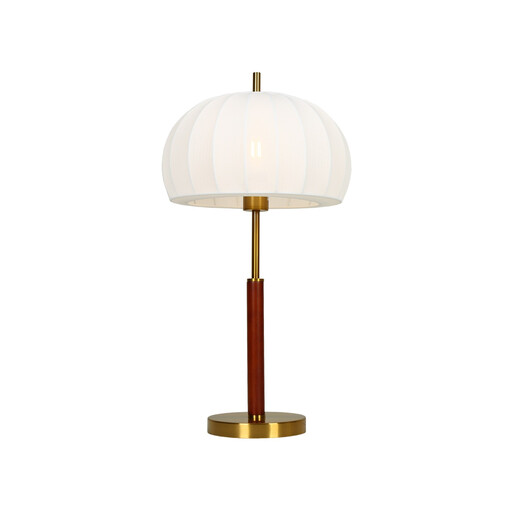
Why this product suits this profile: This compact table lamp is designed for indoor use and pairs a white fabric shade with a rubberwood base. It works well as a bedside lamp or as a subtle light in the living room.
The E27 fitting means you can replace the bulb. You’re not tied to a fixed colour temperature or brightness.
E27 plastic fitting, maximum 40 W according to the product details, fabric shade and for indoor use only.
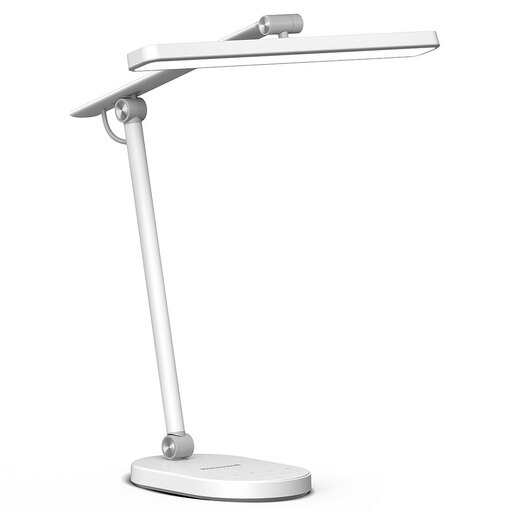
Why this product suits this profile: This model is designed for people who need a choice of lighting settings and flexible positioning for work or study.
You’re not limited to a single brightness setting. According to the product details, it offers five brightness levels and three colour temperatures.
14 W, 700 lm according to the product details, adjustable arm and head, touch controls, timer and memory function.
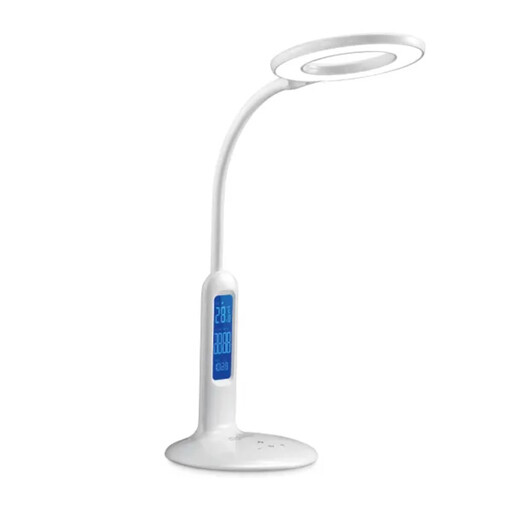
Why this product suits this profile: This lamp combines task lighting with calendar, temperature and alarm displays. It could be a good choice for students or professionals with limited desk space.
The colour temperature is adjustable, so you don’t have to choose between a desk lamp that’s only warm white and one that’s only cool white.
7 W, 360 lm according to the product details, colour temperature from 2700 to 6500 K, stepless touch dimming and adjustable arm.

Why this product suits this profile: This compact reading lamp can stand on its own or be attached with the clip. That makes it suitable for use by the bed, when travelling or on small surfaces.
You’re not tied to a fixed spot on a table. Two brightness settings make it easy to adjust the light while reading.
16 lm, 3000 K, 200 mAh battery, USB charging port, up to 8 hours of use and an adjustable design, according to the product details.
We’ve put together a complete, regularly updated list of products that meet these strict selection criteria and fully comply with the safety regulations in force in the EU.
It depends on the distance, lampshade and room lighting. Around 300 to 500 lm may be enough for a defined reading or work area. What matters is even lighting without looking directly at the light source. A small book light may need fewer lumens because it sits very close to the page.
An 8 W LED table lamp uses 0.008 kWh for every hour it’s switched on. At an assumed electricity price of 0.35 Euro per kWh, that works out at around 0.28 cents per hour. The actual cost depends on your electricity tariff and how long you use the lamp. For a table lamp with a replaceable bulb, calculate consumption based on the LED bulb you install.
For a bedside table, look for a compact base, an easy-to-reach switch and light that won’t cause glare. A table lamp with an E14 or E27 fitting lets you choose a suitable bulb. If you read in bed, a flexible reading lamp or USB-rechargeable clip-on lamp is another option. In general, the lamp should stand securely and only be used in dry indoor spaces.