If you have lots of bowls to wash between class sessions and a water connection is available, a tabletop model with six place settings is a good starting point. Without a fixed water supply, a smaller tank model may be suitable, although larger loads could mean running extra cycles. The place-setting capacity does not tell you whether your bowls will actually fit in the rack, so check their dimensions, the drainage set-up and the programme duration for the specific model. If the class is run as a food business, the cleaning process must also comply with the business’s hygiene procedures.
Who is a tabletop dishwasher suitable for at a cookery class?
Class leaders with lots of bowls to wash
If you have lots of breakfast bowls to wash between class sessions, compare the rack capacity and programme duration, and work out how many cycles will fit into your schedule. Product information from Bomann and Midea Deutschland lists models with different place-setting capacities.
Class leaders without a fixed water supply
If there is no suitable water connection at your class venue, check how the tank is filled, how wastewater is drained and how much space the appliance needs. Bomann and HAVA describe tabletop models that use a water tank.
Food business operators
If the class is run as a food business, dishwashing must form part of its hygiene procedures. The Federal Office of Consumer Protection and Food Safety explains the responsibilities of food business operators; how the rules apply in practice depends on the business.
What should you consider when choosing one?
For breakfast bowls, the key considerations are whether they fit in the rack, how water is supplied and drained at your class venue, and how much time you have.
| What matters |
What to check before buying |
Who is this important to? |
| Bowls per cycle |
Compare the bowls’ diameter and height with the rack layout and the clearance needed for the spray arm. |
If I want to run as few cycles as possible between servings, the usable rack space is crucial. Around 40 % of consumers prioritise capacity. |
| Water supply and drainage |
Check whether the appliance uses a tank or a water connection, and whether there is a suitable place for the drain hose at your class venue. |
If there is no fixed water supply at my class venue, I want to know how water gets in and out. Around 30 % of consumers put this connection flexibility first. |
| Space and time |
Measure the available surface, appliance height and door opening; check how long the programme takes with the load you plan to wash. |
If worktop space is limited and the cycles need to fit around the class schedule, I compare the space needed with the available programmes. Around 20 % of consumers prioritise this combination. |
| Hygiene and running costs |
If you run a food business, check that the cleaning process fits its hygiene plan; compare EU label figures on a like-for-like basis to assess costs. |
If cleaning needs to meet the requirements of my business and I need to plan running costs, I check these separately. Around 10 % of consumers put hygiene or running costs first. For comparisons using the EU label, the Verbraucherzentrale recommends looking at figures including electricity use per 100 Eco cycles and water use per Eco cycle. |
Common buying misconceptions
-
Assuming the number of place settings equals the number of bowls that will fit
The place-setting capacity does not tell you how many breakfast bowls of a particular shape will fit side by side in the rack.
Measure your bowls and check the rack layout and clearance around the spray arm. Work out how many cycles you will need based on the dishes you actually use.
-
Assuming “no water connection” means no need to plan for water or drainage
A tank model still needs water to fill it, as well as a suitable way to drain the wastewater.
Check the tank and drainage arrangements at your class venue before buying. Filling the tank and setting up the drain also take time between class sessions.
-
Assuming a “hygiene programme” is proof that a dishwasher is suitable for a business-run class
A manufacturer’s stated programme temperature alone does not prove that the cleaning process will meet the requirements of a particular food business’s hygiene procedures.
If the class is run as a food business, include the dishwashing process in its hygiene plan and raise any questions with the relevant food safety authority.
Relevant brands and model ranges
Bomann
The German product information includes a tank model with three place settings and a model with a water connection and six place settings.
- The model specifications make it possible to compare tank operation with a higher stated capacity. Source: Bomann.
- The TSG 7405 is specified as requiring a water connection; the TSG 5702 has a lower stated capacity. These are manufacturer specifications, not comparative cleaning test results.
Midea
The German product pages list one model with three place settings and another with six.
- The different stated capacities give you a basis for weighing up appliance size and potential batch sizes. Source: Midea Deutschland.
- The programme temperature stated by the manufacturer for the ST 3.6F wi does not prove a particular disinfecting effect or that the appliance is suitable for every business-run class.
HAVA
According to the product information, the R09 is a tank model with three place settings and an alternative way to supply water.
- The tank and alternative water supply may be useful at different class venues. Source: HAVA.
- The stated capacity is three place settings; temperature and consumption figures are manufacturer specifications, not independent proof of hygiene performance.
Medion
The DWT60 (MD37496) is described as a tabletop model for six place settings with a water connection.
- The stated capacity is a useful point of comparison for larger loads. Source: Medion.
- The product information specifies a water connection. Check that the connection and available space are suitable for your class venue.
Tabletop dishwashers at Joybuy
The tabletop models below include dishwashers with six place settings, as well as compact tank models for smaller loads. Whether your breakfast bowls will fit depends on their dimensions and the rack layout.
 No image available
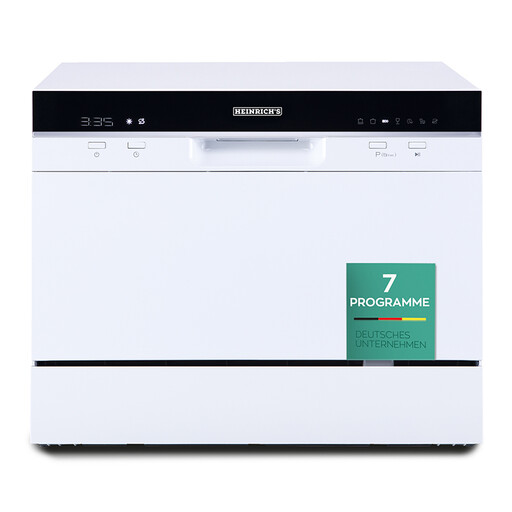
Heinrich's HTG 8840 tabletop dishwasher, white
May suit larger loads if a water connection is available at your class venue; check that your bowls fit in the rack.
The specifications list six place settings, seven programmes and a 30-minute quick programme. The product information also mentions inlet and drain hoses, and states that the appliance is for domestic use only.
View at Joybuy
 No image available
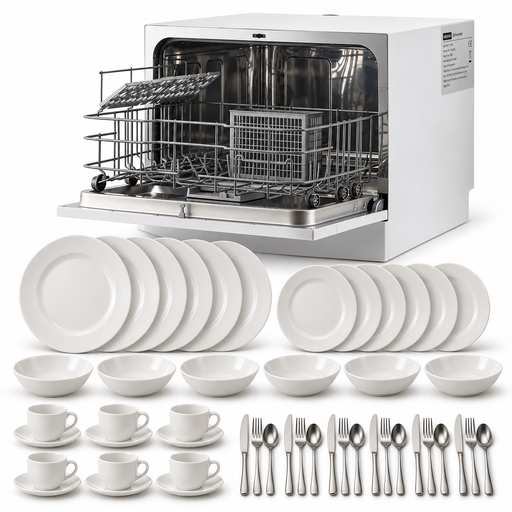
Ochama tabletop dishwasher for six standard place settings
The stated capacity can be a useful guide when comparing models for several items of crockery; check it against the shape and size of your bowls.
The product name specifies six standard place settings, a 30-minute quick wash and eight functions.
View at Joybuy
 No image available
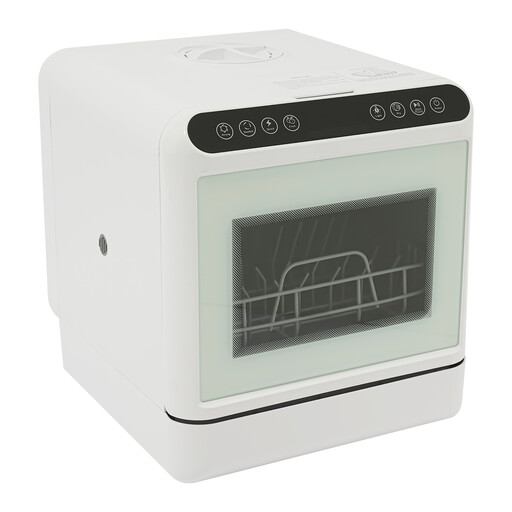
Compact portable tabletop dishwasher with water tank
An integrated tank may be a good option if there is no fixed water supply at your class venue; you will still need to plan for wastewater drainage.
The product name specifies a 1.32Gal tank, hot-air drying and a 72-hour storage function. An EU plug is specified.
View at Joybuy
 No image available
AIRMSEN tabletop dishwasher with integrated 5-litre tank
Tank operation may be useful at a class venue without a fixed water supply; compare the stated dimensions with the space available.
The product name specifies nine programmes and dimensions of 37 × 50 cm. According to the product information, a separately sold adapter may be needed to connect it to a tap.
View at Joybuy
 No image available
Heinrich's HTG 8855 mini tabletop dishwasher
May suit smaller loads and a class venue without a fixed water supply; if you have lots of bowls, plan for extra cycles.
The product information specifies three place settings, a 5-litre tank and seven programmes. According to the product information, the appliance is for domestic use only.
View at Joybuy
Frequently asked questions
Are six place settings enough for six breakfast bowls?
Not necessarily. The place-setting capacity does not guarantee that a particular number of bowls of any shape will fit. Measure your crockery and check the rack layout and clearance around the spray arm for the specific model.
Can a tank model run at a class venue without a water connection?
Yes, provided the model is designed to use a tank. The Bomann TSG 5702 is specified as having an integrated 5-litre tank, but you will still need to plan how to fill it and drain the wastewater.
How do I compare electricity and water running costs?
Compare the figures on a like-for-like basis: the EU label shows electricity use per 100 Eco cycles and water use per Eco cycle. To estimate your costs, factor in the number of cycles you expect to run and your actual tariffs. Other programmes may use different amounts.
What if I run the cookery class as a food business?
The food business operator is responsible for food safety. Regulation (EC) No 852/2004 requires items and equipment that come into contact with food to be thoroughly cleaned and, where necessary, disinfected. Whether your class counts as a food business, and which dishwashing process is sufficient, depends on the circumstances; check with the relevant food safety authority. The regulation provides an exemption for food prepared at home for private consumption.


