Hosts with lots of cups
You want to wash cups and other dishes after a get-together in as few loads as possible. Rack space and suitable connections matter more than choosing the narrowest appliance.


If you have lots of cups and extra dishes to wash, a tabletop dishwasher with a higher stated capacity is a good place to start. If there’s no fixed water supply and you only have a smaller load, consider models specifically designed to work with a built-in tank. Check the height and handles of your cups against the rack, as well as the available space, water supply and drainage. The number of place settings won’t tell you how many of your cups will fit. A quick programme can save time, but the consumption figures on the energy label are based on Eco programmes.
You want to wash cups and other dishes after a get-together in as few loads as possible. Rack space and suitable connections matter more than choosing the narrowest appliance.
You need a tabletop appliance specifically designed for manual water filling, and you’ll still need to plan for suitable drainage.
You only have a few cups to wash and need to check the appliance’s dimensions, the space needed with the door open and the rack against the area available.
For cups after a get-together, the key things to consider are usable rack space, the water supply, the space available where you’ll put it and the choice of programmes.
| What matters | What to check before buying | Who is it especially relevant to? |
|---|---|---|
| Rack space for cups and dishes | Check the height and handles of your cups, the cup holders and the space for plates or cutlery in the actual rack. | If we have lots of cups and extra dishes after a meal, I want to load as many of them together as possible. Around 33 % of consumers prioritise rack space for cups and other dishes. |
| Water supply and drainage | Check whether the specific model uses a tank or a water connection, and how the hoses can be routed and drained in your chosen location. | If there’s no fixed water supply there, I need a model designed to be filled manually, but I still need suitable drainage. Around 27 % of consumers prioritise the water supply and wastewater drainage. |
| Space and cup height | Check the worktop, the space needed to open the door, the hose route and the usable height of the rack. | If worktop space is limited, I want to make sure the appliance will fit with the door open and that my cups will fit inside. Around 20 % of consumers prioritise the space available for the appliance. |
| Wash time and running costs | Check the programme duration and whether it suits your load. Don’t apply Eco consumption figures to quick programmes. | If I’ll need the cups again soon or wash up regularly, I’m interested in quick programmes and comparable consumption figures. Around 20 % of consumers prioritise wash time or running costs. |
Manufacturers’ figures for place settings and cup holders don’t tell you whether your cups will fit in the rack, given their height and handles.
Before you decide, check your cups against the rack dimensions and the instructions for the exact model.
If all your cups won’t fit together, you may need to run extra cycles.
Tank operation relates to the water supply. Appliances with a tank still need to drain wastewater appropriately.
Plan the drainage and hose route for your chosen location using the model’s instructions.
The consumption figures on the energy label are based on Eco cycles and don’t automatically reflect the consumption of a quick programme.
Compare programme durations separately from the Eco figures, and don’t use the label to estimate the cost of a quick programme.
The symbol indicates that a material is suitable for contact with food; it doesn’t mean it’s suitable for the dishwasher.
Check the care instructions for each cup. This guide assumes that the cups you’re considering are dishwasher-safe.
Bomann offers tabletop appliances with different stated capacities and water supply options.
The tabletop appliances listed differ in their stated capacity and features, among other things.
According to MEDION, the LIFE Mini Dishwasher DWT30 (MD370022) is designed for smaller loads and offers several water supply options.
According to Klarstein, the Aquatica 10047348 is a compact tabletop appliance with a tap connection.
This selection includes tabletop dishwashers for larger loads with a water connection, as well as compact models with a tank option. Depending on the model, also check how water is supplied and wastewater is drained.
 No image available
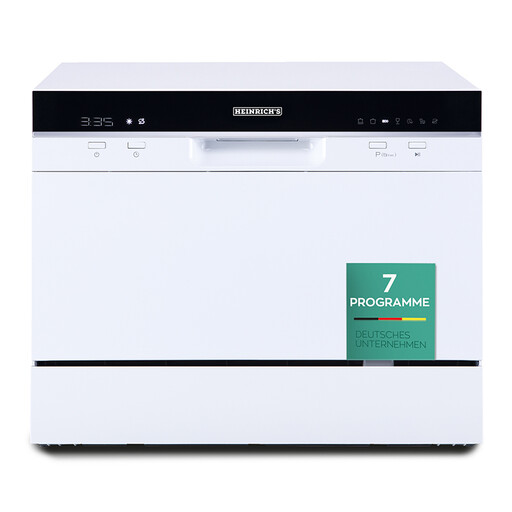
An option for larger loads if you can set up a water supply and drainage where you plan to put it.
The product name lists six place settings and seven programmes. A 1.500-mm inlet hose and a 1.720-mm drain hose are specified.
 No image available
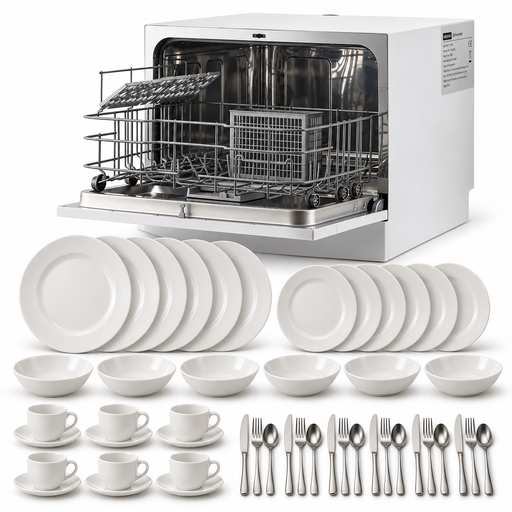
An option if you’re planning to wash cups along with other dishes in a larger load. Check that your cups fit in the rack.
The product name lists six standard place settings, a 30-minute quick wash and eight functions.
 No image available
A compact option if tank operation suits your set-up and you only need to wash a smaller load.
The product name lists a built-in 5-litre water tank and five wash cycles plus a drying mode. According to the product description, wastewater is drained through a hose into a container.
 No image available
A compact option if you’d like to use tank operation. Check in advance that the tap connection and drainage will work where you plan to put it.
The product name lists a built-in 5-litre tank and nine programmes. According to the product description, a separately sold adapter may be needed for the tap connection.
 No image available
An option for smaller loads if you’d like to use tank operation or connect it directly to a tap.
The product name lists three place settings, seven programmes and operation with or without a water connection.
No. Six place settings don’t equate to a set number of cups. Check the height and width of your cups, including their handles, against the usable rack space and cup holders in the specific model.
A model specifically designed for tank operation doesn’t need a fixed water supply. You’ll still need suitable drainage, and should check the set-up and hose instructions in the manual.
For comparisons, the Verbraucherzentrale recommends looking at electricity consumption per 100 Eco cycles, water consumption per Eco cycle and the duration of the Eco programme. These figures don’t automatically measure consumption for a quick programme. To work out the cost, you’ll need the consumption data for that programme, along with your own electricity and water prices.
No. The Verbraucherzentrale explains that the symbol indicates suitability for contact with food. For machine washing, follow the care instructions for the specific cup.
The Umweltbundesamt recommends not rinsing dishes with warm water before loading them and running the dishwasher as full as possible on the Eco programme. Always follow the appliance’s own instructions for care and maintenance too.