Washing several portions at once
You collect used containers and lids for a single wash. The key question is whether all the pieces fit in the basket without overlapping; a capacity of six place settings is only a guide for comparison.


When choosing a tabletop dishwasher for several lunch boxes, focus on the dimensions and arrangement of the containers and lids. A place-setting capacity doesn’t confirm that your particular load will fit. A larger appliance may be worth considering for washing several items at once, provided the basket, worktop space and water connection are suitable. A model with a water tank could be an option if there’s no water supply, but you’ll still need a safe way to drain the wastewater. For plastic containers, also check whether the specific model is dishwasher-safe and bear in mind that some moisture may remain after the cycle.
You collect used containers and lids for a single wash. The key question is whether all the pieces fit in the basket without overlapping; a capacity of six place settings is only a guide for comparison.
You’re looking for a worktop appliance that you can fill manually. Even with a tank-fed model, you’ll need to plan for the space it takes up and a suitable way to drain the wastewater.
You want to refill or put away your containers soon after washing them. Check that the specific container model is dishwasher-safe and bear in mind that plastic may still be damp after the cycle.
| What matters to you | What to check before buying | Who should pay particular attention |
|---|---|---|
| Basket space for containers and lids | Measure your containers and lids, then check the basket layout and door opening. The place-setting capacities listed by Midea Deutschland and Bomann don’t tell you how many lunch boxes will fit. | If I want to wash several portions, including their lids, in one cycle, all the pieces need to fit in the basket without overlapping. Around 40% of consumers say basket space is their main concern. |
| Positioning, water supply and drainage | Check the space available, including room for the door to open, and make sure the tank or water supply and drain hose will work there. | If space is limited or there’s no fixed water supply, I need a practical way to fill the appliance and drain the wastewater. Around 30% of consumers prioritise positioning and water connections. |
| Dishwasher suitability and drying | Check the care instructions for containers and lids separately, then look for any remaining moisture after the cycle. Bosch Hausgeräte points out that plastic may still be damp after washing. | If I want to refill or store containers soon after washing, the dishwasher-safety of each piece and any remaining moisture matter. Around 20% of consumers prioritise container care and drying. |
| Consumption and ongoing maintenance | Compare EU energy label figures on a like-for-like basis, and consider how many cycles you’re likely to need for your own load. | If I use the appliance regularly, I want to compare its consumption fairly and understand what maintenance it will need. Around 10% of consumers prioritise running costs and ongoing maintenance. |
Place settings describe a nominal capacity for crockery, while lunch boxes come in different shapes and heights. Midea Deutschland and Bomann list capacities in place settings; these don’t tell you whether a particular load of containers will fit.
Measure your containers and check how they fit in the specific basket before choosing between appliances with different place-setting capacities.
If the containers and lids won’t all fit together, you may need to run an extra cycle.
A tank can replace a fixed water supply, but it doesn’t remove the need to drain the used water. Bomann lists a tank and a drain hose for the TSG 5702.
Before buying, check the tank access, drain hose and appliance location together, and plan a safe route for the wastewater.
Manual filling and safely positioning the drain hose mean extra steps and careful planning for space.
The European Commission explains that EU energy label comparison figures are based on the Eco programme. Other programmes and the actual load can affect consumption.
Compare label figures on a like-for-like basis, and consider how many cycles you’re likely to need for your containers and lids.
Dishwasher-safe approval applies to the specific container model. It doesn’t mean every piece will be dry after the cycle. Bosch Hausgeräte notes that plastic may retain some moisture.
Check containers, lids and recesses before refilling or storing them closed, and dry them by hand if needed.
Midea Deutschland offers tabletop dishwashers with stated capacities of three or six place settings.
According to the manufacturer, the range includes both a tank-fed model and a tabletop model with a water connection.
Medion describes the MD 37291 as a three-place-setting appliance with extra height that can be used with or without a fixed water connection.
Daan Tech describes Bob as a compact mini dishwasher with a manually filled tank.
The Joybuy products below include compact tabletop models with tanks and appliances with stated capacities of three to six place settings. These figures don’t replace checking whether your containers and lids will actually fit in each basket.
 No image available
This tank-fed model may be an option if there’s no fixed water supply where you plan to position it. Wastewater still needs to be drained through a hose into a container.
The product description lists five wash programmes and a drying mode, an integrated 5-litre tank and the option to connect it to a tap.
 No image available
Could suit a compact space if the tank-fed operation and stated dimensions work for your kitchen.
The product description lists space for four standard place settings, nine programmes, drying and automatic ventilation. The tank needs to be filled manually; a tap adapter may be available separately.
 No image available
The stated capacity may suit smaller or split loads; check individually that your containers and lids will fit.
The title lists three place settings. The product description lists a 5-litre tank, seven programmes and an optional drying function; it can be used with or without a water connection.
 No image available
The stated capacity may help when comparing models for washing several portions, but it doesn’t confirm that your particular load of containers will fit.
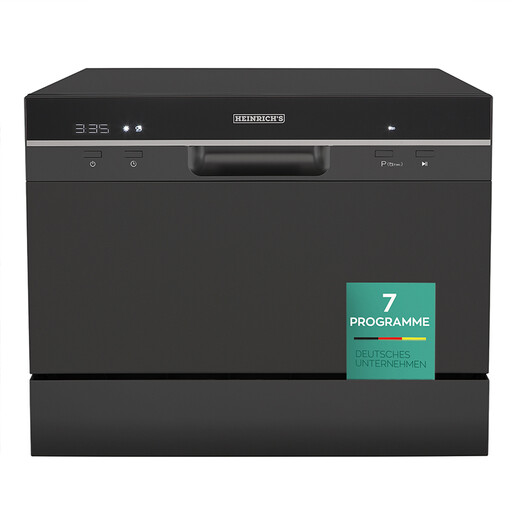
The product title lists six place settings, seven programmes and an Auto-Open drying system. The description lists a water connection, inlet hose and drain hose.
 No image available
Worth considering when comparing tabletop models for washing several portions; check the stated capacity against the actual arrangement of your containers.
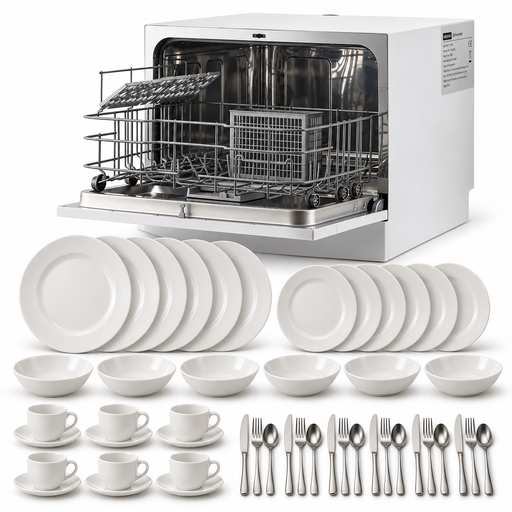
The product title and description list six standard place settings and eight functions. Programmes include a 30-minute quick wash.
No. Check the care instructions for your specific container and each of its parts. EMSA says its CLIP & CLOSE range described here is dishwasher-safe; that doesn’t mean other containers or every programme are suitable.
Yes, the wash water needs to be drained away. For the Bomann TSG 5702, the manufacturer specifically lists a drain hose as well as a tank; plan a safe route for the hose where you intend to position the appliance.
Check containers, lids and recesses before closing them, and dry them by hand if needed. Plastic may retain some moisture, and automatic door opening doesn’t guarantee dry seals.
On the EU energy label, compare energy use per 100 Eco cycles and water consumption per Eco cycle. The European Commission lists these as label figures; also consider how many cycles you’ll need for your actual load of containers.
Household dishwashers use the EU label, with a scale from A to G. According to the European Commission, it includes figures such as energy use per 100 Eco cycles and water use per Eco cycle, so compare appliances using the same label information.