The key factors are the washing instructions for every part of your lunchbox, whether it actually fits in the rack, and the connections available where you plan to put the dishwasher. If there’s no suitable fixed water supply, a model with a tank may be an option. For larger loads shared between several people, consider a model that connects to the mains, provided you have enough space and access to water and drainage. A tank only supplies fresh water, and advertised hygiene or steam features do not, by themselves, prove that your own lunchboxes will be disinfected.
Who are tabletop dishwashers suitable for in a shared kitchen?
Lunchbox users checking fit
If you regularly want to wash plastic containers, lids and small parts, check the washing instructions for each item and make sure it actually fits in the rack. The Verbraucherzentrale (German consumer advice centre) distinguishes the food-contact symbol from dishwasher suitability.
Kitchen teams without a fixed water supply
If you share a small kitchen and can’t use a fixed water supply, check how the dishwasher is filled with fresh water and plan where the wastewater will go. Tank operation is available, for example, on models from Medion and Midea.
Kitchen teams washing shared loads
If several people wash their lunchboxes together, the usable rack space and a suitable place for the dishwasher are important. Models such as the Bomann TSG 7405 are listed as holding six place settings, but that doesn’t tell you how many individual lunchboxes will fit.
What should you look for when choosing one?
Prioritise your choice according to what matters most: whether your lunchboxes fit, the water supply, shared loads or day-to-day running costs.
| Consideration |
What to check before buying |
Who will find this especially important? |
| Material and fit |
Check the washing instructions for each container, lid and seal individually; make sure your lunchboxes fit in the rack and through the door opening. |
If I want to wash my lunchboxes and lids regularly, I’ll check the relevant instructions and whether they fit first. Around 33% of consumers would prioritise material suitability and the right dimensions. |
| Water supply and drainage |
Check the available water supply, a safe route for wastewater and how the hoses can be routed at the installation site. |
If our shared kitchen doesn’t have a fixed water supply, I need a practical way to fill the dishwasher with fresh water and a clear route for wastewater. For around 27% of consumers, this would be the most important consideration. |
| Capacity and space |
Measure the space where you plan to put the dishwasher and think about a typical shared load, including lunchboxes and small items. |
If several people wash their lunchboxes together, I want to know whether a typical load will fit in the rack without taking up too much worktop space. Roughly 27% of consumers would consider shared-load capacity and available space first. |
| Noise and day-to-day running |
Compare noise levels, programme duration and consumption figures on a like-for-like programme basis. |
In a shared space, I want to coordinate running times and noise with everyone else’s routine. Around 13% of consumers would prioritise noise and ongoing running costs. |
Common misconceptions when buying
-
Confusing the food-contact symbol with dishwasher suitability
The glass-and-fork symbol indicates that an item is suitable for contact with food; it doesn’t automatically mean it’s dishwasher-safe. The Verbraucherzentrale explains the difference.
Check the instructions for containers, lids and seals separately before choosing a programme.
-
Assuming a water tank means you don’t need to plan for drainage
A tank supplies the dishwasher with fresh water, but it doesn’t automatically drain the used water.
Before you buy, check where the wastewater can go at your chosen location. Position the dishwasher and route the hoses according to the instructions for the specific model.
-
Assuming place settings guarantee a certain number of lunchboxes
The stated number of place settings doesn’t reflect the size or shape of your lunchboxes. Awkwardly shaped containers and lids may mean you need to run extra loads.
Compare your typical lunchboxes with the usable rack space and door opening, rather than relying on the place-setting capacity alone.
-
Assuming advertised steam or UV features guarantee disinfection
An advertised feature doesn’t prove that your own lunchboxes will be disinfected under your particular conditions of use.
For everyday use, follow the cleaning instructions for each part of your lunchbox and choose a suitable programme. Check any specific hygiene requirements separately.
Relevant brands at a glance
Medion
For the LIFE DWT30 (MD370022), Medion lists three place settings and operation with a fixed water supply, an integrated tank or a bucket. This may be useful if the available connections vary between locations.
- The documented operating modes offer several ways to supply water.
- The advertised fan drying for plastic doesn’t confirm that specific lunchboxes will dry. Three place settings don’t tell you whether your lunchboxes will actually fit.
Midea
Midea lists a 5-litre water tank for its compact MDWMT201DW tabletop dishwasher, and six place settings for its larger MDWTT0602MW-WE model.
- The two models address different space and connection requirements.
- Don’t assume the specifications are the same for both models. Check the relevant figures for the MDWTT0602MW-WE against the data sheet for that specific model.
Bomann
Bomann lists six place settings for the TSG 7405 and includes inlet and drain hoses. It’s worth considering if you want to wash several lunchboxes together and have suitable connections available.
- The manufacturer lists hoses for both the water supply and drainage.
- At 55,0 cm wide, the dishwasher needs enough space. Place settings don’t guarantee that your lunchboxes will fit or that you’ll achieve a particular hygiene result.
Bosch
The SKS2ITW00E is an example of a tabletop model with six place settings and documented product support.
- Bosch lists this specific model as no longer available. Information about this model can’t be applied to other dishwashers from the brand.
Related products at Joybuy
This selection includes tabletop dishwashers for shared loads and models with a water tank. For each one, check which water supply is available at your chosen location, how the wastewater will drain and whether your lunchboxes will fit in the rack.
 No image available
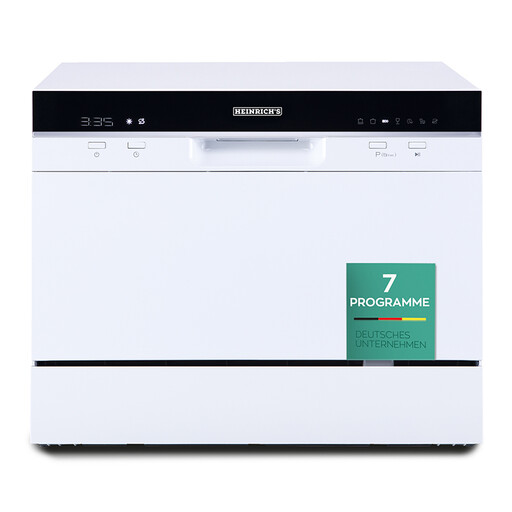
Heinrich's HTG 8840 tabletop dishwasher
This model connects to the mains and may suit a larger shared load, provided there’s a suitable water connection where you plan to put it.
It’s listed with six place settings and seven programmes; the product name also specifies 47 dB and energy class D.
View at Joybuy
 No image available
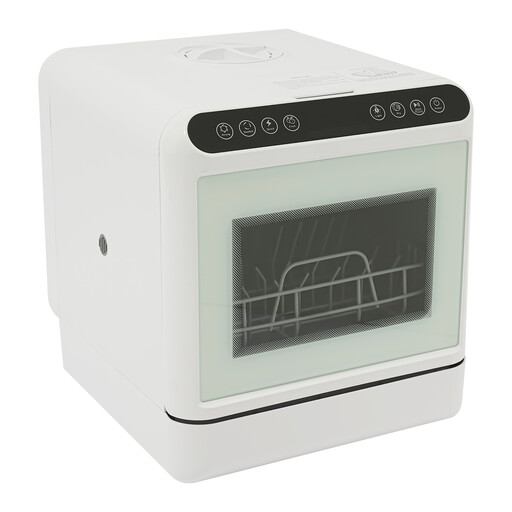
Compact tabletop dishwasher with integrated water tank
An integrated tank may be a good option if there’s no fixed water supply in your shared kitchen. You’ll still need a suitable way to drain the wastewater.
The product name lists a 1.32 Gal tank, hot-air drying and capacity for 4–6 people.
View at Joybuy
 No image available
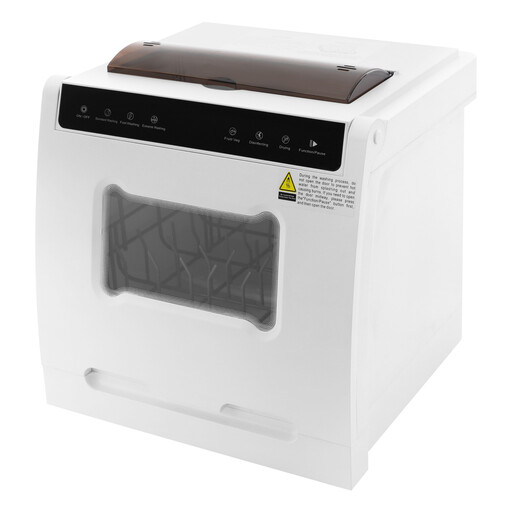
Tabletop dishwasher with 72 °C and six wash modes
This tabletop model may be suitable for lunchboxes if each part is compatible with the programme you choose.
The product name specifies high-temperature cleaning at 72 °C and six wash modes. This doesn’t confirm a disinfection effect for your own lunchboxes.
View at Joybuy
 No image available
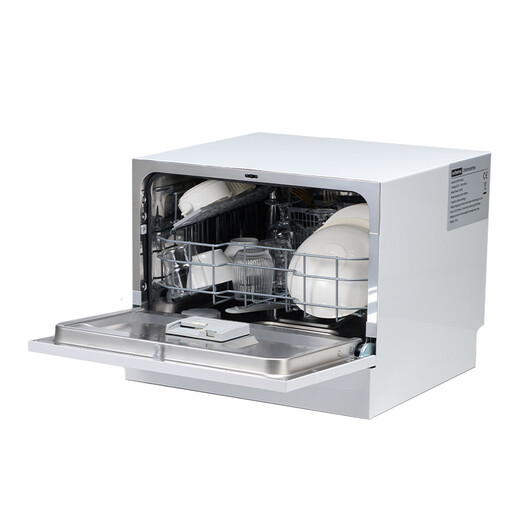
Ochama tabletop dishwasher with six place settings
It’s listed as holding six standard place settings, which may suit shared loads. Still, check that the rack shape works for your lunchboxes.
The product name also lists a 30-minute quick cycle, eight functions and a 24-hour delay-start option.
View at Joybuy
 No image available
AIRMSEN tabletop dishwasher with 5-litre water tank
The integrated tank may be useful if there’s no fixed water supply. The product description says a separately sold adapter may be needed to connect directly to a tap; you’ll also need to plan for wastewater drainage.
Features listed include a 5-litre tank and two spray arms.
View at Joybuy
Frequently asked questions about tabletop dishwashers for lunchboxes
Can you put every part of a lunchbox labelled dishwasher-safe in the dishwasher?
Check the manufacturer’s instructions for the container, lid and any seals. According to the Verbraucherzentrale, the glass-and-fork symbol indicates suitability for contact with food, not dishwasher suitability on its own.
Does a dishwasher with a water tank not need a drain?
It does. Even a model with a tank needs a safe way to drain wastewater. The tank supplies fresh water; position the dishwasher and route the hoses according to the instructions for the specific model.
How can I compare running costs?
Compare figures on a like-for-like programme basis. The Verbraucherzentrale says that the EU energy label shows electricity consumption in kWh per 100 Eco cycles. You can also use this figure alongside your estimated number of Eco washes and electricity tariff to work out a rough cost. Other programmes may use different amounts.
What are the rules on energy labels and old appliances in Germany?
According to the European Commission, household dishwashers have used the A to G scale on the EU energy label since 1 March 2021. Germany’s Federal Ministry for the Environment advises that waste electrical appliances must be handed in at an authorised collection point.
Are the same hygiene requirements in place for every shared kitchen?
No. Sharing a kitchen doesn’t automatically make it a commercial catering operation. If food is prepared there commercially for other people, those responsible should check the relevant hygiene requirements separately. The German Federal Institute for Risk Assessment treats communal catering as a separate area of application.


