Who are tabletop dishwashers suitable for?

People who batch-cook together

You collect lunchboxes and cookware from several meals and want your containers ready to use again before your next group cooking session. Check the basket layout and usable capacity with your actual lunchboxes, rather than relying on the place-setting capacity alone.

Busy kitchen teams

If several people share the hob and washing-up area at set times, a remaining-time display or delay start can make planning easier. The key is to choose a programme that suits your lunchboxes and finishes in time for their next use.

Small kitchens without a fixed water supply

A tank-fed model could be an option if there’s no fixed water supply where you plan to put it. Also check where the wastewater can drain safely, and make sure the appliance, hoses and open door will fit in the space available.

What should you look for when buying?

Tabletop model with a fixed water supply

Suitable if: you tend to collect several lunchboxes and cookware, and have a suitable water supply and drainage connection.

Things to consider: A larger appliance needs space and a suitable connection; a capacity of six place settings doesn’t guarantee that six bulky lunchboxes will fit.

Compact tabletop model with a water tank

Suitable if: you can’t use a fixed water supply and your actual load fits in the smaller basket.

Things to consider: You’ll still need to fill the tank by hand and provide a suitable way to drain the wastewater; larger loads may need extra cycles.

Buying criterion What to look for Who it matters to
Fit and load capacity Check your largest lunchbox, including its open lid, against the basket and cutlery tray, leaving enough clearance for the spray arm and door. If you collect lunchboxes and cookware until your next group cooking session, the actual load needs to fit in the basket. Around 28 % of consumers say handling this kind of collected load is their main concern.
Timing Check the programme duration and any drying time, as well as the delay start and remaining-time display for the exact model. If you share the kitchen and washing-up area at set times, what matters is when the full cycle finishes. Around 22 % of consumers say coordinating timings is their main concern.
Material compatibility Check the temperature limits for each container, lid, seal and insert against the programme you plan to use. If you want to keep using your lunchboxes, every part needs to be approved for the programme. Around 22 % of consumers say gentle cleaning is their top priority.
Water connection Check whether the appliance uses a fixed water supply or a tank, as well as the drainage route, hose position, available space and clearance with the door open. If there’s no fixed water supply where you plan to put it, that will determine your first choice of appliance; you’ll still need a working drainage route. Around 17 % of consumers say this connection requirement is their main concern.
Energy use and noise Compare Eco figures on the same basis: kWh per 100 cycles, litres per cycle, programme duration and dB(A). Once you’ve checked the fit and connections, energy use or noise levels could be the deciding factor. Around 11 % of consumers say these are their main considerations.

Common buying misconceptions

  • Assuming the place-setting capacity tells you how many lunchboxes will fit

    Place-setting capacity is a useful comparison, but it doesn’t tell you whether wide containers or tall lids will fit. A poorly arranged basket could mean splitting the load from your group cooking session across several cycles.

    Measure your largest lunchboxes with their lids open, then check the dimensions against the basket and available clearance in the exact model.

    Wide lunchboxes or lids can take up a lot of room, so you may need extra cycles.

  • Assuming a tank-fed model doesn’t need a wastewater drain

    An integrated water tank can replace a fixed water supply, but it can’t drain the wastewater for you.

    Before buying, check the full route for both the incoming water and wastewater where you plan to put the appliance.

    With a tank-fed model, you’ll need to fill it by hand and plan for a suitable place to drain the wastewater.

  • Assuming one hot programme is suitable for every part of your lunchbox

    Food-contact safety and dishwasher suitability are two different things. Higher temperatures may not suit some plastics; according to the Verbraucherzentrale, the term “dishwasher-safe” is not legally defined.

    Check the instructions for the container, lid and inserts separately, and choose a programme that stays within the temperature limits for each part.

  • Taking energy use per cycle as the total energy use

    A low energy-use figure per cycle doesn’t tell you how much you’ll use if you need several extra cycles.

    Compare Eco figures on the same basis and take into account how many loads you’ll actually need for your lunchboxes.

Brands and model ranges to consider

Exquisit

The manufacturer lists the GSP5206-030D as a tabletop model with six place settings and features to help you plan when it runs.

  • For the black version, Exquisit gives dimensions of 55 × 43,8 × 50 cm and a depth of 81 cm with the door open – useful measurements when checking your available space.
  • The dimensions and place-setting capacity don’t prove that your particular lunchboxes will fit in the basket.

Bomann

The range includes various tabletop models, including the tank-fed TSG 5702 and the TSG 7405, which connects to a water supply.

  • Bomann lists a 5-litre tank and three place settings for the TSG 5702; the TSG 7405 is listed with six place settings.
  • These specifications apply to the respective models. With several lunchboxes and extra cookware, the smaller basket may mean running several cycles.

Midea

According to Midea Germany, the MDWMT0305EW-WE is a tabletop model with three place settings that can run with or without a fixed water connection.

  • Midea gives dimensions of 435 × 420 × 465 mm for this model, along with Eco, Glass, Quick and Intensive programmes.
  • When checking the model and buying, make sure the specifications and documentation show the exact model number MDWMT0305EW-WE.

Klarstein

The Amazonia 6 is a model with six place settings and six programmes.

  • For the silver version with item number 10028325, Klarstein lists water consumption of 6,5 l per cycle and a noise level of 49 dB.
  • Check the product documentation for the specific item variant to confirm how it is installed.

Medion

The LIFE DWT20 (MD37763) is a compact tabletop model with two place settings that can run with or without a fixed water supply.

  • Medion lists six programmes and a delay start.
  • Two place settings offer limited capacity for a collected load of several lunchboxes and cookware.

Tabletop dishwashers at Joybuy

Joybuy tabletop dishwasher products include models with larger capacities and tank-fed appliances for different spaces.
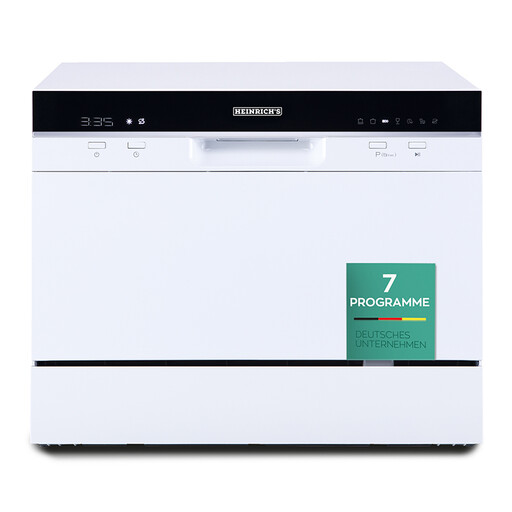
Heinrich's HTG 8840 tabletop dishwasher in white

Heinrich's HTG 8840, white

If you have larger loads to wash and want to plan when the appliance starts, the listed capacity and delay start may be useful; you’ll need to check separately whether your lunchboxes fit.

Six place settings, seven programmes, digital display and 24-hour delay start.

The product title also lists an automatic door-opening function for drying, a water softener and energy class D.

View at Joybuy
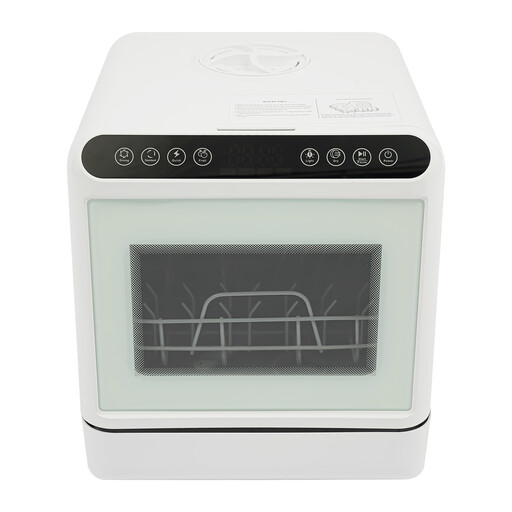
Tabletop dishwasher with a 6-litre water tank

Tabletop dishwasher with a 6-litre water tank

The integrated tank could be useful if there’s no fixed water supply where you plan to put the appliance; make separate arrangements for draining the wastewater.

The product title lists a 6-litre water tank and touch controls.

View at Joybuy
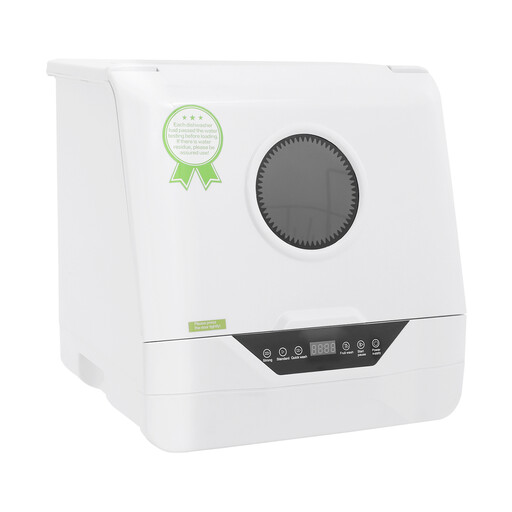
Compact tabletop dishwasher with four wash modes

Compact tabletop dishwasher, 220 V, 800 W

The operating specifications listed in the product title are useful if you’re choosing based on power requirements and the number of programmes.

220 V, 800 W and four wash modes.

The product title also lists a self-cleaning function and a white finish.

View at Joybuy

Comfee' CDWMTO201D(W) tabletop dishwasher with a 5-litre tank

Comfee' CDWMTO201D(W)

The integrated tank could suit a space without a fixed water supply; check the drainage route and the temperature limits for your lunchbox parts.

The product title lists a 5-litre tank, six plus three programmes and energy class D.

The listed 98-°C steam function is only suitable for lunchbox parts if their manufacturer approves this temperature; higher temperatures can damage some plastics.

View at Joybuy

Heinrich's HTG 8855 tabletop dishwasher with a water tank

Heinrich's HTG 8855

This model could suit a space without a fixed water supply; check whether three place settings are enough for your collected load.

Three place settings, seven programmes, 5-litre tank and 24-hour delay start.

The product title also lists operation with or without a water connection, a water softener and energy class C. You may need extra cycles if you’re washing several lunchboxes and cookware.

View at Joybuy

Frequently asked questions

Does the glass-and-fork symbol mean my lunchbox is dishwasher-safe?

No. The symbol indicates that an item is suitable for contact with food, not that it can go in the dishwasher. Check the separate instructions for the container, lid and any other parts; according to the Verbraucherzentrale, the term “dishwasher-safe” is not legally defined.

Can a tank-fed tabletop dishwasher run without a fixed water connection?

Yes, if the specific model is designed to run from a tank. For example, the manufacturer lists an integrated 5-litre tank and a drain hose for the Bomann TSG 5702; you’ll still need a suitable way to drain the wastewater.

How do I compare energy and water use if we run the dishwasher different numbers of times?

First, compare the Eco figures on the same basis, such as kWh per 100 cycles and litres per cycle. To estimate use in your own home, you can then consider consumption per cycle alongside the expected number of cycles and your electricity and water prices. Eco figures don’t describe Quick or Intensive programmes.

How should we look after the dishwasher when sharing it?

Scrape off large food scraps before loading, without rinsing the dishes under hot water, and follow the appliance instructions for the filter, detergent and, where applicable, regeneration salt. The Federal Environment Agency recommends running the machine as full as possible on the Eco programme to save energy and water, and highlights the importance of water softening.

Which labels and warranty rights apply when buying in Germany?

Household dishwashers carry the EU energy label, with classes from A to G and information including Eco consumption, programme duration, place settings and noise. According to the European Union’s Your Europe website, if goods are faulty, you have at least two years’ statutory legal guarantee from the date you receive them, provided by the business seller; an additional manufacturer’s warranty does not replace this.