Households with shared kitchen schedules
If you need to coordinate cooking and washing-up times, check the delay-start function and programme duration, as well as how noisy the machine is while running.


If you want to keep the sink free during busy times in a shared kitchen, choose a tabletop dishwasher based on its footprint, water supply and drainage options, and the number and shape of your mugs. A tank can replace a fixed water connection, but it still needs filling and you’ll need to plan how wastewater is drained. A delay-start function can help you time wash cycles around everyone’s schedules. Check the care instructions for your mugs, and compare noise and consumption figures for the same programme.
If you need to coordinate cooking and washing-up times, check the delay-start function and programme duration, as well as how noisy the machine is while running.
A model with a tank may be an alternative if there’s no suitable water connection. You’ll still need somewhere to put it and a suitable way to drain the wastewater.
What matters is whether your mugs, including those with handles, fit in the rack and leave enough room for the rest of the load. Place settings don’t guarantee a specific number of individual mugs.
| Feature | What to check | Who it matters most to |
|---|---|---|
| Timing wash cycles | Check the delay-start function and the length of your chosen programme; the Eco programme duration is shown on the EU energy label. | If I need to plan a wash cycle around cooking and kitchen use, the start time and programme duration are essential. Around 29% of consumers put being able to coordinate timings first. |
| Mugs and load capacity | Check the height, handles and rack layout against your own mugs; don’t assume place settings equate to a particular number of mugs. | If I want to wash several mugs alongside other dishes, I need to know whether my mugs will fit in the rack. Around 29% of consumers prioritise mug shape and load capacity. |
| Connection and footprint | Check the water supply, drainage route, appliance dimensions and the space needed to open the door. | If there’s no fixed water supply or worktop space is limited, the appliance needs to fit your kitchen while still allowing wastewater to drain safely. Around 24% of consumers prioritise flexible connections and space. |
| Noise and consumption | Compare figures for the same programme; don’t apply Eco figures to a quick wash. | If the appliance runs in a shared space, I want to take the start time and noise level into account. Around 18% of consumers prioritise noise and running costs. |
For comparing dishwashers, the consumer advice centre recommends looking at factors including water consumption, the duration of the Eco programme and noise levels. The European Commission explains that the EU energy label for household dishwashers includes information about the Eco programme. So make sure you compare like-for-like programmes and conditions.
A tank can replace a fixed water supply, but it doesn’t solve the drainage issue or help coordinate use of a shared sink.
Plan when to fill the tank, where to position the drain hose, and when to load and unload the dishwasher.
Filling the tank and setting up the drain are part of the regular upkeep for this type of appliance.
Tall mugs or wide handles can take up space differently from ordinary dishes.
Measure your mugs and check the rack, cup shelf and internal height of the specific model.
The figures on the EU energy label relate to the Eco programme and can’t automatically be applied to a quick wash.
Compare Eco figures with Eco figures only, and check the duration of the programme you actually plan to use.
The TSG 5702 and TSG 7405 tabletop models differ in features including tank operation, capacity and delay-start options.
Midea offers tabletop models with tanks, as well as models with different capacities.
The LIFE DWT50 (MD 37775) is a tabletop model with a water connection, designed for worktops with limited depth.
The Oceana version reviewed here connects to a tap and doesn’t have an integrated tank.
This selection includes tabletop dishwashers with tanks and models with a fixed water connection, including options with delay-start settings or different load capacities.
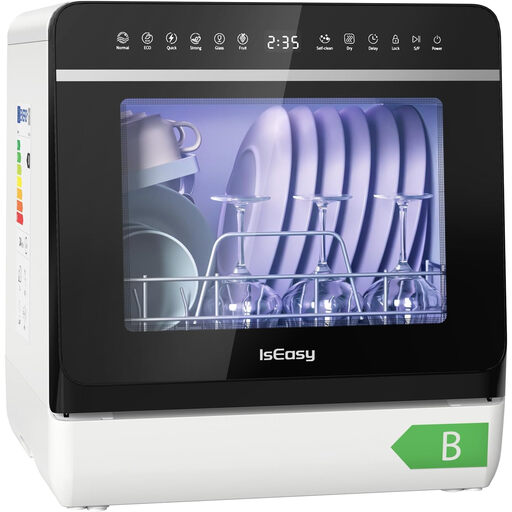 No image available
An option if there’s no fixed water supply and you want to wash smaller loads on a schedule.
The title specifies a 5-litre tank; the description lists three place settings, seven programmes and a delay-start timer of up to 18 hours. The inlet and drain hoses are included, according to the description. The capacity doesn’t guarantee a particular number of individual mugs or that they will fit.
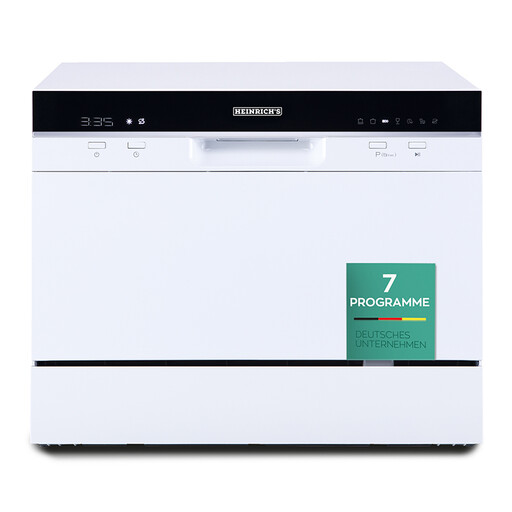 No image available
A possible choice if a larger load and a scheduled start time matter more to you than tank operation.
The specifications list six place settings, seven programmes and a 24-hour delay start. The title states 47 dB; the description gives the Eco and quick-wash programme durations. The appliance is described as requiring a water connection.
 No image available
An option for smaller loads if tank operation and a delay start suit your kitchen routine.
The specifications list a 5-litre tank, three place settings, seven programmes and a 24-hour delay start. The title states 56,3 dB; the description says it can be used with or without a water connection. Capacity doesn’t tell you whether individual mugs will fit.
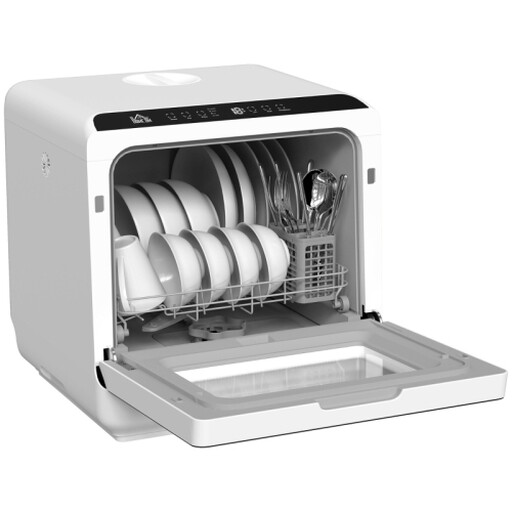 No image available
A possible choice if you need tank operation and a choice of programme durations to fit the time available in your kitchen.
The specifications list a 6-litre tank, four place settings and five programmes. These include a 29-minute quick wash; a direct tap connection is also described. Four place settings don’t guarantee a particular number of mugs will fit.
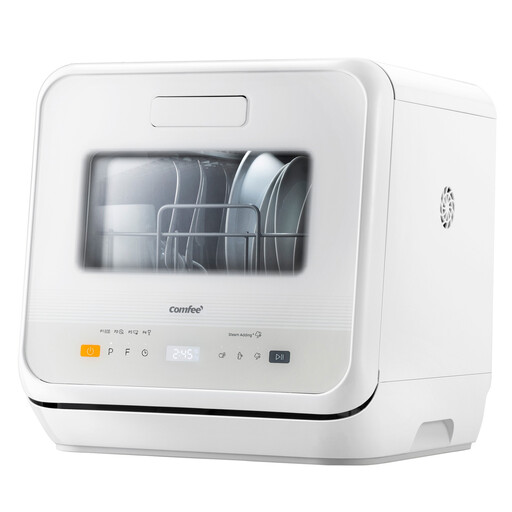 No image available
An option if you want tank operation but would also consider a tap connection.
The title specifies an integrated 5-litre tank and six programmes; the description also lists a Rapid cycle. Filling the tank and connecting to a tap are both listed as water supply options. The description says it’s suitable for households of two to three people.
No. Whether one mug is suitable doesn’t tell you whether the others are. Check the care instructions for every mug. The consumer advice centre explains that the glass-and-fork symbol indicates that an item is suitable for food contact; it doesn’t confirm that it’s dishwasher-safe.
On the Bomann TSG 5702, the integrated tank replaces a fixed water supply. You’ll still need a suitable drain for wastewater; Bomann specifies a drain hose.
The EU energy label figures for duration, water and energy consumption relate to the Eco programme. Don’t apply these figures to a quick wash. Check its duration separately against the time available in your kitchen.
Check the space available, how you’ll fill the tank and the route for draining wastewater. An integrated tank can replace a fixed water supply, but you’ll still need to dispose of the wastewater.
The EU energy label for household dishwashers shows programme-specific information about the Eco programme. The Federal Network Agency lists the CE mark, correct manufacturer details and a German-language instruction manual among the points it checks when monitoring the market. A label alone doesn’t prove that a particular model has been independently tested for cleaning performance.