Dinner plates, limited worktop space
If your kitchen has little worktop space, check the appliance dimensions and plate diameter separately. For the GSP206-030D, Exquisit also specifies how much room it needs with the door open.


The key is to find a tabletop dishwasher with a basket that fits your dinner plates and a body that, with the door open, fits the space available. Measure your plates, the space where the appliance will sit, the height beneath any wall units and the clearance in front before choosing a model. A tank-fed model can do away with a fixed water supply, but you’ll still need electricity and a way to drain the wastewater. Models that take more place settings usually need more room.
If your kitchen has little worktop space, check the appliance dimensions and plate diameter separately. For the GSP206-030D, Exquisit also specifies how much room it needs with the door open.
A model with a manually filled tank may suit you if there’s no fixed water supply. You’ll still need to plan for an electrical socket and wastewater drainage; MEDION describes several water-supply options for the DWT30.
If several place settings build up after meals, usable basket capacity matters. Exquisit and Bomann each specify six place settings for the models mentioned here, but that doesn’t automatically mean your plates will fit.
First check that your plates fit and the door has room to open. Then consider the water supply and the amount of crockery you need to wash, followed by the specific model’s energy and water use.
| What matters when buying | What to check | Who should pay particular attention |
|---|---|---|
| Space and door clearance | Measure the width, depth and height of the space where the appliance will go, as well as the clearance in front when the door is open. For the Exquisit GSP206-030D, the manufacturer gives dimensions of 55 × 43.8 × 50 cm and a depth of 81 cm with the door open. | If worktop space is limited, the open door must not get in the way of everyday kitchen tasks either; around 28% of consumers prioritise the space needed for the appliance and door clearance. |
| Whether your dinner plates will fit | Measure the diameter of your largest regularly used plates and compare it with a specification or basket diagram for that exact model. The number of place settings does not prove that a particular plate diameter will fit. | If you have large dinner plates, how they fit in the specific basket matters more than a general capacity figure; around 28% of consumers pay particular attention to plate diameter. |
| Water supply and drainage | Check whether the model uses a fixed water supply, a tank or both, and how the wastewater is drained. A tank doesn’t replace the need for electricity or a way to drain the water. | If there’s no suitable water supply where you plan to put the appliance, an alternative water-feed option is essential; around 17% of consumers prioritise the connection options. |
| How much crockery it can wash per cycle | Compare the stated number of place settings with a typical load for your household, and check the basket layout. The manufacturers specify three place settings for the MEDION DWT30 and six each for the Exquisit GSP206-030D and Bomann TSG 7405. | If plates, cutlery and other crockery regularly pile up after dinner, you’ll want to fit as much as possible into one cycle; around 16% of consumers prioritise load capacity. |
| Consumption and ongoing costs | For the specific model, compare electricity use per 100 Eco cycles and water use per Eco cycle, as well as capacity and how you’ll use it. The Verbraucherzentrale explains these figures for comparing dishwashers. | If you want to take running costs and any connection costs into account, comparable figures are important; around 11% of consumers prioritise ongoing costs. |
Width alone won’t tell you whether there’s enough depth, clearance beneath wall units or room for the door to open. For the Exquisit GSP206-030D, the manufacturer specifies a depth of 81 cm with the door open.
Measure the full space available and compare it with the dimensions for the specific model.
The number of place settings doesn’t tell you the maximum diameter of your plates or how they’ll fit alongside bowls and glasses.
Measure your plates and check the model-specific diameter specification or basket diagram.
A tank can replace a fixed water supply, but not the electricity supply or wastewater drainage.
Plan for the water supply, drainage and socket together, based on where the appliance will actually go.
An annual figure, such as the 174 kWh/year stated for the Klarstein Amazonia 6, can’t be directly compared with kWh per 100 Eco cycles. The Verbraucherzentrale explains how EU energy-label figures can be used to compare models.
Compare like-for-like figures and consider how often you’ll run the dishwasher and how full you’ll load it.
The LIFE DWT30 (MD370022) offers tank-fed and connected water-supply options for kitchens where a fixed water supply isn’t a given.
The black GSP206-030D is a tabletop model with capacity for six place settings and specific manufacturer dimensions to help you plan where to put it.
According to the manufacturer, the TSG 7405 is a tabletop model for six place settings, supplied with inlet and drain hoses.
The Amazonia 6 is a range of tabletop dishwashers with capacity for six place settings. Check the available space and consumption figures together.
The Bob range includes compact appliances with a manually filled tank, designed for places without a fixed water supply.
This selection includes tabletop dishwashers with a tank or water connection, with different capacity and installation specifications. Compare the dimensions and plate specifications for each version with the space available in your kitchen.
 No image available
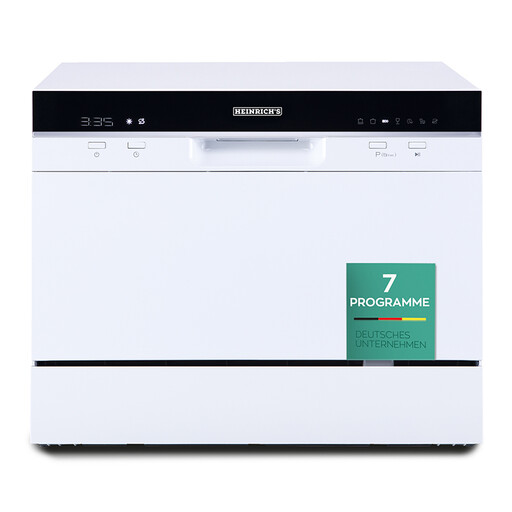
Worth considering if you’re looking for a tabletop model that takes several place settings and have a water connection where you plan to put it. Measure your plates and available space first.
The product specifications state a capacity of six place settings, seven programmes, inlet and drain hoses, and water use of 6.5 litres per cycle. The appliance is also rated energy efficiency class D and 47 dB.
 No image available
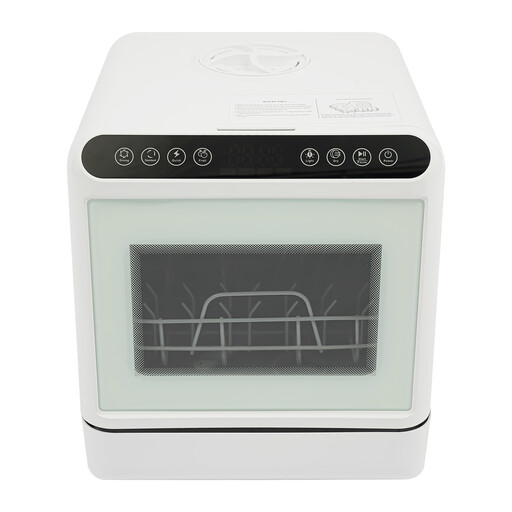
The built-in tank is useful if you don’t have a fixed water supply where you plan to put the appliance; you’ll also need to plan for electricity and wastewater drainage.
The product description specifies a 6-litre tank, four wash programmes and dimensions of 16.14 × 18.11 × 18.11 inches. It states a capacity for four to six people.
 No image available
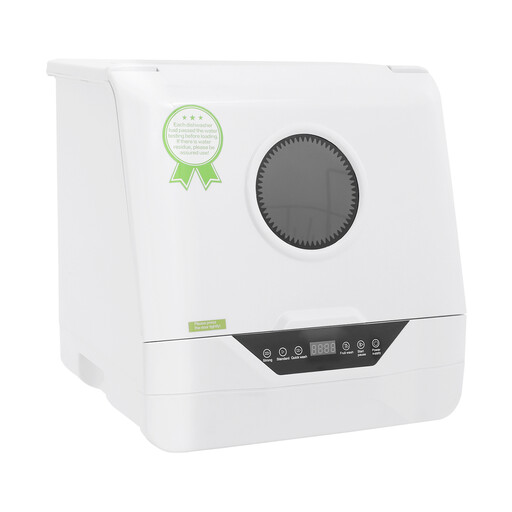
Could suit a small worktop if its stated dimensions and inlet and drain hoses are suitable for the space where you plan to put it.
The product description gives dimensions of 15.24 × 14.69 × 15.43 inches and four wash modes.
 No image available
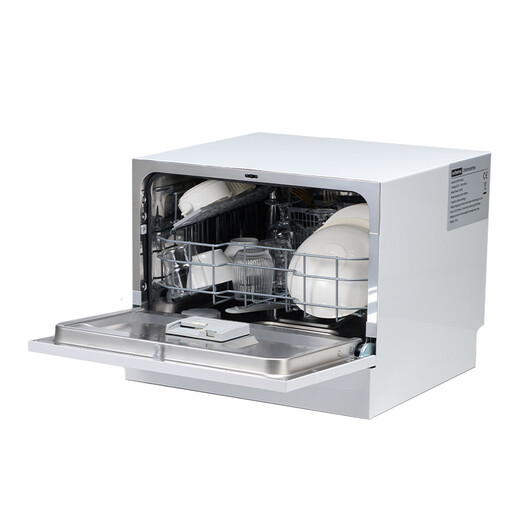
If you want to wash several place settings in one cycle, check first that your plates fit in the basket and the appliance fits on your worktop.
The product specifications state a capacity of six place settings, eight programmes or functions, and a 30-minute quick cycle.
 No image available
Tank operation and a specific plate-size limit are useful if you don’t want to use a fixed water supply and want to check that your dinner plates will fit.
The product description specifies a 5-litre tank, tank and tap water supply options, six programmes and dimensions of 420 × 435 × 435 mm. The stated maximum plate diameter is 250 mm.
No. Measure your plates and compare their diameter with the specification for that exact model. For example, the Comfee' CDWMTO201D(W) product description gives a maximum of 250 mm; that figure doesn’t automatically apply to other appliances.
A manually filled tank can replace a fixed water supply, but not the electricity supply or wastewater drainage. The available water-feed options depend on the model; also check how wastewater can be drained where you plan to put the appliance.
Compare the same figures for each model, particularly kWh per 100 Eco cycles and litres per Eco cycle, and take capacity and usage into account. The Verbraucherzentrale explains these figures; an annual figure can’t simply be compared directly with them.
The Umweltbundesamt recommends using the Eco programme and running the appliance with a full load; you shouldn’t pre-rinse dishes with warm water. Also follow the loading and care instructions for your specific model.
The Umweltbundesamt lists local collection points and returning the appliance when buying a new one as disposal options. Before placing your order, check whether collection or return is available where you live.