People who eat together
When several people eat together, the dinner plates you actually use and how much you want to fit in one load matter. Check the plate dimensions and basket layout for the specific model.


Choose based on the plates you actually use, the amount of crockery from each shared meal and the space available: a model with six place settings offers greater stated capacity, while a smaller tank-fed model may give you more flexibility with the water supply. Also check the drainage requirements, start delay and programme duration, along with the Eco programme’s consumption figures; these don’t automatically apply to a quick programme.
When several people eat together, the dinner plates you actually use and how much you want to fit in one load matter. Check the plate dimensions and basket layout for the specific model.
A tank-fed model may let you set up your dishwasher without a fixed water supply. You’ll still need a suitable drain, so check both before deciding where to put it.
If you plan cooking and washing up around one another, the start delay and duration of the programme you actually use are worth considering. Bomann and Midea list these start options for certain models; check the features against the full model number.
First, check that your plates and the amount of crockery you typically use will fit in the basket. Then compare the connections, available space and programme options with your cooking routine.
| What matters | What to check when buying | Who will find this most important |
|---|---|---|
| Plates and load capacity | Measure your largest plates and check the basket, plate supports and space for bowls on the specific model. | After a shared meal, I want to fit the plates and bowls in one load if possible; around 36% of consumers put suitable capacity first. |
| Connection and space | Check the dimensions, door clearance, water supply and a suitable drain for your chosen model. | If there’s no fixed water supply, I need a suitable place to install it and a plan for draining the water; around 29% of consumers prioritise the connection or available space. |
| Scheduling | Compare the start delay and the duration of your intended programme separately. | I want to plan the wash so the crockery is ready for our next shared meal; around 21% of consumers prioritise fitting the cycle into their schedule. |
| Consumption and noise | Consider the Eco cycle, noise level and place settings together, and relate them to how you’ll use the dishwasher. | If the dishwasher runs in a shared kitchen, I want to weigh up consumption and noise based on how often I wash up; around 14% of consumers focus on these ongoing costs. |
The Verbraucherzentrale recommends comparing factors including energy use per 100 Eco cycles and water use per Eco cycle. The Umweltbundesamt recommends using the Eco programme with a full load wherever possible; however, Eco figures don’t tell you how much other programmes use.
The stated capacity alone doesn’t tell you whether your large plates and serving bowls will all fit in the basket at once.
Measure your largest items and check the basket layout of the full model before buying.
If everything doesn’t fit, you may need to run extra cycles or wash some items by hand.
The tank in the Bomann TSG 5702 can replace a fixed water supply, but you’ll still need a drain hose.
Plan the water supply and drainage separately, and set up the hose according to the instructions for your model.
Make sure you plan for a suitable way to drain the water when choosing where to install it.
Energy and water consumption figures refer to the Eco programme and don’t necessarily describe a shorter wash cycle.
Compare the duration and programme-specific figures for the cycle you actually plan to use.
The models listed offer a comparison between six place settings with a fixed connection and three place settings with a tank option.
Midea offers tabletop models with six or three place settings; the MDWTT0602MW-WE is worth considering if you have a larger load of crockery from a shared meal.
The DWT60 (MD37496) is a tabletop model with a water connection and six place settings.
The Amazonia Nano is positioned as a smaller tabletop model for kitchens with limited space.
This selection includes tabletop dishwashers for shared meals: models with six place settings and more compact tank-fed options. What matters most is whether your plates fit, whether you have a suitable drain and how long the programme you actually use takes.
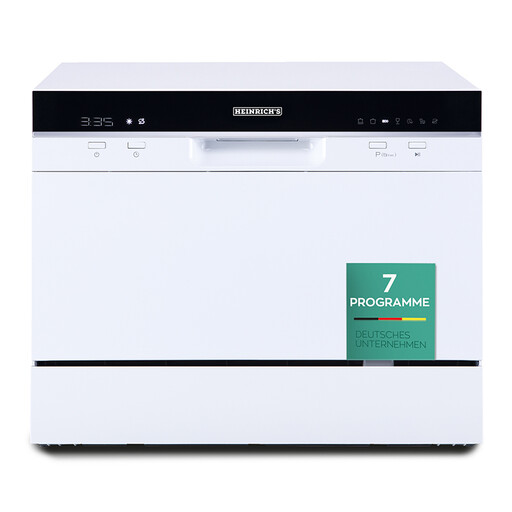 No image available
Six place settings may suit crockery from a shared meal; check that your plates fit in the basket.
The product details list seven programmes, a start delay of up to 24 hours, a 30-minute quick programme and a noise level of 47 dB.
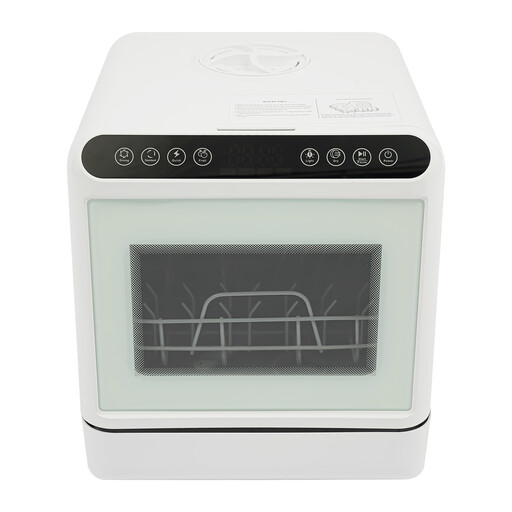 No image available
The integrated tank may be useful if you can’t use a fixed water supply; make sure you have a suitable drain.
The product name lists a 6-litre tank and touch controls.
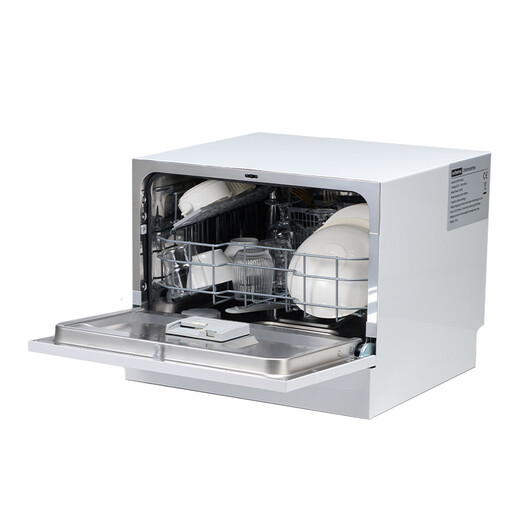 No image available
Six standard place settings may suit a shared meal; compare your plates’ dimensions with the basket.
The product name lists a 30-minute quick programme, a start delay of up to 24 hours and eight functions.
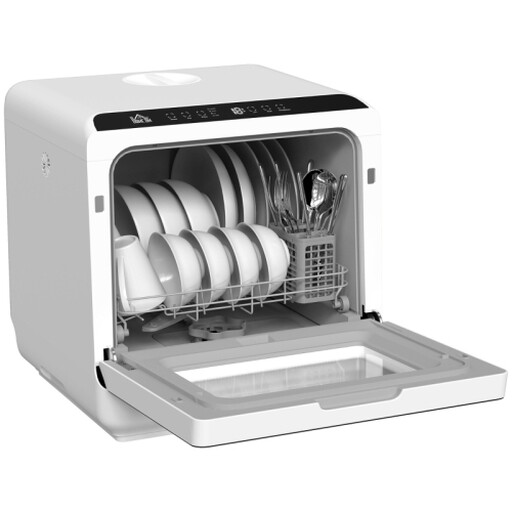 No image available
Four place settings are suited to a smaller load per cycle; compare this with the crockery you use for a shared meal.
The product name lists a 6-litre tank, five programmes and a drying function. According to the product details, the adapter needed to connect it to a tap isn’t included.
 No image available
The tank may be useful if you don’t have a fixed water supply; also check how you can arrange drainage in your kitchen.
The product name lists an integrated 5-litre tank and 6+3 programmes. The maximum plate size is listed as 250 mm, so check that your plates will fit.
Not necessarily. The place setting count indicates capacity, but doesn’t guarantee that your largest plates, bowls and cutlery will all fit at once. Check the diameter and shape against the basket of the specific model.
No. When using the tank on the Bomann TSG 5702, you don’t need a fixed water supply, but you’ll still need a drain hose. Make sure you have a suitable drain and follow the model’s instructions.
The Umweltbundesamt advises against pre-rinsing crockery and recommends using the Eco programme with a full load wherever possible. For the Bomann TSG 7405, make sure no large item blocks the spray arm; check the instruction manual for details.
It includes details such as energy use per 100 Eco cycles, as well as the water use and duration of the Eco programme. Check the figures for the quick programme itself, as Eco figures don’t automatically tell you how much it uses.