Who is a tabletop dishwasher suitable for?

Small household with meals at different times

If plates and cups build up throughout the day, it’s important to choose a suitable load size and run the dishwasher at a sensible time. The German Environment Agency recommends running the machine as full as possible on the Eco programme.

Kitchen without a usable fixed water connection

A model designed for tank or manual water supply could be an option. Also check how to drain the wastewater safely; Bomann and Medion’s manufacturer information describes different water-supply options for their respective models.

Household with limited worktop space

Compare the dimensions of the space where you plan to put it with the usable interior. According to the manufacturer, Bomann offers tabletop models with different capacities; place settings don’t tell you whether your plates, bowls and cups will fit.

What should you consider when choosing one?

Tank operation

Suitable if: you can’t use a suitable fixed water connection and tend to have smaller loads. Bomann lists three place settings and an integrated 5-litre tank for the TSG 5702.

Bear in mind: You’ll need to fill the tank by hand and drain the wastewater safely.

Fixed water connection

Suitable if: the water inlet and drain at your chosen location are suitable, and more crockery builds up before you run a wash. Bomann lists six place settings for the TSG 7405.

Bear in mind: Compare the space it needs with the room available and check how the hoses will be routed.

Multiple water-supply options

Suitable if: you want the option of switching between a suitable fixed connection and manual water supply. Medion describes the LIFE DWT30 (MD370022) as having three place settings and offering connection, tank and bucket operation.

Bear in mind: Flexible water supply doesn’t give you more interior space; check that your crockery will fit and that drainage will work in your kitchen.

Priority What to check when buying Who it matters most to
Suitable capacity Measure your own plates, bowls and cups; check the basket layout and the load you plan to wash. If I save my crockery until the next wash, I want to know whether my items will fit in the basket. Around 36% of consumers prioritise finding the right capacity.
Water supply and drainage Check the operating modes supported by the specific model, along with the drain hose and how it can be routed safely. If I don’t have a usable fixed connection, I need a suitable water-supply option and a safe way to drain the water. This is a priority for around 29% of consumers.
Available space and crockery shape Check the height, width and depth of the space where you plan to put it; allow for the door to open and for larger items of crockery. If worktop space is limited, I want to be sure the appliance will fit without having to leave out the crockery I usually use. Around 21% of consumers pay particular attention to where it will go.
Eco programme and consumption Compare the Eco figures for electricity per 100 cycles, water per cycle and programme duration; check quick programmes separately. If I wash up frequently, I want to assess the programme and consumption in terms of how I use the appliance. Running costs and programme choice are key priorities for around 14% of consumers.

Common selection pitfalls

  • ‘No water connection’ doesn’t mean ‘no drainage’

    A tank model still needs water to be added and a suitable way to drain the wastewater.

    Before buying, check the operating modes specified in the instructions, the drain hose and where you plan to put the appliance.

  • Place settings don’t guarantee that every item will fit

    The stated capacity doesn’t account for the shape of your plates or cookware; the external dimensions also don’t show how the interior is laid out.

    Compare the dimensions of your usual crockery and the basket layout with the information for the specific model.

  • A quick programme isn’t automatically the most economical choice

    The figures on the EU energy label relate to the Eco programme and can’t necessarily be applied to shorter programmes.

    Check how long the quick programme takes and assess consumption using the figures for the programme you actually plan to use.

Brands to consider

Bomann

The tabletop models mentioned come in different sizes and offer different connection options.

  • According to the manufacturer, the TSG 5702 is designed for three place settings and has an integrated tank; the TSG 7405 is listed for six place settings.
  • The tank information for the TSG 5702 doesn’t necessarily apply to the TSG 7405. The manufacturer’s cleaning claims are not independent test results.

Medion

The manufacturer describes the LIFE DWT30 (MD370022) as a compact model for three place settings, with several water-supply options.

  • The model is listed as offering fixed-connection, tank and bucket operation.
  • The manufacturer’s claims about drying plastic and the effects of UV light are not independently verified performance tests.

Midea

The MDWMT0305EW-WE is listed for three place settings and can be used with or without a water connection.

  • The model offers another option to compare for smaller amounts of crockery.
  • The names used on the product page differ. Before buying, check the full model number against the instructions.

Klarstein

Klarstein describes the Amazonia Nano as a range of compact tabletop models that can be used without a fixed water connection.

  • For the version described, the manufacturer lists a width of 42 cm.
  • The maximum noise level of 58 dB comes from the manufacturer. Claims about quieter operation or saving water compared with washing by hand are not based on independently verified comparisons.

Bosch

The compact dishwasher SKS62E32EU is an example of a model with a different set of features.

  • Bosch lists six place settings and AquaStop for this model.
  • Bosch marks this specific model as no longer available, so this doesn’t indicate current availability.

Tabletop dishwashers at Joybuy

The range includes compact tabletop dishwashers with different stated capacities; several models are listed with tank or alternative water-supply options.

AIRMSEN tabletop dishwasher with 5-litre tank, 9 programmes and delay start

AIRMSEN tabletop dishwasher with 5-litre tank

The stated capacity and water-supply options could suit smaller accumulated loads where there’s no usable fixed connection.

Four place settings; integrated 5-litre tank; 9 wash programmes; delay start from 1–24 hours; 37 × 50 cm; energy efficiency class D.

According to the product description, a separately available adapter may be needed to connect it to a tap.

View at Joybuy

Heinrich's HTG 8855 tabletop dishwasher for three place settings

Heinrich's HTG 8855 tabletop dishwasher

Designed for smaller loads, this model has three place settings; the specifications list tank operation or a direct connection to a tap.

Three place settings; 7 programmes; delay start up to 24 hours; 56.3 dB; energy efficiency class C.

View at Joybuy
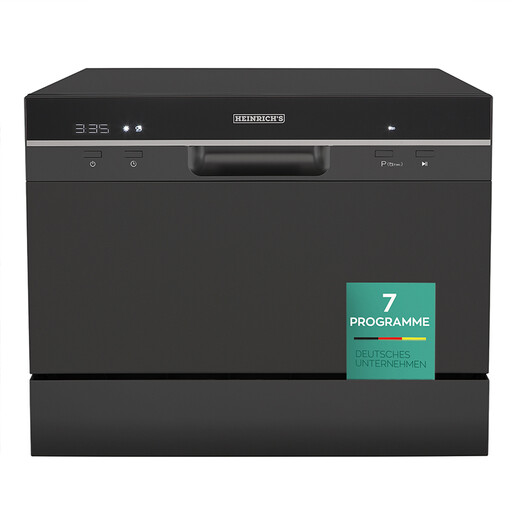
Heinrich's HTG 8840 in black for six place settings

Heinrich's HTG 8840 in black

The stated capacity could be a good fit if more crockery builds up over several meals.

Six place settings; 7 programmes; delay start up to 24 hours; automatic door opening for drying; water softener; 47 dB; energy efficiency class D.

View at Joybuy
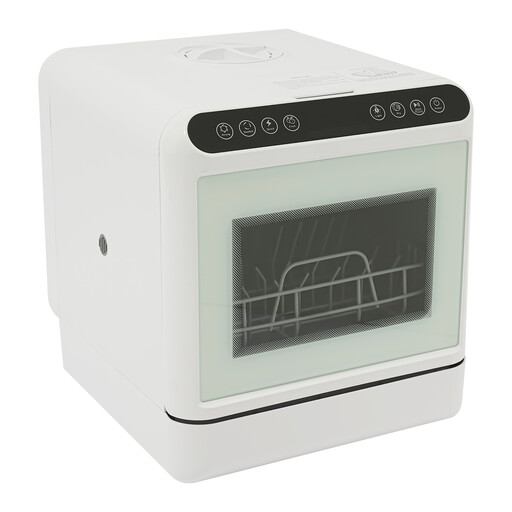
Compact tabletop dishwasher with integrated 1.32Gal tank and 72h storage

Compact tabletop dishwasher with 1.32Gal tank

The integrated tank is designed for manual water supply; the product specifications also mention a storage mode.

Integrated 1.32Gal water tank; hot-air drying; 72h storage; listed in the product title as suitable for 4–6 people.

View at Joybuy
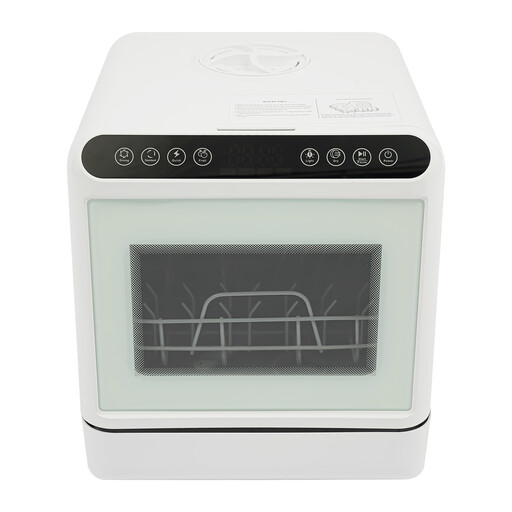
Tabletop dishwasher with 6-litre tank and touch controls

Tabletop dishwasher with 6-litre tank

The tank is designed to supply water without a fixed connection; the product description also mentions a two-level loading layout.

Integrated 6-litre tank; 4 programmes; hot-air drying; 72h storage mode; two-level loading for up to 4–6 people.

View at Joybuy

Frequently asked questions

Do I need to start a programme straight after every meal eaten at a different time?

No, not just because you eat at different times. The German Environment Agency recommends running the machine as full as possible on the Eco programme. If you need your crockery sooner, check the programmes available on your model; Eco consumption figures don’t automatically apply to a quick programme.

Does a tabletop dishwasher with a tank still need a drain?

Yes. Not having a fixed water connection doesn’t solve the question of how to drain the wastewater. For the Bomann TSG 5702, the manufacturer lists a drain hose as well as the tank; plan how to route it safely by following the instructions.

How do I compare electricity and water consumption?

For models with a similar capacity, compare the electricity figures per 100 Eco cycles and the water used per Eco cycle. Also consider the Eco programme duration and check quick programmes separately, as the Eco figures don’t apply to other programmes.

What information does the EU energy label show for dishwashers?

The EU energy label shows, among other things, the energy efficiency class, electricity consumption for 100 Eco cycles, water consumption per Eco cycle, capacity, Eco programme duration and noise levels. Use these figures to compare similar models, and don’t assume they apply to other programmes without checking.

What happens in Germany if an appliance develops a fault or needs disposing of?

If a product is faulty, the statutory guarantee generally applies to the seller; it is separate from any voluntary manufacturer’s warranty, as explained by the Verbraucherzentrale (German consumer advice centre). The German Environment Agency lists local collection points as an option for disposing of old electrical appliances free of charge; check the retailer’s take-back policy if you want to return it to a shop.