If you regularly have several plates, bowls and pieces of cutlery to wash after batch cooking, and you have suitable water and waste connections, a tabletop model with six place settings is a sensible starting point – though that doesn’t guarantee it will fit large bowls. If there’s no fixed water supply or space is limited, a smaller tank model may suit you; just check how much it can actually hold and how the water drains away. To compare consumption, the Verbraucherzentrale recommends checking the figures on the energy label. The German Environment Agency points out that its assessment of washing up on the Eco programme assumes a full load.
Who is a tabletop dishwasher suitable for?
Batch cooks with lots of dishes
If you want to wash plates, bowls and cutlery together after preparing several portions, and you can use a water connection, check the capacity and available space before choosing a model. Bomann lists six place settings for the TSG 7405, but that alone doesn’t tell you whether large cooking bowls will fit.
Small kitchens without a fixed water supply
If you need a tabletop model that doesn’t require a fixed water supply, look for one that explicitly supports tank operation. You’ll still need a suitable place for the drain. Midea and HAVA each offer a three-place-setting model that can be used with a tank.
Keeping an eye on the cost of washing up
If you can collect enough dishes for a suitable load, compare electricity and water figures on the same Eco basis. The Verbraucherzentrale recommends checking, among other things, electricity consumption per 100 Eco cycles and water consumption per Eco cycle.
What to prioritise when washing up after batch cooking
| Priority |
What to check before buying |
Who is this important for? |
| Capacity for a batch-cooking session |
Number of place settings, basket layout and the dimensions of your plates and bowls. Don’t assume large cooking utensils will fit just because of the stated number of place settings. |
If I want to wash as many dishes as possible from one batch-cooking session together, I need to know whether my largest items will actually fit in the basket. Around 33% of consumers prioritise usable capacity for this load. |
| Connections and space |
Appliance dimensions, clearance in front of the door, access to a water supply and a suitable drain. For tank models, check the installation instructions. |
If my kitchen has no fixed water supply or worktop space is limited, I need to make sure tank operation, door clearance and wastewater drainage all work together. Around 27% of consumers prioritise connections and space. |
| Running costs |
Compare Eco figures on the same basis: kWh per 100 Eco cycles and litres per Eco cycle. Take your own usage frequency into account. |
If I plan to use the appliance regularly, I want to estimate the consumption of comparable programmes rather than compare individual marketing claims. The Verbraucherzentrale explains the energy-label figures; the German Environment Agency’s comparison with hand-washing assumes a full load. Around 20% of consumers focus on running costs. |
| Dishes and programmes |
Check the care instructions for the container and lid separately, and look at the programmes offered by the specific appliance. |
If I want to wash freezer containers and lids, I need confirmation that each item is suitable. I don’t want to assume that a material is dishwasher-safe just from a programme name. The Verbraucherzentrale points out that the glass-and-fork symbol indicates suitability for food contact, not automatic suitability for dishwashers. Around 20% of consumers pay particular attention to dishware and programme suitability. |
Common buying and usage mistakes
-
Assuming the place-setting capacity means large batch-cooking bowls will fit
The stated capacity doesn’t tell you whether individual cooking utensils or food-storage containers will fit in the basket.
Measure the largest items you use regularly, then check the basket layout and the loading instructions for the specific model.
If the usable capacity is too small, you may need extra cycles or to wash some items by hand.
-
Assuming tank operation means you don’t need to plan for wastewater
A tank can replace a fixed water supply, but the used water still needs to drain away.
Before buying, check the appliance instructions for the water supply, drain, hose routing and recommended position.
The drain position needs to work with your kitchen layout and hose routing.
-
Comparing marketing claims directly with your own hand-washing
Eco-label figures are based on a set programme. The German Environment Agency’s favourable assessment of Eco dishwashing compared with hand-washing assumes a full load.
First compare the appliances’ Eco-label figures, then consider how full you’ll actually be able to load them.
-
Assuming the food-contact symbol means an item is dishwasher-safe
According to the Verbraucherzentrale, the glass-and-fork symbol indicates suitability for food contact, not for a dishwasher cycle.
Read the care instructions for each container and its lid before putting them in the machine.
Cleaning items in an unsuitable way can damage containers or lids.
Key brands to consider
Midea
Midea offers a three-place-setting tabletop model that can be used with a tank, as well as a six-place-setting model. The details are from Midea Germany.
- The different stated capacities offer a useful guide for smaller and larger loads of dishes.
- For the MDWTT0602MW-WE, check the details on the exact model and in its documentation, as some descriptions use a different model name.
Bomann
Bomann lists the TSG 7405 as a tabletop model for six place settings, and provides its dimensions and hose lengths.
- The manufacturer’s details can help you check the space available and plan hose routing.
- Six place settings don’t guarantee that large cooking bowls will fit. The water supply and drain also need to work at the chosen location.
Exquisit
Exquisit offers the GSP206-030D silver tabletop model for six place settings. The manufacturer’s website also gives the depth with the door open.
- The open-door measurement can help you check whether the appliance will fit.
- Check the dimensions of the specific appliance and allow enough clearance in front of the door.
HAVA
HAVA describes the R09 as a three-place-setting tabletop model with an integrated tank and salt compartment.
- The stated tank option is useful for kitchens without a fixed water supply.
- The lower stated capacity may be limiting for a larger batch-cooking load. The manufacturer’s consumption and performance comparisons are not independent measurements.
Klarstein
Klarstein offers the Amazonia Nano as a tabletop model with six programmes and the option to connect it without a fixed water supply.
- The connection method may be useful in a small kitchen.
- The manufacturer’s description says it connects to a tap; that doesn’t mean it has an integrated tank. Comparisons with hand-washing are the manufacturer’s claims, not independent tests.
Joybuy products for small kitchens
The Joybuy options below are compact tabletop dishwashers. For models whose titles mention a water tank, you should also check the drainage and installation requirements.
 No image available
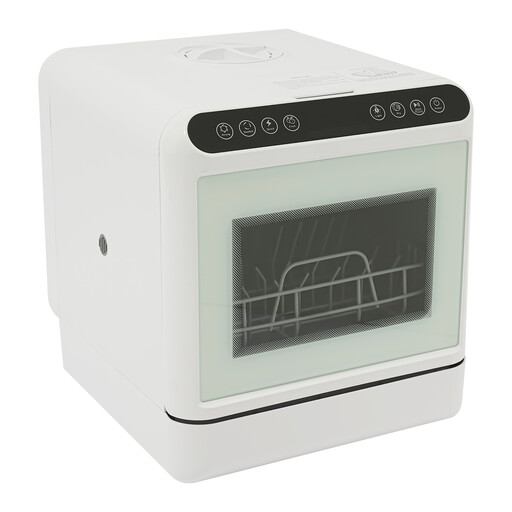
Compact tabletop dishwasher, 1.32Gal tank, hot air drying, 72h storage, 4–6 people, EU Plug, White
Designed for a compact installation; the product title mentions an integrated water tank.
Features listed in the title: 1.32Gal tank, hot air drying, 72h storage, capacity for 4–6 people and EU Plug.
View at Joybuy
 No image available
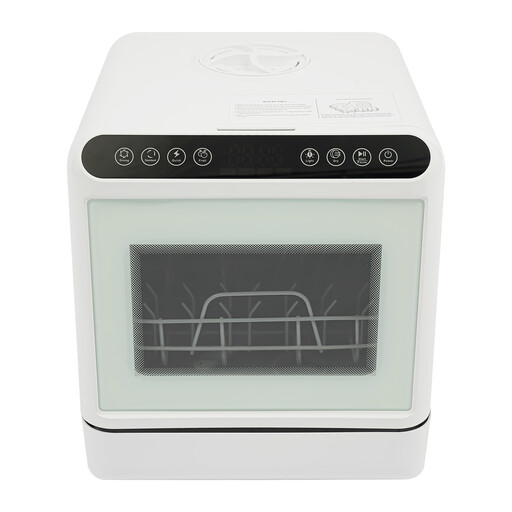
Tabletop dishwasher with 6L water tank and touch controls
For anyone looking for a tabletop model with a tank; the product title mentions a 6L water tank.
Features listed in the title: 6L water tank and touch controls.
View at Joybuy
 No image available
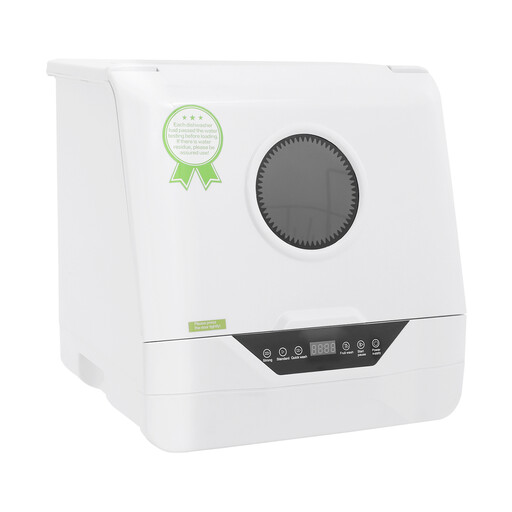
Compact tabletop dishwasher, 220V, 800W, 4 wash modes, self-cleaning function
For anyone looking for a compact tabletop model; the product title lists several wash modes.
Features listed in the title: 220V, 800W, four wash modes and a self-cleaning function.
View at Joybuy
 No image available
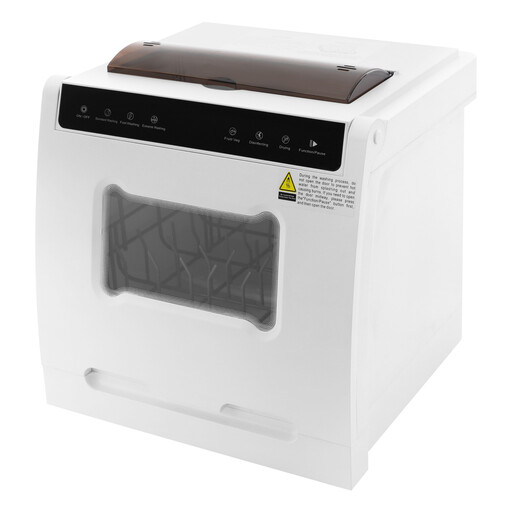
White tabletop dishwasher with 6 wash modes
Designed for a compact kitchen; the product title mentions six wash modes.
Feature listed in the title: six wash modes.
View at Joybuy
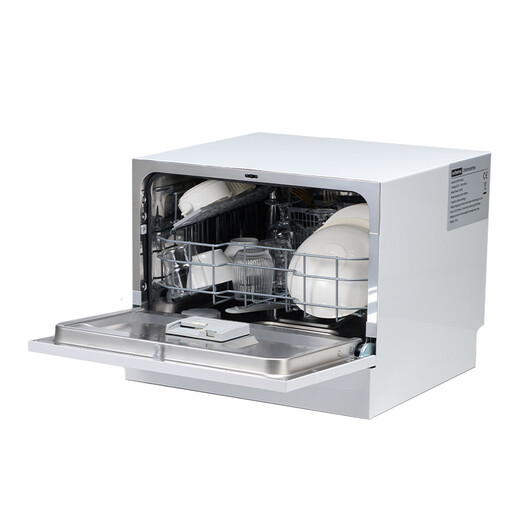 No image available
Tabletop dishwasher, 6 standard place settings, 30-minute quick programme
For a larger load of everyday dishes; the product title mentions six standard place settings.
Features listed in the title: six standard place settings and a 30-minute quick programme. It also mentions a 24-hour start delay and eight functions.
View at Joybuy
Questions about tabletop dishwashers and freezer containers
Can I wash any freezer container and its lid in the dishwasher?
No – not just because the container is intended for food or freezing. Check the care instructions for the container and lid separately. According to the Verbraucherzentrale, the glass-and-fork symbol indicates suitability for food contact, not automatic dishwasher suitability.
Does a tank model need a connection at all?
A model specifically designed for tank operation doesn’t need a fixed water connection. You’ll still need to check how to drain the wastewater, as set out in the appliance instructions. Tank operation doesn’t mean you can do without a drain.
Which running costs can I compare before buying?
The EU energy label includes figures such as kWh per 100 Eco cycles and litres per Eco cycle, as explained by the Verbraucherzentrale. To estimate your own costs, you’ll also need to factor in how often you wash up and your electricity, water and detergent costs.
What are the rules in Germany if the appliance breaks or you want to dispose of it?
Your statutory rights against the seller for faulty goods are separate from any voluntary manufacturer’s guarantee. For ordinary movable goods, § 438 BGB generally provides for a two-year limitation period from delivery. Old electrical appliances can be taken to local collection points. Retailers also have take-back obligations in certain circumstances, as described by the German Federal Ministry for the Environment.


